As a bit of a politics nerd (yes, I admit it), I have been looking forward to the pageantry around this referendum on Britain’s membership of the European Union. There’s something about these political events – whatever they are ultimately about – which thrills and fascinates.
The debates! The interviews! The triumphs! The cock-ups! Staying up all night eating curry and watching David Dimbleby filling time as the results slowly filter in! I love it.
But this excitement has been spoilt somewhat by those killjoys in the SNP. Ever since the Scottish people’s own referendum on their national future in September 2014, those who campaigned for Scotland to leave the UK have made it their business to ruin not just this referendum, but all referenda. Never again can we sip from the cup of a national plebiscite, without tasting the taint of Scottish nationalism.
The simple fact is that the tactics of the SNP and their supporters have changed the way that referenda in this country are fought – and, in my view, not for the better.
But in order to understand how this affects the upcoming referendum on the EU, let us first briefly examine the two key faults at the core of the way the SNP operates.
The first is that the SNP and its party machinery are seemingly unable to view politicians and activists (of any party) as individuals. This is a topic I have touched on before. The SNP is the only party in the UK whose rules actively prohibit its MPs from speaking out against party policy. There can be no ‘rebels’; no dissenters; no brave individuals who put principles before career prospects to defy the party whip. Not in the SNP.
No, the gradually dwindling numbers of SNP MPs in the House Of Commons (we all know it started out as fifty-six, but two have already been suspended by the party…) speak with one voice on every issue. All of the (almost) one-and-a-half million Scottish voters who chose the SNP at the 2015 General Election might just as well be represented in Westminster by one single person, voting on all issues according to Nicola Sturgeon’s orders. (Maybe that’s something they should look into? It might at least save a bit on Parliamentary travel expenses.)
The second is the SNP’s unshakeable belief that the only thing which really matters is Scotland’s independence. Any other political problems are subsumed by this one great issue. Tax? Health? Education? Infrastructure? It doesn’t matter what the challenges facing these policy areas – all will be solved in the blink of an eye, come Independence Day. And, until independence, there is nothing that can be done about any of them, so they may as well go hang.
These two central conceits were underlined for me recently by a conversation I had with an SNP activist while a protest march against the Trident nuclear weapons system was occurring in London. I challenged something that he wrote on Twitter about the future of Trident; his response was, weirdly, about Scotland. Apparently, I was wrong about Trident because “I didn’t understand the Scottish people”; I tried to say that I wasn’t talking about Scotland as a nation, or as a people, but that I was responding to what he had posted on the topic of nuclear missiles – but he was unable to make the distinction.
Within a few Tweets, our Nationalist friend had successfully twisted my disagreeing with one specific thing he had said about Trident into me being somehow anti- the entire country of Scotland and its population. Because no issue, and no policy, can be discussed without it inexorably transforming into The Scottish Matter. And because ‘The Scottish People’ (whose ‘mindset’ I was assured I ‘didn’t understand’) are one homogeneous groupthinking bloc, rather than over five million individuals representing a plurality of opinion across all areas of policy. Such is the SNP mentality: everything is about Scotland, always – and all Scots think alike, on every issue.
So where does this leave our European plebiscite? A referendum in this country has traditionally transcended ordinary party politics. Faced with an issue deemed to be of such burning national importance that it is not enough for our elected representatives simply to vote on our behalves in Parliament, as is normal for most day-to-day political decisions, the usual rules and ways of operating are thrown out of the window. The party whips are suspended, and the campaign is not split along party lines like at a general election. Strange alliances are forged – fractious, often, but motivated. This is not ‘politics as usual’.
The SNP, it appears, cannot understand this. The fact that the ‘Better Together’ campaign – which pushed for, and eventually won, a majority ‘No’ vote in Scotland’s independence referendum in 2014 – was supported by all three of the major UK political parties has become a standard campaigning tool for the Nationalists. That Labour (traditionally the SNP’s main opposition in Scotland) had campaigned on this issue alongside the Conservatives makes them – apparently – ‘no better than the Tories’. (And what worse insult could there possibly be, for anyone whose understanding of politics reaches no further than the end of his own nose?!)
Once again, we see how the importance of the independence debate sweeps aside all other concerns, in the eyes of the SNP faithful – that Labour and the Tories agree on Scotland’s constitutional future makes them politically identical, no matter how many other major policy areas they vehemently disagree on. “Who cares if Labour and the Conservatives disagree on far more policies than they agree on?!”, say the SNP supporters; they agree on the only one which actually matters, so they can be lumped in together for all time.
(Of course this ignores even the basic maths of a referendum. With only two possible outcomes to choose from – ‘Yes’ or ‘No’ – there is bound to be some overlap in campaigning. There are simply not enough answers on the ballot paper for all the political parties involved to have one each, so you will, at some point, inevitably find yourself on the same side as politicians who are normally your opponents. But then, figures aren’t exactly the SNP’s strong point, are they…?)
“Well, what a short-sighted, obstinate, overly simplistic view of party politics!” you might very well be thinking now. Well, yes. Exactly. And yet this pervasive, barely-literate nonsense is now shaping the way our politicians are gearing up for the referendum on the European Union.
Keen not to be tarred with the same brush as their sworn political enemies, simply because they happen to feel the same about one point of policy, MPs now seem reticent to engage in the very cross-party campaigning which makes a referendum campaign different, and worth having at all. The fear of ‘sharing a platform’ with one’s usual political enemies – and the damage this could do to one’s own political image and career in the future – is distracting from the more pressing matter of actually campaigning for the result one believes is best for the country.
If this – or any – matter is of enough significance to be put to the population as a whole to vote on, rather than being left to representatives in the Commons and the Lords, is it not also important enough to put aside party political bickering and campaign alongside whoever happens to want the same outcome as you?
In a referendum such as this, you don’t get to choose your allies – you work with whoever happens to agree with you as to the best path for the country to take. And you should reasonably expect to do so without the threat of this being held up as a stain on your character in years to come, once the referendum is over and political life has gone back to normal.
If some cabinet ministers believe Britain should remain in the EU, while other ministers feel strongly we should leave, they should be free to campaign on whichever side of the argument they wish. It is not ‘weak’ of the Prime Minister to allow his ministers this freedom – and it is not very edifying to see politicians from other parties attempting to portray him as such, choosing petty political points-scoring over the matter at hand.
And if a politician from any party finds himself by some happenstance on the same side of this debate as a politician from another party (which – as I have said – is mathematically certain to happen, given the limited number of options for campaigning), this does not suddenly make the two politicians, or their two parties, indistinguishable from each other on all matters. It would be sheer folly to suppose it did. And yet, that has been the SNP’s take on things for over two years, now – and it is a view starting to permeate the mainstream national consciousness.
I can’t help but feel sad that the SNP’s small-minded, parochial mentality is being allowed to set the agenda for a national question about which many people feel very strongly – and as a result, we are all being denied a proper referendum campaign which truly cuts across, rather than entrenches, party lines.
Showing posts with label campaigning. Show all posts
Showing posts with label campaigning. Show all posts
Sunday, 6 March 2016

Sunday, 21 February 2016
What do we gain from #Brexit?
We know, now, the date of Britain's referendum on membership of the European Union – 23rd June. Soon, the campaigning will begin in ernest, as politicians attempt to convince us either to 'Remain' a member, or 'Leave' the EU.
Personally, I am undecided on how I will vote. I can see good arguments on both sides – and I can see wild hysteria and condescension on both sides too. However, it's my view that the burden of proof is on those who wish to 'Leave'.
The lawyer and legal commentator David Allen Green writes on his blog Jack Of Kent that he is 'neutral' about 'Brexit', observing that the referendum's outcome will make little difference to law and policy, on a practical level. Neutral, perhaps – but in reality this is a de facto argument to 'Remain'. If things will be basically the same either way, why would we go through all the hassle of leaving, and all the tremendous upheaval that will entail? Unless we can be fairly sure that getting out of the EU will tangibly improve life for most people in Britain, aren't we better off just staying as we are?
To my mind, 'Brexit' is not a matter of life-and-death. The UK will basically be fine, whatever happens. For all that the zealots on both sides of the argument would have us believe otherwise, neither result will truly be a catastrophe. Maybe I will lose some friends by saying that – but friendship shouldn't be contingent on sharing a particular viewpoint on the European Union, should it?
But as I say, the onus is on the 'Leave' camp to make their case – and unless they can convince me of some very real benefits of leaving the EU (and I am still open to being persuaded), I shall end up as 'Remain' by default.
Maybe this seems uncaring, or half-hearted; a rather uninspiring way to make a decision about the future of the country. But if it would be a touch unfair to say this is a vote about minutiae, it is at least a vote about something which few people really see as the crucial matter of our time.
For those of us who follow politics closely, it's a chance to spend a second year in a row geekishly obsessing over exit polls and sitting up all night eating takeaway food and watching David Dimbleby looking for something to say to fill in time – however, I think the wonks who inhabit the fringes of political society for whom Europe has always been a burning issue seriously overestimate the number of people who hold strong, passionate opinions about the EU.
To large amounts of people, the European Union matters vastly less than those who shout the loudest on either side of the debate could possibly comprehend. Plenty of people are, like me, quite happy muddling along as we are – unless the case emerges that 'Brexit' would leave us decidedly better off. Perhaps the initiative in this referendum campaign will ultimately be seized by whoever is the first to grasp this.
Wednesday, 3 June 2015
The furore over MPs' pay shows political campaigning at its worst
The prickly topic of MPs' pay is in the news again. And when I say 'in the news', I also mean that self-righteous social media warriors are shouting through a dense smog of knee-jerk outrage and sharing poorly-researched, inaccurate 'infographics' which look like a nine-year-old created them in Microsoft Paint.
Leaving aside the sheer ignorance of many of these campaigners – I have lost count of how many Tweets I have seen blaming David Cameron for this, when in fact MPs' pay is set by an independent body precisely to stop it becoming such a contentious political issue (and how did that work out for you?!) – it occurs to me there are some very nasty political implications in this vilification of MPs.
One thing which comes up time and time again is the idea that MPs can, or should, 'reject' their pay rise. According to IPSA (the independent body responsible for MPs' pay), actually, they can't – but more to the point, I fail to see why they should. Taking a rise of £7000 would be 'out-of-touch', we are told. (The most pointless, nonsensical, unmeaning insult in politics strikes again!)
But surely what would be really 'out-of-touch' would be not taking a £7000 pay rise! After all, we're always being told that we want politicians who are 'ordinary' people – people who are just like us, with the same priorities and the same experiences as us. How many ordinary people do you know who would turn down an extra £7000 a year?
No, what's really 'out-of-touch' is already being rich enough that you can afford to haughtily wave away the offer of an extra £7000 because you think doing so will make you look good. Because that's all turning down the pay rise would be: a PR stunt. MPs with enough independent wealth that £7000 is neither here nor there to them will make a big show of what good guys they are by ostentatiously not accepting their pay rise, or giving it away to charity – thus putting pressure on MPs from more modest backgrounds, who are not already vastly wealthy, to behave likewise or else be seen to be venal, greedy and self-serving.
I think MPs' pay needs to be enough to attract talented people to do what is actually a very tough and under appreciated job – and I mean talented people from all backgrounds. But so, too, do attitudes towards this sensitive issue.
For bright, capable people who might be considering going into politics, especially people from lower income backgrounds, too low a salary might put them off and they will go into other areas instead. So might the enormous personal costs of even becoming a candidate in the first place (not much is spoken about the fact that MPs have had to invest a lot of their own money and time in being selected as a candidate and winning their seat before they get the rewards of their higher-and-average salary). But from my point-of-view, what would put people off going into politics the most is this furious, incensed obloquy from the public and the press.
I'm not sure I could handle the constant contradictions of having to be an 'ordinary' person to whom the voting public can 'relate', and yet also being expected to behave in ways no 'ordinary' person would, turning down a bit of extra cash when you are offered it. But the fact is that however you conduct yourself in matters like these, people will scream that you are avaricious, lazy, and only looking out for yourself – even thought they often won't have any of the actual facts to hand.
Politicians need to be scrutinised, and they need to be held to account by each other, by the press, and ultimately by the public. But they need to be scrutinised in an informed and rational way. To my mind, one of the biggest barriers to entry is just how uninformed so many of the people who pretend to care about politics are; how quickly outright lies and deceit can spread when they paint the negative image of politicians people are clamouring to see; and how quick and eager people are to believe the very worst about politicians, even when what they're being told is patently not true.
It is a backwards-looking process (as I have already written about in regards to conspiracy theories), working back from a pre-determined conclusion borne of entrenched prejudices rather than a careful consideration of the evidence available. Anti-government campaigners already know that they want to portray politicians in a bad light before they have written a word; they have their conclusion mapped out before they have the facts, so they either twist the facts, or cherry-pick convenient ones to suit the case they are trying to build – or they simply disregard facts entirely.
How many of the 'activists' who are angry about IPSA recommending a pay rise for MPs have actually bothered to look into how parliament works, and what an MP's job really entails? Do they watch the BBC Parliament channel? Do they read Hansard? Do they meet their local MPs and get to know them before meting out aggressive and judgemental online content about what awful, nasty, evil people they are? Do they know how IPSA came to the conclusions they did on the topic of MPs' pay, and the reasoning behind their recommendation that it should be increased?
Or do they – as I suspect – catch a whiff of a controversial issue which can be used to whip up an angry rabble and instantly reach for the Photoshop and the bold, all-caps font without bothering to look into the details any further and find out what it's actually all about? My concern is: should we really be letting such people set the agenda in issues like these?
Sunday, 4 January 2015
The road to hell is paved with good intentions
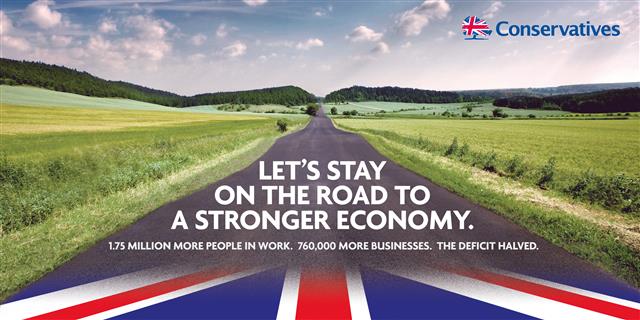
This Conservative campaign poster for the upcoming General Election is already under fire. Why? Because, as correctly predicted by my brother, the road in the picture is, in fact, not in Britain at all – but is in Germany, outside Weimar.
Who cares?! I can't, for the life of me, think why this matters. Of all the things to get worked up about, is this really the one you would pick? It's a stock photo of a road, and it could be anywhere in the world – adverts use stock photos. There isn't really a 'road to recovery' which you can actually drive down at all; it's a metaphor. The manufactured outrage surrounding this is ludicrous.
What we should be looking at is the claims which the Conservative Party makes on its campaign poster. One of the boasts they make on 'the road to recovery' is that 'the deficit is halved'. Is it? Fraser Nelson described in the Spectator last month why this may not be strictly accurate – and yet people are more interested in foaming at the mouth about the location of the photograph being used in the campaign! Isn't this akin to seeing a company's advert on television and being more angry about the fact they used actors in the advert than about the possibility they may be making false claims about their product?
In politics, facts matter. Stock images don't. The next few months are going to get pretty ridiculous if the criticisms levelled at this Conservative 'road to recovery' poster are indicative of the level of discourse we can expect from the General Election campaign. Let's stop worrying about these trivialities and instead subject all parties' claims and policies to the kind of proper scrutiny required to make an informed choice about who to vote for in May.
Sunday, 18 May 2014
Campaignful
Don't believe the UKIP lies. The idea that all politicians are the same, or that all 'mainstream' political parties are the same (or however you want to phrase) is one of the most ludicrous concepts to have permeated the public consciousness in recent times - as even the most cursory glance at a manifesto will tell you. However, there is one way in which all politicians are very much alike; they are all universally adored by the people in their local area - at least, according to their own Tweets, they are!
With the European Elections coming up in less than a week, now, politicians and activists of all parties are feverishly taking to Twitter to try and create a good impression. The good impression they all want to make goes as follows:
They have been out-and-about in the local area (wherever that is - some of them don't even know themselves!), meeting the local people "on the doorstep" (which always sounds very draughty, to me). It is hard, physical work because it involves a lot of walking, not to mention carrying pieces of paper - but it's all worth it, because for the local candidate and his or her team of enthusiastic volunteers, engaging with the voters at this personal level is such an invigorating and life-affirming experience.
Personally, I suspect that a healthy proportion of people who answer their front doors to find an out-of-breath gaggle of political zealots armed with shiny leaflets standing there just tell them to sod off again. But these respondents are carefully filtered out of the picture painted on social media, and the stories we read on Twitter are all of local residents who are not only keen to lay all their concerns (about "local issues" - like parking outside the school, and the planned closure of the duck pond) at the feet of the politicians whom they trust explicitly to deal with such matters, but are eager to make it clear just how delighted they are by all the hard work the party has done so far on their behalf.
No matter which party a candidate or activist represents, or the area in which he or she is campaigning, his or her canvassing activities only ever elicit "a very positive response from locals" - or, at least, appear to.
Frankly, it's getting a little tedious. Yes, we know there are elections around the corner - but do you honestly think that telling everyone on Twitter how many local people you have spoken to (as if that's supposed to impress us?!), and how much all of them liked and respected you (as if we're going to believe that?!) is going to get you any more votes? Maybe you should Tweet about your policies instead…
Subscribe to:
Posts (Atom)