Showing posts with label internet. Show all posts

Sunday, 4 January 2015

The road to hell is paved with good intentions


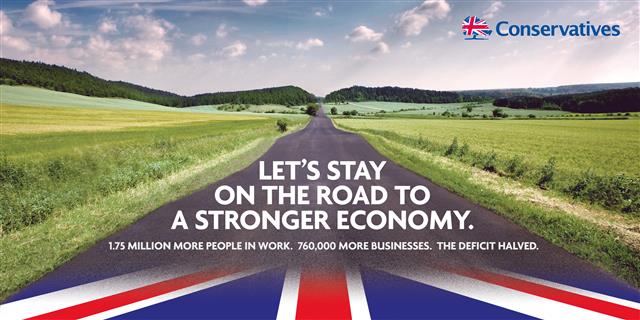
This Conservative campaign poster for the upcoming General Election is already under fire.  Why?  Because, as correctly predicted by my brother, the road in the picture is, in fact, not in Britain at all – but is in Germany, outside Weimar.

Who cares?!  I can't, for the life of me, think why this matters.  Of all the things to get worked up about, is this really the one you would pick?  It's a stock photo of a road, and it could be anywhere in the world – adverts use stock photos.  There isn't really a 'road to recovery' which you can actually drive down at all; it's a metaphor.  The manufactured outrage surrounding this is ludicrous.

What we should be looking at is the claims which the Conservative Party makes on its campaign poster.  One of the boasts they make on 'the road to recovery' is that 'the deficit is halved'.  Is it?  Fraser Nelson described in the Spectator last month why this may not be strictly accurate – and yet people are more interested in foaming at the mouth about the location of the photograph being used in the campaign!  Isn't this akin to seeing a company's advert on television and being more angry about the fact they used actors in the advert than about the possibility they may be making false claims about their product?

In politics, facts matter.  Stock images don't.  The next few months are going to get pretty ridiculous if the criticisms levelled at this Conservative 'road to recovery' poster are indicative of the level of discourse we can expect from the General Election campaign.  Let's stop worrying about these trivialities and instead subject all parties' claims and policies to the kind of proper scrutiny required to make an informed choice about who to vote for in May.

Saturday, 27 December 2014

Breakfast radio

Sitting in a van at six o'clock this morning, having traveled all night from a gig in Plymouth back to the East Midlands, I became more and more irritated by the banality and forced joviality of the presenter we were listening to on BBC Radio 1.

As this constant stream of inane babble, interspersed with regular pleas for listeners around the country to text the radio station and stick their oar in too (who actually does that, thinking 'yes, my life and what I'm doing right now are so interesting that all the other people listening to national radio will want to hear all about it'?!), seeped into my brain, I hosted my own little breakfast radio show on Twitter…

Wednesday, 12 November 2014

Comment on this

Do you write comments on newspaper articles online?  You shouldn't.

I very rarely get comments on my Blog posts – and for that, I am very grateful.  The problem with online comments is that no one is listening, and everyone is talking; it is a world where people scream their opinions into the abyss with an obstinate certainty they would never display in real life – there is no persuading anyone of an alternate point-of-view because everyone's positions are already so entrenched, and ad hominem is the default approach for making any point.

No one can ever 'win' one of these arguments (read: shouting matches).  I don't think anybody is even trying to.  There are plenty of comments on this critique of Russell Brand's latest book by Michael Moynihan, most of which are pretty hostile – and yet there are precious few attempts logically to refute the arguments the author makes, and instead the commenters' points are almost all "you're jealous of him!" or "you're just a stooge of 'the establishment' anyway!"

I've lost count (OK, I was never really keeping count) of the number of times I've read an excellent article, followed by a bunch of moronic comments from people with no interest at all in debating the issues raised in the piece with an open mind.

So, let's all try to  restrain ourselves, and stop posting comments – the world will be a happier, nicer place for it.

Thursday, 6 November 2014

#MontyThePenguin

I've just watched the new John Lewis Christmas advert.  If you haven't seen it yet, here it is:


According to the response on my Facebook and Twitter feeds, people have actually been crying at this.  Genuinely shedding real life tears.  Can you believe that?  It's a television advert.  And you're crying at it?!  Pull yourselves together!  You'll find you get a lot less emotional watching it if you bear in mind that it's been cynically calculated to make you spend as much money as possible.

Even worse, however, is John Lewis' appropriation of Christmas.  This article in The Telegraph declares that "today sees the start of the countdown to Christmas: the launch of the John Lewis Christmas advert".  No, it doesn't.  We already have a 'countdown to Christmas' – it's called Advent, and it begins four Sundays before Christmas Day (this year, that's 30th November).  And with its traditions of lighting candles, singing songs and baking cakes, Advent is considerably more festive and more community-spirited than an unashamed attempt to squeeze more money out of consumers by tugging on their heartstrings.

I shall be expanding on this at a later time, but when my political party sweeps to power next May in a landslide election victory, our flagship policy will be to double corporation tax on any company who puts out a Christmas advert before the last week of November.  If John Lewis decide to pass that increase on to their customers, they may find their Christmas marketing campaign doesn't bring it quite so much profit any more.

Thursday, 9 October 2014

#Portmantober

Make the month of October fun/exciting/charitable/healthy/aromatic by taking part in Portmantober! Take the Portmantober challenge, and for thirty-one days find ever more annoying and self-serving ways to mash up the word ‘October’ with another word of your choosing, all in aid of charity/fun/personal development!

How to participate:

  1. Choose your word or phrase: for example, you might want to dedicate the entire month to the teachings of Swiss Philosopher Jean-Jacques Rousseau.
  2. Write a smug Facebook status informing all your friends that you’re doing ‘Jean-Jacques Roussober’ this year. (Don’t forget to include a good dollop of subtext designed to make your ‘friends’ feel bad if they don’t also join in!)
  3. Tweet with the hashtag ‘#portmantober’ at least once a day, but preferably much, much more often than that.
  4. Convince yourself you’re doing something profoundly worthwhile, while actually just being a tremendous nuisance to everyone you know (and quite a few people you don’t know).

Have fun out there, Portmantoberists!

Wednesday, 8 October 2014

Twitter for business

If you do it right, Twitter is the perfect customer support tool for your business.  It's instant, it's convenient, it's free, it's twenty-four hours.  If you own a business, train your staff to use social media well, and it will pay dividends - and the bigger your business, the more important it is to harness the power of Twitter to keep your customers happy!

Why do I bring this up?  Well, we (as a society) are always very keen to complain about poor service - I think it's good to recognise when service is done well, too.  With that in mind…  I Tweeted about an issue I was having with Barclays' online banking, and I received a very prompt, helpful response from Barclays' official Twitter.  Simple, painless - and fixed my problem straight away.


See?  Customer service is easy!

Saturday, 4 October 2014

Don't cry for Jeremy, Argentina

One doesn't haven to be a fan of Jeremy Clarkson to condemn mob violence.  Clarkson and the Top Gear team were recently chased out of Argentina by an angry mob hurling bricks and rocks, after locals took exception to a vehicle number plate which they thought was a jibe about the Falklands War.  (The BBC denies that this was the case, and insists the number plate was purely a coincidence.)

Clarkson is a controversial figure, and not without his critics.  However, to be seeing comments on Facebook and Twitter about this incident supporting the actions of the Argentinian rioters, or even offering to supply them with more rocks to hurl at the presenter, is pretty disgraceful.


Condoning and supporting this sort of 'lynch mob' rioting is never OK.  Not even if the target is somebody you don't like.

Monday, 21 July 2014

Equality of outrage

Following the promotion of several female MPs to the Cabinet in last week's reshuffle, criticism was heaped upon the Daily Mail* for it's coverage of the new ministers - which focussed on their clothes and general appearance, rather than their qualifications for the job and their qualities as serious politicians.


Labour MP for Bishop Auckland Helen Goodman, however, chose to Tweet this:


It does female ministers a great disservice to think they are only there to 'make up the numbers'; when a male politician is promoted, no one asks whether he has been put in that position because the Prime Minister thinks he'll be good at it, or just to keep up appearances - why should we cast these aspersions on female MPs?

When Sajid Javid was made Minister for Culture, attacks in the press focused mainly on the fact he was a former banker, rather than claiming he was only there to increase muslim representation in the cabinet instead of on his own merits - even though a look at the cultural background of someone who is in charge of culture might actually be relevant to how he might undertake the job.  It is distasteful that female politicians are still seen merely as 'window dressing'.

For those interested in more than just a female MP's clothing and appearance, this excellent Buzzfeed article goes into more detail about some of the newly promoted ministers' CVs, backgrounds, what inspires them, etc. - and aptly demonstrates that they have been put in the cabinet on merit, not purely to fulfil some quota.

A few hours later, Helen Goodman deleted her Tweet, and wrote that it had been 'intended as a lighthearted remark'.


Now, I don't really think that Helen Goodman is sexist.  If she genuinely thinks that the 'most interesting' thing about Esther McVey, Nicky Morgan, Penny Mordaunt, et al is their clothes, then that's her opinion - but I highly doubt she is in any way an enemy of women in politics.  What's remarkable is the muted response her comments received; with the exception of a few Conservative activists seeking to make hay over an opponent's blunder, I have seen very little said about this incident at all.

Imagine, if you will, what the reaction would've been to a male MP (of any party) Tweeting the same incendiary and derogatory remarks about female ministers - and then trying to pass it off as "aww, c'mon guys - it was just a joke!"  He would've been hauled over the coals.  Whether that would be the correct reaction to his comments is another matter - but he would certainly have been castigated for saying what Helen Goodman said.  Ms Goodman, on the other hand, seems to have got off fairly lightly.

The real sexism here is that people seem to be considerably less offended by Ms Goodman's Tweet than they would have been had it been posted by a male politician.  If particular comments are deemed sexist - and, therefore, unacceptable - it shouldn't matter who says them.  The equality movement are fighting the good fight for causes such as equal pay - but we won't truly achieve those goals until we have equal outrage too.

* When is criticism NOT heaped upon the Daily Mail?!

Saturday, 14 June 2014

Why I am IN

No, this isn't a Liberal Democrat party political broadcast (although if they asked me to do one, I wouldn't rule it out).  I'm talking about staying in to watch the football…

This evening - at the ungodly (to many, but to me perfectly reasonable) time of eleven o'clock - is England's first game of the 2014 FIFA World Cup.  For me, conversation about the match has dominated the past few days; discussions about tactics, possible lineups, score predictions - and about viewing arrangements on the night.  During rehearsals yesterday with one of the bands I work for, there was a keen debate about which pubs would be the best places to watch the game - there was even talk of watching it in one of the local nightclubs.  Honestly?  I can't think of anything worse.

Yes, watching the football down the pub is a typically British, typically blokey thing to do.  I just fail to see any appeal.  Is there any way in which watching the game in a pub is actually better than just watching at home?  Let's see…

Screen

Yes, most pubs are going to be showing the match on a screen significantly bigger than my TV at home.  Is this a good thing?  No.  At least, not when it will either be so high up on the wall that watching a full ninety minutes causes a permanently cricked neck for days afterwards, or positioned awkwardly behind a pillar, 'round the corner, past a group of exceedingly tall people who arrived early and positioned themselves inconsiderately close.  My television is of a perfectly adequate size for viewing officiating disasters and Wayne Rooney's missed chances, thank you very much.

Environment

At home, I can sit on a comfortable sofa, with a clear view of my quite-big-enough television; I can see everything that's going on, and I can hear all the commentary and analysis (even if I sometimes wish I couldn't).  I can have a drink or a snack without having to pay ridiculous amounts for the privilege, after queueing for twenty minutes (thus missing a large portion of the game) only to be told that the establishment's selection of whiskies is "Jack Daniels or Bells, mate."

I won't be in the lose-lose situation of having to choose between standing up all evening and enduring the agony of aching feet and having nowhere to put anything, or sitting on either a rickety and uncomfortable barstool with a partially obscured view or a marginally less rickety and uncomfortable chair with a totally obscured view.

Connectivity

Like it or not, the internet and social media have become a part of the way many people experience big global events - like a World Cup.  Personally, I like it.  I would much rather be at home where I know I have access to WiFi and charging sockets than in a pub fretting about intermittent 3G and dwindling phone battery.

Atmosphere

This is the big one.  People like going to the pub to watch the game because of the 'atmosphere' (whatever that means).  To me, it means having to share an experience I ought to enjoy with a group of loutish strangers who get steadily more drunk and more rowdy as the night wears on, in a setting where every surface is sticky, the air is hot and humid with the fetid sweat of many men, and there is a lengthy queue for basic amenities like food, drinks and toilets.

Just because I enjoy football, it does not necessarily follow that I enjoy the company of hoards of lager-swilling "white van man" types in England shirts which stretch unedifyingly over their burgeoning beer guts, each convinced he is the biggest football expert in the room and determined to shout down anyone who thinks otherwise.  Nor that I enjoy having to jostle for position just to see the lower left-hand corner of a TV screen which really needs the colour contrast adjusting; nor having beer spilt on my shoes; nor paying £3 for a packet of crisps; nor "banter".

No, I'm definitely going to stay at home to watch England - where I can actually relax and enjoy the game.

Tuesday, 13 May 2014

#NCFC - the future's yellow

Every fairytale comes to an end after a while.  Norwich City's relegation to the Championship last weekend marked the end of an era which had seen the club gain back-to-back promotions after the dark days of a 7-1 defeat to Colchester United in League One in 2009, and go on to spend three successive seasons in the Premier League.

It is with no inconsiderable trepidation that I take to the airwaves of the internet to write about the situation at Norwich City now.  However, one of the greatest things about sport is its ability to get people talking; differences of opinion are common, but there is always room for debate.

For Norwich fans, the 2013-14 season has been characterised predominantly by acrimony and bitter disappointment.  It has been a season of frustration and anger, with few high points, considerable periods of misfortune, and culminating in relegation from the Premier League.

There is little mileage, however, in a backward-looking 'blame game', at this point - and fans who are looking for a single figure of woe at whose door they can lay all the responsibilities for this train-wreck of a season are going to be disappointed.  Who will be our scapegoat now that manager Chris Hughton is gone?  Club CEO David McNally?  Interim manager Neil Adams?  Record signing Ricky Van Wolfswinkel?  No, far more productive than a bile-satiating but ultimately fruitless quest to apportion blame is to look to the future, and think about how we move on from this.
The question on everybody's lips now is "who will be the next manager?"  It's a good question.  Already, there are rumours flying around that Malky Mackay has been offered with the position.  A favourite with the fans, and widely regarded to have been very wrongfully treated during his time in the Premier League with Cardiff City, Mackay was already on Norwich fans' managerial radar long before the sacking of Hughton at the beginning of April.

When I wrote at the time about the various managerial options open to the club, I said that, in my opinion, Mackay was a good manager, but not necessarily a 'step up' - and although he should've been given more time by Cardiff, his record in the Premier League was, overall, quite poor.  Of course, the situation has changed now; Norwich will be a Championship team next season, not a Premier League team, and Mackay has a proven track record of getting a team promoted from the Championship.

However, I feel the club needs to tread very carefully here.  To allow ourselves to slip into the mindset of being a 'Championship club' could be a very slippery slope indeed.

Now, I don't buy this nonsense some fans seem to be pedalling that it's better to be in the Championship anyway.  Some people are saying that the Championship is a closer-fought, more exciting league; that the games are better to watch; that the league is more open because it's not dominated by a handful of super-rich clubs; that "at least, in the Championship, we might win some games".  I am reminded of an expression my Grandfather had - that "it's better to be bottom of the top group than top of the bottom group".  It might help to make you feel better about relegation to say these things, but this is a loser's attitude; the Premier League is the elite of football in this country, and it is where all clubs should want to be - if you don't want to be in the top flight, then what is your raison d'être as a club?

So, let's forget that argument straight away.  As a football club, we want to get back into the Premier League as quickly as possible.  But again, we need to be a little careful here, and not take too shortsighted an approach.  Winning promotion again would be fantastic, of course - but this time, that needs to be sustainable.  What we need is a strategy which not only gets us back into the Premier League, but keeps us there.

This is why I am slightly wary of the forthcoming managerial appointment.  I am worried that those making the big decisions at the club won't be thinking big enough - that they will start to think of us as a 'Championship club', and therefore appoint a 'Championship manager'.  The groundwork for becoming an established Premier League team needs to start now, not after promotion, and that comes from the top, with a good, ambitious manager.

Malky Mackay might win automatic promotion with Norwich, just as he did with Cardiff - and that would be excellent.  But would he then struggle in the Premier League with Norwich, as he did with Cardiff?  Mackay is a safe and solid choice, and would do a good job - but, in my view, there are better managerial options out there.

In my previous post about Norwich City's managers, I spoke of Michael Laudrup (inexplicably sacked by Swansea during the season just gone) as being my preferred candidate.  In his first season at Swansea, Laudrup's record was excellent, and I think his style and approach would suit Norwich well.  Another name to throw into the hat (which was not the case back in February), would be Tim Sherwood - with the highest win percentage of any Spurs manager ever, and with links to Norwich City already, Sherwood was let go by Tottenham just this morning, and will surely be looking for opportunities to get back into management.

Again, as I said before, it is easy to throw these names around.  Hey, while we're at it, why don't we try and get Jupp Heynckes out of retirement?!  The other side to the coin is whether these managers would even want to come to Norwich anyway.  As a newly relegated club, whose form in the league over the past few months has been pretty dire, we are surely an even less attractive destination for ambitious, forward-thinking managers than we were before?

Well, maybe so.  But this is where we need to bring our biggest strengths into play - namely, the club's strong financial position, and passionate fan-base - and, again, where our top brass need to be thinking big, and long-term.  We don't know what options Laudrup or Sherwood (or, for that matter, Heynckes!) have on the table already; it may be that an approach from Norwich would be by far and away the best job offer either of them has had since their respective sackings - or it may be that they're both already being courted by Man. Utd., Arsenal and Real Madrid.  Who knows?!

What we need to do, though, is approach these managers and set out a vision for the club.  We need to show them that there is money available for transfers, and that they will be allowed to bring in the players that they want; we need to assure them that we're not the sort of club to indulge in knee-jerk sackings the moment we concede a goal or lose a game; and, most importantly of all, we need to make it clear that the club has long-term ambitions to become an established part of the Premier League, and that we are building this from the ground up, starting now.

There is no doubt that this is going to be a very hard task for whoever takes over.  The Championship is very competitive, and lots of clubs are after that prize of promotion, and a shot at the big time.  But this is why it is now so important to lay the foundations for a long-term plan; relegation from the Premier League is not a reason to be less ambitious - no, it is a reason to be more ambitious.
Wednesday, 16 April 2014

Go on, spoil yourself

Spoiler alert!  That abomination won't actually make your
nasty little Vauxhall Nova go any quicker.

The author Stephen King has got himself in trouble on Twitter a few times for posting 'spoilers' relating to hit television programmes - most recently, the sensationally popular Game Of Thrones.

As an avid Formula 1 fan who can't afford the special Sky F1 channel (and who's often working when races are broadcast anyway), I know all too well the dangers associated with going on the internet when everyone else has already seen something that you're still waiting to watch.  But if there's one thing more irritating than people posting spoilers online, that's people moaning about other people posting spoilers online.

Like it or not, Stephen King (or anyone else) can write whatever he likes on his Twitter account.  If you don't want to read it, don't follow him.  Or, better yet, don't go on Twitter at all until after you've been able to see whatever it is everyone's talking about that you haven't seen yet.

I've been doing this for years.  My general rule is: no social media (Twitter, Facebook, Instagram, etc.), emails, TV or radio from ten minutes before the formation lap until after I've been able to watch the race myself.  That may seem like an awful lot of hassle - but when something's important to you, you're willing to put yourself out to make sure you can enjoy it to the full.

Which is exactly the issue I have with people whining about spoilers - it isn't anyone else's responsibility to make sure you're able to enjoy your favourite programmes on television.  If you don't want to find out the score of a football match, or what happens in your favourite drama, or who wins the Grand Prix, it's up to you to avoid finding out in whatever way you see fit - go to whatever lengths you deem appropriate, but don't expect others to restrain themselves on your behalf.

In short, if you know there are going to be things on the internet which you don't want to read, stay off the internet; don't go on the internet anyway, and then complain that other people are talking about things you'd rather they weren't talking about.  If you don't want to see spoilers, it's no one's job but your own to make that dream a reality.

Saturday, 12 April 2014

Never say 'die'

For Norwich City fans, today's 1-0 defeat by fellow Premier League strugglers Fulham was a huge disappointment.  Billed as a 'must-win' game - as classic 'relegation six-pointer' - it was believed that whoever lost this match would be in serious trouble.

Serious trouble, yes.  But not certain relegation.  The Norwich City FC Facebook page has quickly filled up with comments saying "well, that's that, then - we're definitely going down now!"  I don't know how anyone can be so sure.

Football is inherently unpredictable.  How anyone can say with such cocksure arrogance that relegation is a certainty for Norwich now is beyond me.  After all, while the result at Fulham today doesn't exactly help matters, as things stand we're still not in the Relegation Zone even now.

Plenty of supporters are pointing to 'the Run-In', and the fact that Norwich's last four games are against four of the so-called 'big teams'; many people believe that, although Norwich are currently 17th, Fulham (and maybe even Cardiff, too) can catch us because their final four games are that bit easier.

Even though this ignores the fact that there are no 'easy games' in the Premier League, I am again at a loss to understand how these people can be so certain.  The prevailing attitude seems to be that the possibility of Norwich taking any points at all from their last four fixtures is so unlikely as to be discounted entirely - but the fact is, nothing is impossible, and stranger things have happened in football, over the years.  After all, few people would've given Norwich a hope of beating Spurs earlier this season, or holding Manchester City to a very creditable draw after having been hammered 7-0 the first time around.

Yes, staying is going to be difficult for Norwich, and there is no doubt that the task which now faces us is enormous - but there are so many factors involved in this equation, no one can really know for definite what will happen.  To act as though relegation is already a mathematical certainty is as foolish as to act as if survival is a certainty - and that sort of negativity and despair does nobody any favours.

If the manager, one of his staff, or any of the players came out after today's match and publicly stated that we hadn't got a hope they would be absolutely crucified by the media and the fans - and rightly so!  They would be expected to keep fighting right to the very end, giving everything they have for the club and its supporters.  So why do some people think it is OK for us, as fans, just to give up on our season with four games still left to play?

Let's not be under any delusions as to how tough the remainder of this season will be.  But we can still beat the drop, and there is still everything left to play for - so let's get behind the manager and the team, and give it everything we've got for these last four games!

Ignore my stupid Profile Picture - the points are still valid...!

Monday, 24 March 2014

Regurgitated media

I was recently introduced to the phenomenon of GoggleBox - a television programme on Channel 4.  Billed as a window into the world of 'Britain's most opinionated viewers', GoggleBox features a variety of 'ordinary people' watching television and talking about it.

It was not long into my first viewing of GoggleBox before I realised that instead of watching television, I was watching other people watch television.  I was consuming second-hand television - instead of choosing to watch something myself, and form my own opinions about it, I had chosen to watch other people do that.

Quite apart from the fact that we are more obsessed that we have ever been about what 'ordinary people' think about anything (that is a topic for another day!), this must be a very easy programme for Channel 4 to make.  It doesn't need a set, or costumes, or scripts, or stuntmen - it doesn't even need any original or creative thinking to make it.  And this, I think, is the main issue I have with GoggleBox; there's nothing new in it - it is regurgitated media.

More and more media these days falls into this category.  On the internet, you'd probably expect that - the average Tumblr Blog probably has more content 'reblogged' from other users than original posts written by the Blog's owner (just one of the reasons why I don't like Tumblr).  But sites like BuzzFeed have taken collating and redistributing other people's material to a whole new level - and now even serious, reputable newspapers post 'articles' which are just a collection of Tweets or posts from other sources, apparently thinking that this constitutes journalism.

On television, though, that feels a little like cheating.  GoggleBox is on at nine o'clock on a Friday night - that's seriously mainstream primetime television - but it doesn't require the creation of any original material at all.  It is simply relaying people's reactions to other original programmes which have already been broadcast.  Channel 4 are passing this off as a television programme in its own right, but I think they're having a laugh.

Saturday, 22 March 2014

#NoMakeUpSelfie and the culture of 'Facebook Activism'

The 'No Make-Up Selfie' is one of the biggest stories on social media this week.

The way it's supposed to work is:  you post a picture of yourself wearing no make-up on Facebook, then you nominate a couple of friends who also have to post pictures of themselves wearing no make-up, and somewhere along the line somebody texts the word BEAT to 70099 to donate £3 to Cancer Research UK.

But, this being Facebook, even the humble act of charitable giving has developed into an argumentative brawl.  There has been a backlash against the 'No Make-Up Selfie' campaign, with people claiming that simply posting a picture of yourself on the internet doesn't actually do anything to raise money for Cancer Research (which is true).  But other people have pointed out that Cancer Research UK have seen a £2m increase in donations since the campaign began, so if the posts are encouraging more people to give to the cause, what's the big deal?

If you take it in isolation, the 'No Make-Up Selfie' campaign is undoubtedly a force for good; the increase in the amount raised by Cancer Research UK bears that out.  But in context, it is part of a growing trend of 'Facebook Activism', which I worry might be harming, rather than helping, charitable causes in the long run.

I'm sure the 'No Make-Up Selfie' is not the first charity-related Facebook campaign you have seen.  I remember a time when everyone was supposed to change their profile picture to a cartoon character from a TV programme they used to watch in their youth, to 'raise awareness' for child abuse - to name just once.

Of course, there's nothing inherently wrong with this.  'Raising awareness' about important issues on social media is great, as far as it goes.  But that's just the point - it doesn't go nearly far enough.

The trouble with 'Facebook Activism' is that it gives you the illusion of doing good without actually making any real difference.  People can feel complacent, believing that they have 'done their bit' merely by posting a status update, or changing their profile picture.

Coming back to the excellent work done by Cancer Research UK, for a moment...  I myself have had a direct debit set up to make a regular donation to Cancer Research UK since long before the 'No Make-Up Selfie' craze took off, and I have taken part in several fundraising events to raise money for cancer charities.  I'm not saying this to hold myself up as some paragon of charitable piety (it's more to fill space in this post - y'know, add another paragraph), but I think it's interesting to put yourself in the position of someone working at one of these charities.  I'm sure you'd be delighted to know that some social media craze meant everyone was talking about the charitable work you did, and that your cause was at the forefront of the national consciousness - but you'd probably be even happier to think people were actually going out and doing something to help, instead of tapping away on a smartphone and thinking that, in itself, constituted 'doing enough'.

'Raising awareness' on Facebook is a brilliant way to augment the tireless work of charity activists - but it doesn't, and can't, replace it.


Text BEAT to 70099 now.

Sunday, 16 February 2014

GeckNominate

I'm going to start a new super-trendy internet craze called GeckNominate - you tag a friend on Facebook to 'nominate' them, and then they have spend the next three-and-a-half weeks living as a gecko, licking their eyes instead of blinking and shedding their skin.

Except, of course, they don't.  They don't have to do anything.

And it's just the same with current viral internet drinking madness NekNominate.  The NekNominate game has been in the news recently, and is under fire for being irresponsible and dangerous, and encouraging excessive drinking.  The Mirror claims the game has caused the deaths of five people in the UK.

But despite the so-called 'rules' of NekNominate, it's still up to you what you put in your body.  You've been tagged in a Facebook post - it's not a legally-binding agreement!  If you don't want to do it, just don't do it.

And if you do want to do it, fine - that's up to you.  But if you end up in the hospital because you drank a pint of Stella Artois with Royal Icing, two squeezes of Fairy Platinum washing up liquid, grapefruit juice and and a shot of Cointreau - can you really say that's anyone's fault but your own?

Tuesday, 4 February 2014

Vlog: TMI YouTube Tag

The 'TMI Tag' YouTube video involves answering fifty questions about yourself which are supposed to be highly personal - but are actually disappointingly middle-of-the-road.  (The kind of high school 'Truth Or Dare' questions like "do you have a crush?")

Anyway, I'd seen a few of these things posted on social media just recently, so I thought I'd have a go - but I found I wasn't able to take all the questions seriously enough.


Saturday, 1 February 2014

No, we don't have WiFi; talk to each other!

But I don't want to talk to you; I don't even know you.

I've seen this picture (or a variation on it - this one seems to be the most common, though) posted on a variety of social networking websites (ironically) just recently.  Most people see it as 'striking a blow' against modern social norms of using smartphones and tablets in public instead of talking to people face-to-face - and they seem to love that.  I, on the other hand, think it's incredibly condescending.

Firstly, to suggest that technological advances (particularly WiFi and mobile internet) have had an adverse affect on social communication is patently absurd.  Sure, internet technologies have changed the nature of social interactions, but the fact is that people are now able to communicate more easily with more people more of the time.  It maybe that some people still prefer more 'traditional' interactions, but to suggest (as this sign seems to) that using WiFi and being a social human being are mutually exclusive is demonstrably false.

Most importantly, however, the tone of the sign seems very rude, to me.  It is each establishment's prerogative whether or not to offer WiFi access to patrons - but to put up a smug, moralising sign about it seems a little unnecessary.

So, you don't have WiFi available here?  Fine.  But sanctimoniously telling me that your lack of WiFi is somehow 'better', or 'for my own good', would definitely be a good way to put me off giving you my custom.

Monday, 16 July 2012

Damn those noisy megabytes!

Yesterday, I went to London by train.  I don't travel by train very often, as I much prefer driving to taking public transport.  (Long-time readers may well recall some of the reasons for my dislike of trains.  Newer readers - or those who simply wish to refresh their memories - can read my post about the trials of rail travel here.)

Thankfully, my rail journeys yesterday were pretty uneventful - aside from the vague uneasiness caused by sharing my mode of transport with so many strangers.  (I am always nervous that someone will drug me and steal my shoes.)  However, something which perplexed me was the rules and regulations surrounding the Quiet Coach.

The Quiet Coach is one coach of the train in which one is not permitted to behave in a way that disturbs other people.  The idea is to provide a refuge for those who might want to travel without the annoyance of people talking on mobile phones, or playing music through speakers, noisy kids, screaming babies, etc.  I can understand that.  But I can't understand this announcement made by the Guard on the train:
"There is WiFi available throughout the train - except in Coach B, which is the Quiet Coach."
I didn't know WiFi was particularly loud.  Indeed, I've never been disturbed in any way by the presence of WiFi.

I know that the reasoning for this is that being able to access the internet gives one the facility to be watching videos on YouTube, playing games, talking on Skype, and generally using technology to make a nuisance of oneself.  But that's totally illogical - it isn't the WiFi itself that's annoying, it's the way certain people might use it; you may as well say that people clicking their fingers could be irritating, so everyone in the Quiet Coach has to wear mittens the entire time.

It is, of course, possible to access the internet very quietly indeed.  In fact, I am doing so right now.  Withholding WiFi in the Quiet Coach is absurd - it's not WiFi which is the problem, it's people's inconsiderate behaviour.

Saturday, 14 July 2012

Happy Facebirthday!

So, yesterday was my birthday...  (I'm twenty-two; thanks for asking.)

As is normal in this day and age, I experienced a high volume of traffic on my Facebook profile, with plenty of friends and acquaintances dropping by to wish me many happy returns.  (I probably had more people talking to me on Facebook within the space of twenty-four hours, than I do in six months during the rest of the year!)

Of course, Facebook is in now, when it comes to communicating.  Some people would say that a message written on someone's Facebook Wall (sorry, Timeline) is less personal than a traditional birthday card, a handwritten note, or even a 'phone call - but we must move with the times, and personally, I still appreciate the fact that people have got in touch with me to wish me well on my birthday.  It's nice.


As I said, I really appreciate my friends' taking the trouble to speak to me on my birthday, and I always try to respond to each person who has done so.  However, it really irritates me when other people respond so impersonally to birthday wishes on Facebook.

I often notice other Facebook users displaying less gratitude to their friends, and simply posting a "one-size-fits-all" status update during the day, saying "thanks to everyone who has wished me a happy birthday!!"  No doubt they feel overwhelmed by the large amounts of people getting in touch with them, and feel it unnecessary to reply to each one individually - I'm sorry, but I don't agree, and I think if someone has taken the time to write you a comment, you can take the time to write them one back.

After all, it wouldn't look great if, on every day which is not my birthday, I just posted a status saying "happy birthday to anyone whose birthday it happens to be today!" instead of actually bothering to talk to my friends individually, would it?

Sunday, 3 June 2012

Web and email: making the switch

After the high drama and excitement of last week's double sandwich review and comparison post, I am going to become very pedestrian now, and talk about which web browsers I use, and things like that.  So, if you don't want to know the results, look away now...!

I have been a loyal Mozilla user for close to ten years, now.  I got my first computer (a desktop PC from Evesham Technology) in 2003.  The first thing I did was to download Mozilla Firefox, in order to escape the slimy clutches of Microsoft's own browser, Internet Explorer.

I continued using Mozilla products (by now using both Firefox, and its sister email client, Thunderbird) on my HP Windows laptop, and when I got my first Mac (a second-hand G4 iBook) in 2009, I saw no reason to change this.  Eschewing Apple's native software (Safari for the web, and Mail for emails) I continued using the Mozilla applications with which I was most familiar.

Yesterday, however, I made the switch away from Mozilla, for the first time.  Why?  I don't feel they're keeping up in terms of design, and the software increasingly feels clunky and poorly-made.

In recent months, I have felt more and more frustrated watching other Mac users using slick, shiny, web and email interfaces, while I stick with programs whose interfaces haven't changed, in essentials, for years.  The aesthetics of Mail, in particular, seemed far superior to Thunderbird - and although Safari and Firefox are built on the same tabbed browsing model, Safari somehow manages to make this look cleaner and more modern than Firefox does, and Firefox just can't compete on performance and speed any more.

So, I am now an Apple Mail user.  So far, I am happy with it.  I like the "grouped conversations" feature, and I like that it brings my email management on my MacBook in line with on my iPhone.  Safari, however, impressed me less.  Having been used to the marvellous AdBlock Plus addon with Firefox, Safari bombarded me with adverts in the first five minutes before I Quit it in exasperation.

Following the advice of some people on Twitter, I gave Google Chrome a try.  This was a big step, as I had previously discounted Chrome, on the grounds that Google don't make an equivalent email client to run alongside their browser application.  (One of the irritating things about being as meticulous in certain aspects of life as I am is that I always prefer to use a matching pair of web programs than a hotchpotch of different software.)  In spite of these OCD-related misgivings, I decided to give Chrome it a try...

My first impressions of Chrome were that it was just as fast and stable as I had been told.  The interface, while nothing special, is uncluttered to the point of serviceable, and, perhaps most crucially of all, there is a version of AdBlock Plus available for Chrome as well.  So, I am now using Chrome - at least for the foreseeable future.  The idea of using a non-matching web browser and email client is still slightly unsettling, for now, but I'm sure I can get used to it, in time.

I'm still very disappointed not to be able to continue using Mozilla products.  I like the ethos and the open source nature of their software packages, and (although this is a small point) I think their software icons (in the Dock, or on the Desktop) are better.  At some point, I hope, Mozilla's performance and interface design can catch up with the rest of the world, and their products can become viable options for Mac users again.  Until then, though, I shall be sticking with Chrome and Mail.

Sandwiches will return later in the week.