Showing posts with label social networking. Show all posts

Friday, 5 June 2015

#RedToriesOut and SNP homogeneity

One of the (many) social media slogans of the armies of online Scottish National Party activists – or 'cybernats' – is 'Red Tories Out'.  'Red Tories' is a derogatory reference to the Labour party, implying that they are just the same as – for which, read 'just as bad as' – the Conservatives.  It's a nasty, small-minded slur, not least because the claim that Labour and the Conservatives are 'the same' is demonstrably nonsense, as is borne out by the differing attitudes of the SNP leadership towards each – and also because it further legitimises the use of the word 'Tory' as a generic political insult, which is rather disrespectful to people who hold the perfectly legitimate (even if you don't agree with them) political views of the Conservative party.

But what's really intriguing is the '…Out'.  Red Tories Out.  Out of where?  When David Cameron won his second term as Prime Minister last month, protestors gathered in London to shout 'Tories Out Now!'  But Labour (the 'Red Tories') are not 'in'.  They are in opposition at Westminster – and they are in opposition also in the devolved Scottish Parliament at Holyrood.  The only place where Labour hold any power is in the Welsh Assembly; is that what all those SNP supporters on Twitter are getting so hot-under-the-collar about?

I asked one of the SNP-supporting Tweeters you sometimes see – y'know the sort, 'We Are The 45', 'We Are The 56', yellow and black avatar, the referendum isn't over, type of chap – what it all meant.  He was perfectly pleasant, actually.  But he told me that 'Red Tories Out' meant 'out of Scotland'.  I'm sure this isn't true of all SNP activists, or members – but it would seem that there is a school of thought within the Nationalist movement which wants to drive the Labour party and its supporters into the sea.

In other words, they want to establish a one-party state.

'Traitors to Scotland'.  Their crime?  To have a
different point-of-view.

With the Liberal Democrats' decimation at the election, and Conservative support in Scotland still very low, Labour are the only effective alternative to the SNP.  And some SNP supporters want this dissension quashed.  Wiped out.  Is that healthy?

In the world of sport, the greatest performances are borne of the greatest rivalries.  Roger Federer and Rafael Nadal are considered two of the 'greats' of tennis – but neither would've been 'great' without the other to push him.  The same is true of Alain Prost and Ayrton Senna in Formula 1.  Having a strong rival forces you to raise your game.  In politics, just as in sport, competition is healthy and produces better results.

The SNP likes to think of itself as 'progressive' – but a society in which there is only one mainstream political view is a society which stagnates.  The ruling party can do as it wills, with no opposition to hold it to account.

When any difference of opinion is crushed as insubordination – or when a culture develops in which disagreement is tantamount to treason – nobody benefits; support for the ruling party is as much an article of faith, with no rational basis for it, as it is rooted in an objective appreciation of their arguments.  This is especially true when you consider that party rules prohibit SNP MPs from speaking out against the party line at all; the whole basis of the organisation seems to be to smother and stifle disagreement, instead of confronting and defeating it – and this has resulted, as I wrote in my immediate reactions to the General Election, in SNP politicians and activists believing that they exist to represent the totality of Scottish though, rather than certain specific policies and viewpoints.

In the end, this creates a mentality where, if you are not a 'true believer', you are an outcast.  But this is no way to conduct politics.  It is only through challenging prevalent ideas, and questioning the status quo, that progress is made, that new ideas can develop, and that a society can grow.  That, after all, is how the SNP rose to prominence in the first place – by being an alternative; a different point-of-view; outsiders.  Now, however, they are very much the establishment – and their supporters are throwing their weight around more and more.

In contrast, pluralism allows for the open, noisy clash of ideas – as opposed to the suppression of 'bad' ideas – which politics should be all about.  He may be the cybernats' favourite hate figure, but I agree with Jim Murphy (the outgoing leader of Scottish Labour) when he says that 'Scotland needs a strong Labour Party'; even when you disagree with what they say, the need for strong opposition parties should be clear to everyone.

Wednesday, 3 June 2015

The furore over MPs' pay shows political campaigning at its worst

The prickly topic of MPs' pay is in the news again.  And when I say 'in the news', I also mean that self-righteous social media warriors are shouting through a dense smog of knee-jerk outrage and sharing poorly-researched, inaccurate 'infographics' which look like a nine-year-old created them in Microsoft Paint.

Leaving aside the sheer ignorance of many of these campaigners – I have lost count of how many Tweets I have seen blaming David Cameron for this, when in fact MPs' pay is set by an independent body precisely to stop it becoming such a contentious political issue (and how did that work out for you?!) – it occurs to me there are some very nasty political implications in this vilification of MPs.

One thing which comes up time and time again is the idea that MPs can, or should, 'reject' their pay rise.  According to IPSA (the independent body responsible for MPs' pay), actually, they can't – but more to the point, I fail to see why they should.  Taking a rise of £7000 would be 'out-of-touch', we are told.  (The most pointless, nonsensical, unmeaning insult in politics strikes again!)

But surely what would be really 'out-of-touch' would be not taking a £7000 pay rise!  After all, we're always being told that we want politicians who are 'ordinary' people – people who are just like us, with the same priorities and the same experiences as us.  How many ordinary people do you know who would turn down an extra £7000 a year?

No, what's really 'out-of-touch' is already being rich enough that you can afford to haughtily wave away the offer of an extra £7000 because you think doing so will make you look good.  Because that's all turning down the pay rise would be: a PR stunt.  MPs with enough independent wealth that £7000 is neither here nor there to them will make a big show of what good guys they are by ostentatiously not accepting their pay rise, or giving it away to charity – thus putting pressure on MPs from more modest backgrounds, who are not already vastly wealthy, to behave likewise or else be seen to be venal, greedy and self-serving.

I think MPs' pay needs to be enough to attract talented people to do what is actually a very tough and under appreciated job – and I mean talented people from all backgrounds.  But so, too, do attitudes towards this sensitive issue.

For bright, capable people who might be considering going into politics, especially people from lower income backgrounds, too low a salary might put them off and they will go into other areas instead.  So might the enormous personal costs of even becoming a candidate in the first place (not much is spoken about the fact that MPs have had to invest a lot of their own money and time in being selected as a candidate and winning their seat before they get the rewards of their higher-and-average salary).  But from my point-of-view, what would put people off going into politics the most is this furious, incensed obloquy from the public and the press.

I'm not sure I could handle the constant contradictions of having to be an 'ordinary' person to whom the voting public can 'relate', and yet also being expected to behave in ways no 'ordinary' person would, turning down a bit of extra cash when you are offered it.  But the fact is that however you conduct yourself in matters like these, people will scream that you are avaricious, lazy, and only looking out for yourself – even thought they often won't have any of the actual facts to hand.

Politicians need to be scrutinised, and they need to be held to account by each other, by the press, and ultimately by the public.  But they need to be scrutinised in an informed and rational way.  To my mind, one of the biggest barriers to entry is just how uninformed so many of the people who pretend to care about politics are; how quickly outright lies and deceit can spread when they paint the negative image of politicians people are clamouring to see; and how quick and eager people are to believe the very worst about politicians, even when what they're being told is patently not true.

It is a backwards-looking process (as I have already written about in regards to conspiracy theories), working back from a pre-determined conclusion borne of entrenched prejudices rather than a careful consideration of the evidence available.  Anti-government campaigners already know that they want to portray politicians in a bad light before they have written a word; they have their conclusion mapped out before they have the facts, so they either twist the facts, or cherry-pick convenient ones to suit the case they are trying to build – or they simply disregard facts entirely.

How many of the 'activists' who are angry about IPSA recommending a pay rise for MPs have actually bothered to look into how parliament works, and what an MP's job really entails?  Do they watch the BBC Parliament channel?  Do they read Hansard?  Do they meet their local MPs and get to know them before meting out aggressive and judgemental online content about what awful, nasty, evil people they are?  Do they know how IPSA came to the conclusions they did on the topic of MPs' pay, and the reasoning behind their recommendation that it should be increased?

Or do they – as I suspect – catch a whiff of a controversial issue which can be used to whip up an angry rabble and instantly reach for the Photoshop and the bold, all-caps font without bothering to look into the details any further and find out what it's actually all about?  My concern is: should we really be letting such people set the agenda in issues like these?

Tuesday, 2 June 2015

Charles Kennedy's untimely death is not your soapbox

I was very saddened to wake this morning to news that the former Liberal Democrat leader Charles Kennedy had passed away at the age of fifty-five.  I was almost as saddened to see that, amongst the many and varied warm, personal tributes to the former MP for Ross, Skye and Lochaber, a few people on social media have decided that Mr Kennedy's passing is the perfect platform for their own axe-grinding political prejudices.


Of course Charles Kennedy had principles.  But Nick Clegg led his party into coalition on principle too.  If the Lib Dems hadn't gone into government with the Conservatives, would their voteshare have collapsed so dramatically at last month's general election?  Of course not.  To do something even though it is bound to be unpopular and lose you votes, because you think it is the right course of action, is surely the very definition of 'principled'.

Using Mr Kennedy's death as an opportunity to take a swipe at those in the Lib Dems who supported going into coalition in 2010 seems cheap.  Undignified.  When you say 'RIP Charles Kennedy', it is a statement of respect for someone who is sadly no longer with us; how respectful is it to cherry-pick certain aspects of Mr Kennedy's life which tally with your own world view, and use them for tacky political points-scoring, or to push your own agenda?

When someone well-known dies, and your response boils down to 'the best thing about Charles Kennedy was how he agreed with me and vindicated my opinions!' that's not a eulogy, that's petty, self-serving banner-waving.  Charles Kennedy's death is not all about you.

Wednesday, 20 May 2015

We're on our way to Wembley… Or, some of us are, at least

The following is an edited, cleaned-up, more coherent rendering of something I posted late last night to a 'Norwich City Fan Forum' group on Facebook, regarding the somewhat fractious exchanges recently between those supporters who've been able to get hold of tickets to the Play-Off Final at Wembley, and those who've missed out.
I can't believe some of the bollocks that's being talked regarding tickets for Wembley.  I would've loved to have gone.  The club have decided not to put any tickets on general sale – no obviously, now, I can't.  That sucks.  But it's up to the club to decide how to do their business regarding ticket sales, and I understand their reasoning. 
What I don't understand is a bunch of smug gits telling fans who are – completely understandably – disappointed not to be able to go one of the biggest occasions for Norwich City in a long time that they're not as 'worthy', not as 'loyal', or whatever.
Everyone understands that when demand outstrips supply, some people will lose out.  We (those people), for the most part, understand why that is, and respect that.  But when the response from those who have managed to get tickets is essentially "Well, that's your own stupid fault – you should've been a better, more virtuous fan, like me!" that can really grate on you. 
Nothing gives any supporter the right to strut about, lording it over others, thinking they're better.  It's "true fan" nonsense – the nasty mindset where some supporters think they are more 'pure', or that their support is somehow worth more than others', because they do it 'better' – and in the past, that has been (rightly) frowned upon by most of the Norwich City Supporters' community.  Lots of things determine whether or not somebody buys a Season Ticket, or Priority Membership – not just the 'quality' of their support – and you have to be either inordinately stupid, or insufferably obtuse, not to see that.  Or, you have to be the kind of self-absorbed, ostentatious cretin who likes nothing more than to feel a sense of superiority over other fans who, for whatever reason, can't have what you have.  And, frankly, that's how a lot of people are acting – which is rather sad, isn't it? 
If you think you are more 'worthy' than another supporter, someone needs to tell you what a stupid, venal attitude that is.  We're all Norwich fans, and we should be enjoying this momentous moment for our club, and celebrating together; instead, some people are bitter, whiney and hurt – while others are being pompous, gloating, self-congratulator popinjays.  It's not pleasant, it's not cool, and it's not a good look for any of us. 
Enjoy Wembley.

Wednesday, 22 April 2015

Is Ed's #Milifandom a force for good?

I think it's fair to say that the news of Ed Miliband having his own 'fandom' has come as a bit of a surprise to most of the politics world.  While some people are content to praise the teenagers who have developed a strange obsession with the Labour leader for 'proving that young people do care about politics', and for 'helping other young people to engage', the whole thing seems to me to be rather sinister…

Started up by Twitter user '@twcuddleston', and gaining momentum and breakneck speed, the 'MiliFandom' is one of those strange, left-field phenomena which no one could ever have predicted would be filling news columns just a few weeks out from a general election.  Ed Miliband having his own ‘fandom’ of adoring teenage girls would’ve seemed extraordinarily unlikely even just a couple of weeks ago – but a quick search on Twitter and an article on BuzzFeed confirm that this is in fact the case.

Personally, I have always found the ‘fandom’ concept a little odd – it is a strangely cultish attachment to an icon whose cultural significance is transient and often quite flimsy (most likely a pop star, or television programme).  Ultimately, however – although these things do sometimes have a dark side – they tend to be relatively harmless; the kind of teenage obsessions many people have felt, fuelled by the passions and the certainty of youth, which subside as we progress into ever more bewildered adulthood.

When it comes to politicians, though, I’m not sure this is actually the case.  Most ‘fandoms’ start out as a genuine liking for that particular thing – but this quickly morphs into besotted fanaticism where the object of the fandom’s adoration can do no wrong.  This is why the most obsessive fans of pop singer Justin Bieber still leap to his defence even when he is caught drink-driving, or when he is seen on video spitting at his own fans.

From a rational, objective standpoint, this is disgraceful, indefensible behaviour and Bieber should be hauled over the coals for it; his ‘fandom’, however, make excuses for him and defend him, because their idol could never be to blame.  And in doing so, members of the ‘fandom’ signal to each other what die-hard fans they truly are; somebody who enjoys Bieber’s music, but believes drink-driving is just not on, is not enough of a ‘true fan’ – the more obsessive you become about your hero, the more of a real fan you are, and the more you prove your unwavering faith to the rest of your peers in the ‘fandom’.

I don’t believe we should see politicians this way.  We should respect them for taking on a difficult, often thankless, but incredibly important job – and we should give them credit when they do it well (something we currently do nowhere near enough) – but we should also view them with a healthy scepticism, not with wide-eyed adulation, or with the dogmatic devotion of religious zealots.  In despotic dictatorships, political leaders demand to be worshipped; they demand unthinking praise, and total fealty even in the face of rational criticism.  The cult of personality around 'the leader' in North Korea is particularly intense.  In such climates, questioning a politician – or any authority – is unthinkable.

Ed Miliband has not demanded this deification – in fact, he seems slightly embarrassed by it – but it is disturbing all the same.  The blinkered hero-worship of ‘fandoms’ is the antithesis of rational debate and the exchange of ideas; no matter how much it might help young people to 'engage' with 'issues', when politics becomes about the former, not the latter, we are all in trouble.

Tuesday, 21 April 2015

Demo-crass-y

'Democracy', we are told, is a good thing.  Unfortunately, it turns out most people no longer know what 'democracy' means.

According to Graeme Archer (writing today for the Daily Telegraph), a minority Labour government supported by the Scottish Nationalists would 'have no democratic legitimacy'.  As Twitter user 'Primly Sable' points out, this must mean the last coalition government also 'lacked legitimacy'.
And it's true that I did see plenty of people complaining about the coalition in 2010, claiming that the government had no mandate.  Phrases like "nobody voted for this government!" were very much in evidence (despite being demonstrably false).  The truth is, however, not that those people genuinely believed the coalition government 'lacked legitimacy', but more that they simply didn't like the coalition government.  All too often, questioning a government's mandate is simply a tactic to damage the credibility of a government you don't support.

I do not like the SNP.  Not one bit.  But it is ludicrous to think that, if they win a significant number of Westminster seats on 7th May (as well they might!), any influence they end up having in a UK government is somehow 'illegitimate' – as if they took part in some sort of heist.  Like MPs from any other party, SNP MPs are democratically elected to parliament, because that is who the voters in that constituency want to represent them.  And although the SNP, or their supporters, have occasionally been guilty of this themselves (think 'postal votes' in the Scottish Independence Referendum last September!), being an advocate of democracy also means not crying 'foul!' and branding the whole system bankrupt just because you end up with a result you don't like.

It's fine not to like the government – in fact, it should be encouraged!  But if that's the case, just say so, instead of hiding behind high-minded obfuscation about 'democratic legitimacy'.

Sunday, 4 January 2015

The road to hell is paved with good intentions


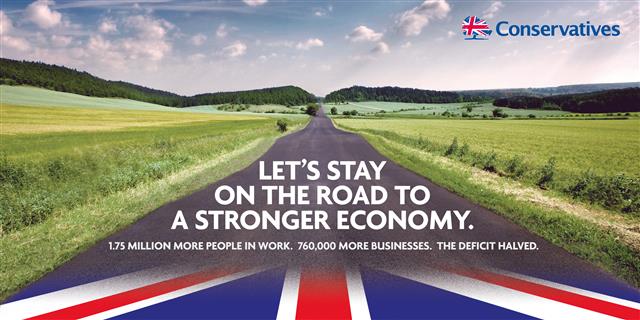
This Conservative campaign poster for the upcoming General Election is already under fire.  Why?  Because, as correctly predicted by my brother, the road in the picture is, in fact, not in Britain at all – but is in Germany, outside Weimar.

Who cares?!  I can't, for the life of me, think why this matters.  Of all the things to get worked up about, is this really the one you would pick?  It's a stock photo of a road, and it could be anywhere in the world – adverts use stock photos.  There isn't really a 'road to recovery' which you can actually drive down at all; it's a metaphor.  The manufactured outrage surrounding this is ludicrous.

What we should be looking at is the claims which the Conservative Party makes on its campaign poster.  One of the boasts they make on 'the road to recovery' is that 'the deficit is halved'.  Is it?  Fraser Nelson described in the Spectator last month why this may not be strictly accurate – and yet people are more interested in foaming at the mouth about the location of the photograph being used in the campaign!  Isn't this akin to seeing a company's advert on television and being more angry about the fact they used actors in the advert than about the possibility they may be making false claims about their product?

In politics, facts matter.  Stock images don't.  The next few months are going to get pretty ridiculous if the criticisms levelled at this Conservative 'road to recovery' poster are indicative of the level of discourse we can expect from the General Election campaign.  Let's stop worrying about these trivialities and instead subject all parties' claims and policies to the kind of proper scrutiny required to make an informed choice about who to vote for in May.

Saturday, 27 December 2014

Breakfast radio

Sitting in a van at six o'clock this morning, having traveled all night from a gig in Plymouth back to the East Midlands, I became more and more irritated by the banality and forced joviality of the presenter we were listening to on BBC Radio 1.

As this constant stream of inane babble, interspersed with regular pleas for listeners around the country to text the radio station and stick their oar in too (who actually does that, thinking 'yes, my life and what I'm doing right now are so interesting that all the other people listening to national radio will want to hear all about it'?!), seeped into my brain, I hosted my own little breakfast radio show on Twitter…

Friday, 21 November 2014

The political Richter Scale

UKIP are keen to tell us that there is a 'political earthquake' underway.  That the party is gathering momentum is not in doubt – but is it really an 'earthquake'?  No.

Last night saw Mark Reckless (re)elected as the MP for Rochester Strood, to become the second MP to be elected under the UKIP name.  His majority of close to three thousand over the Conservatives was comfortable, but not insurmountable for the Tories at a General Election, where polls show voters do tend to approach things slightly differently.  Nevertheless, it was a good victory for UKIP and they are quite understandably celebrating the result.

However, I don't believe this result is quite as momentous as the UKIP types on the news and on social media would have us believe.  Sure, it's a good result for them – but how earth-shattering really is it?

As in last month's by-election in Clacton, UKIP's candidate was a defector to the party from the Conservatives, and the incumbent MP in that seat.  Incumbency brings with it certain benefits, and when we look at other recent by-elections in Heywood & Middleton and in Newark – where UKIP have not been 'helped along' by the defection of a local MP already known to the people in the constituency – UKIP have polled fairly well, but not won the seat.  Really winning a seat is a different proposition from holding a seat (even under different party colours), and that is something UKIP are still yet to do.
What is certain, though, is that the General Election next year is looking set to be very interesting indeed!  It will be fascinating to see how UKIP fare with their 'homegrown' (for want of a better word) candidates – those dyed-in-the-wool 'Kippers who haven't crossed over from another party, taking with them a certain level of local support and a preexisting record of achievement in parliament which they can use on the campaign trail.

Personally, I think it's quite unlikely that we'll see any further defections to UKIP before the General Election.  So, when we come to May next year, UKIP candidates will stand or fall on their own merits – and although the party is on the rise, I don't think we will see the huge numbers of UKIP MPs some of their activists are hoping for.

My personal feeling is that they'll be extremely lucky to get into double figures with the number of seats they win.  That's a tremor, but is it truly an earthquake?  Not really.

Thursday, 6 November 2014

#MontyThePenguin

I've just watched the new John Lewis Christmas advert.  If you haven't seen it yet, here it is:


According to the response on my Facebook and Twitter feeds, people have actually been crying at this.  Genuinely shedding real life tears.  Can you believe that?  It's a television advert.  And you're crying at it?!  Pull yourselves together!  You'll find you get a lot less emotional watching it if you bear in mind that it's been cynically calculated to make you spend as much money as possible.

Even worse, however, is John Lewis' appropriation of Christmas.  This article in The Telegraph declares that "today sees the start of the countdown to Christmas: the launch of the John Lewis Christmas advert".  No, it doesn't.  We already have a 'countdown to Christmas' – it's called Advent, and it begins four Sundays before Christmas Day (this year, that's 30th November).  And with its traditions of lighting candles, singing songs and baking cakes, Advent is considerably more festive and more community-spirited than an unashamed attempt to squeeze more money out of consumers by tugging on their heartstrings.

I shall be expanding on this at a later time, but when my political party sweeps to power next May in a landslide election victory, our flagship policy will be to double corporation tax on any company who puts out a Christmas advert before the last week of November.  If John Lewis decide to pass that increase on to their customers, they may find their Christmas marketing campaign doesn't bring it quite so much profit any more.

Wednesday, 5 November 2014

Taylor Swift and Spotify

Taylor Swift has been much lauded for her decision to take all her music off the Spotify streaming service.  I can understand why she has, and why people think this was a good decision – but I worry that setting precedents for a music industry 'business model' is not such a good idea.

Comments like 'Taylor Swift is doing it right!' imply that other musicians, who have made different choices for their own music and their own careers, are doing it 'wrong'.  And that is not cool.  As I ruminated on Twitter earlier, one of the most exciting things about a career in music is the way everyone can do things their own way…

Friday, 10 October 2014

It's all a conspiracy!

My brother has, in the past, postulated that government agents may be engaged to combat conspiracy theories which threaten the ruling order, by inventing and disseminating fake conspiracy theories so patently ludicrous that their sheer absurdity serves to discredit the entire sphere of conspiracy theories. It’s an interesting thought. (He also reckons he might be rather good at this job - he’s probably right, but I can’t image how one would embark on such a career!)

Personally, I’ve no time for conspiracy theories, or those who propagate them. They are fascinating - and yet often so tortured and tenuous that it amazes me just how many people seem to take them seriously. In many cases, it feels as though the theory is not a conclusion reached after examining evidence but a twisting of correlations in order to fit the narrative which the theorist has already decided he wants to tell. In other words, conspiracy theorists know what they want their theory to be in advance - then they go out and look for evidence to support their hypotheses. This is the opposite of an evidence-based scientific process.

It is this dogmatic adherence to principle, often in spite of evidence, which makes me so suspicious of conspiracy theorists in general. Indeed, the absence of evidence supporting the conspiracy theorists’ stance - and sometimes even the presence of evidence directly contrary to it - is more likely to be presented as further evidence in their favour than taken as a sign to reconsider the position (ie. the lack of evidence is, in itself, ‘proof’ that something is being suppressed by ‘the establishment’).

Conspiracy theories can become almost cult-like in nature. And this is exactly why they are nonsense. Anything which has a basis in truth is not advocated solely by hysterical zealots screeching on the internet.

How many times do you see someone on Facebook posting a link to an article claiming to have uncovered some great ‘truth’ about the world in which we live, which is oh so obvious when once your eyes have been opened to it; and yet, if you comment to question the premise - not in a hostile or offensive way, but simply in the spirit of having an open debate on the topic - the original poster instantly becomes defensive, and highly personal? Anyone who can back up their position with facts doesn’t have to resort to such tactics, but is happy to enter into a reasoned discourse and present their side of the argument in a rational, logical way. Conspiracy theorists do the opposite of this, and the great irony is that these people who delight in telling the rest of us among the common herd to ‘open our eyes’ and ‘wake up’ and ‘see things for what they really are’ are actually some of the most closed-minded people one is likely to encounter.

Which is why none of what I’ve written here will make any difference to people who actually believe conspiracy theories - of that, I am certain. “Oh, but of course, you would say that. You’ve been taken in!” they will say. “Of course there’s no evidence to support conspiracy theories - it’s all been carefully removed or covered over by the ruling establishment, to keep you in the dark!” (And thus, as I’ve mentioned, a lack of evidence to support a conspiracy theory becomes, in itself, evidence supporting that conspiracy theory.) But this is precisely the problem I have with conspiracy theorists - the unwavering faith in their own agenda, the twisting of facts to suit their narrative, and the absolute point-blank refusal to countenance anything outside the confines of their own world view makes it supremely difficult to take any of what they say seriously.

Thursday, 9 October 2014

#Portmantober

Make the month of October fun/exciting/charitable/healthy/aromatic by taking part in Portmantober! Take the Portmantober challenge, and for thirty-one days find ever more annoying and self-serving ways to mash up the word ‘October’ with another word of your choosing, all in aid of charity/fun/personal development!

How to participate:

  1. Choose your word or phrase: for example, you might want to dedicate the entire month to the teachings of Swiss Philosopher Jean-Jacques Rousseau.
  2. Write a smug Facebook status informing all your friends that you’re doing ‘Jean-Jacques Roussober’ this year. (Don’t forget to include a good dollop of subtext designed to make your ‘friends’ feel bad if they don’t also join in!)
  3. Tweet with the hashtag ‘#portmantober’ at least once a day, but preferably much, much more often than that.
  4. Convince yourself you’re doing something profoundly worthwhile, while actually just being a tremendous nuisance to everyone you know (and quite a few people you don’t know).

Have fun out there, Portmantoberists!

Good by-election

Douglas Carswell - former Conservative MP for Clacton, and now UKIP candidate in today's Clacton by-election - is almost certainly going to retain his seat in Parliament, and become UKIP's first MP.  Which I find a little odd.

The thing is, voting UKIP is a protest - a kick in the teeth to the corpulent, self-serving, disinterested complacency of the political establishment.  It is a vote for change.  A vote for a different kind of politics - not for 'more of the same'.  Which is why it is a little strange, then, to cast this anti-establishment vote for somebody who, until only a few weeks ago, was as much a part of the ruling elite as any other politician in the mainstream parties.

Mr Carswell is clearly popular with the people of Clacton; at the last general election, he achieved a majority of over 12,000 votes.  But to be so disaffected with 'business as usual' in politics that you vote to maintain the status quo is a bit unusual, isn't it?

Mr Carswell's highly probable re-election in Clacton is likely to owe as much to the benefits of incumbency and local voters' familiarity with him as a candidate as it is to UKIP's rising popularity as a party.

Much more interesting, as a barometer of the political mood, will be the concurrent by-election in Heywood & Middleton.  Following the death of Labour MP Jim Dobbin in September, this is a by-election campaign with no incumbent fighting to retain the seat - it is expected that Labour will hold this constituency, but UKIP's progress here will tell us a lot more about their fortunes ahead of next year's general election than the 'coronation' of an already popular defector could ever hope to.

Wednesday, 8 October 2014

Twitter for business

If you do it right, Twitter is the perfect customer support tool for your business.  It's instant, it's convenient, it's free, it's twenty-four hours.  If you own a business, train your staff to use social media well, and it will pay dividends - and the bigger your business, the more important it is to harness the power of Twitter to keep your customers happy!

Why do I bring this up?  Well, we (as a society) are always very keen to complain about poor service - I think it's good to recognise when service is done well, too.  With that in mind…  I Tweeted about an issue I was having with Barclays' online banking, and I received a very prompt, helpful response from Barclays' official Twitter.  Simple, painless - and fixed my problem straight away.


See?  Customer service is easy!

Saturday, 4 October 2014

Don't cry for Jeremy, Argentina

One doesn't haven to be a fan of Jeremy Clarkson to condemn mob violence.  Clarkson and the Top Gear team were recently chased out of Argentina by an angry mob hurling bricks and rocks, after locals took exception to a vehicle number plate which they thought was a jibe about the Falklands War.  (The BBC denies that this was the case, and insists the number plate was purely a coincidence.)

Clarkson is a controversial figure, and not without his critics.  However, to be seeing comments on Facebook and Twitter about this incident supporting the actions of the Argentinian rioters, or even offering to supply them with more rocks to hurl at the presenter, is pretty disgraceful.


Condoning and supporting this sort of 'lynch mob' rioting is never OK.  Not even if the target is somebody you don't like.

Thursday, 14 August 2014

A-Level results

If you're collecting your A-Level results today, I hope you get the results you wanted.  If you didn't get the results you wanted, remember that isn't the end of the world - life doesn't end at eighteen years old with a piece of paper shunting you off into some inescapable backwater of boredom because you messed up in an exam.  But don't make the mistake of dismissing disappointing A-Levels as 'not worth anything anyway' either!

Every year, on A-Level results day, social media and the popular press are awash with 'celebrities' denigrating the concept of formal education.  "I didn't get any A-Levels at all, and that didn't hold me back!" says xyz famous, successful person.  "My teachers told me I didn't have any career prospects, but look at me now!" they boast.  "I never learnt to read, write, walk or tie my shoelaces, but I'm still a star!"

It's worth remembering that these people are the exceptions, not the general rule - and that their success in later life is despite their poor performance at school, not because of it.  They still had to work hard to get to where they are in life, because success doesn't happen without work - be that in school, or elsewhere.  If they imply otherwise, that is highly irresponsible of them, because it makes people think that life can be easy, and that there's no correlation between how much effort you put in and what you get out.

A poor set of A-Level results is not going to put an end to all your hopes and dreams - but an attitude of complacency which says you never needed your stupid A-Levels anyway because 'everything will work out in the end' and because people will always reward you for simply 'being you' just might.

Tuesday, 22 July 2014

A true friend

Things like this crop up in my Facebook feed from time-to-time. I hate them.


The trouble is, all those things (being broke, being a a bitch, etc.) are 'who you are'!  Or, at least, are a part of 'who you are'.  The idea that you can separate out 'who you are' from all the things you do and say and the events of your past is ludicrous.

No, the purpose of posts like this on the internet is to make the person posting them feel better about his or her own life - to say to people: "hey, if you have a problem with the way I behave, that's your fault for not being a 'true friend', and not accepting me for who I am - not my fault for being a selfish, inconsiderate, unhygienic, narcissistic knob-end! Besides, I may have all these flaws, but that's not really 'who I am', is it?"  Rubbish.


Kind-of related… I played on this track:

Monday, 21 July 2014

Equality of outrage

Following the promotion of several female MPs to the Cabinet in last week's reshuffle, criticism was heaped upon the Daily Mail* for it's coverage of the new ministers - which focussed on their clothes and general appearance, rather than their qualifications for the job and their qualities as serious politicians.


Labour MP for Bishop Auckland Helen Goodman, however, chose to Tweet this:


It does female ministers a great disservice to think they are only there to 'make up the numbers'; when a male politician is promoted, no one asks whether he has been put in that position because the Prime Minister thinks he'll be good at it, or just to keep up appearances - why should we cast these aspersions on female MPs?

When Sajid Javid was made Minister for Culture, attacks in the press focused mainly on the fact he was a former banker, rather than claiming he was only there to increase muslim representation in the cabinet instead of on his own merits - even though a look at the cultural background of someone who is in charge of culture might actually be relevant to how he might undertake the job.  It is distasteful that female politicians are still seen merely as 'window dressing'.

For those interested in more than just a female MP's clothing and appearance, this excellent Buzzfeed article goes into more detail about some of the newly promoted ministers' CVs, backgrounds, what inspires them, etc. - and aptly demonstrates that they have been put in the cabinet on merit, not purely to fulfil some quota.

A few hours later, Helen Goodman deleted her Tweet, and wrote that it had been 'intended as a lighthearted remark'.


Now, I don't really think that Helen Goodman is sexist.  If she genuinely thinks that the 'most interesting' thing about Esther McVey, Nicky Morgan, Penny Mordaunt, et al is their clothes, then that's her opinion - but I highly doubt she is in any way an enemy of women in politics.  What's remarkable is the muted response her comments received; with the exception of a few Conservative activists seeking to make hay over an opponent's blunder, I have seen very little said about this incident at all.

Imagine, if you will, what the reaction would've been to a male MP (of any party) Tweeting the same incendiary and derogatory remarks about female ministers - and then trying to pass it off as "aww, c'mon guys - it was just a joke!"  He would've been hauled over the coals.  Whether that would be the correct reaction to his comments is another matter - but he would certainly have been castigated for saying what Helen Goodman said.  Ms Goodman, on the other hand, seems to have got off fairly lightly.

The real sexism here is that people seem to be considerably less offended by Ms Goodman's Tweet than they would have been had it been posted by a male politician.  If particular comments are deemed sexist - and, therefore, unacceptable - it shouldn't matter who says them.  The equality movement are fighting the good fight for causes such as equal pay - but we won't truly achieve those goals until we have equal outrage too.

* When is criticism NOT heaped upon the Daily Mail?!

Saturday, 14 June 2014

Why I am IN

No, this isn't a Liberal Democrat party political broadcast (although if they asked me to do one, I wouldn't rule it out).  I'm talking about staying in to watch the football…

This evening - at the ungodly (to many, but to me perfectly reasonable) time of eleven o'clock - is England's first game of the 2014 FIFA World Cup.  For me, conversation about the match has dominated the past few days; discussions about tactics, possible lineups, score predictions - and about viewing arrangements on the night.  During rehearsals yesterday with one of the bands I work for, there was a keen debate about which pubs would be the best places to watch the game - there was even talk of watching it in one of the local nightclubs.  Honestly?  I can't think of anything worse.

Yes, watching the football down the pub is a typically British, typically blokey thing to do.  I just fail to see any appeal.  Is there any way in which watching the game in a pub is actually better than just watching at home?  Let's see…

Screen

Yes, most pubs are going to be showing the match on a screen significantly bigger than my TV at home.  Is this a good thing?  No.  At least, not when it will either be so high up on the wall that watching a full ninety minutes causes a permanently cricked neck for days afterwards, or positioned awkwardly behind a pillar, 'round the corner, past a group of exceedingly tall people who arrived early and positioned themselves inconsiderately close.  My television is of a perfectly adequate size for viewing officiating disasters and Wayne Rooney's missed chances, thank you very much.

Environment

At home, I can sit on a comfortable sofa, with a clear view of my quite-big-enough television; I can see everything that's going on, and I can hear all the commentary and analysis (even if I sometimes wish I couldn't).  I can have a drink or a snack without having to pay ridiculous amounts for the privilege, after queueing for twenty minutes (thus missing a large portion of the game) only to be told that the establishment's selection of whiskies is "Jack Daniels or Bells, mate."

I won't be in the lose-lose situation of having to choose between standing up all evening and enduring the agony of aching feet and having nowhere to put anything, or sitting on either a rickety and uncomfortable barstool with a partially obscured view or a marginally less rickety and uncomfortable chair with a totally obscured view.

Connectivity

Like it or not, the internet and social media have become a part of the way many people experience big global events - like a World Cup.  Personally, I like it.  I would much rather be at home where I know I have access to WiFi and charging sockets than in a pub fretting about intermittent 3G and dwindling phone battery.

Atmosphere

This is the big one.  People like going to the pub to watch the game because of the 'atmosphere' (whatever that means).  To me, it means having to share an experience I ought to enjoy with a group of loutish strangers who get steadily more drunk and more rowdy as the night wears on, in a setting where every surface is sticky, the air is hot and humid with the fetid sweat of many men, and there is a lengthy queue for basic amenities like food, drinks and toilets.

Just because I enjoy football, it does not necessarily follow that I enjoy the company of hoards of lager-swilling "white van man" types in England shirts which stretch unedifyingly over their burgeoning beer guts, each convinced he is the biggest football expert in the room and determined to shout down anyone who thinks otherwise.  Nor that I enjoy having to jostle for position just to see the lower left-hand corner of a TV screen which really needs the colour contrast adjusting; nor having beer spilt on my shoes; nor paying £3 for a packet of crisps; nor "banter".

No, I'm definitely going to stay at home to watch England - where I can actually relax and enjoy the game.