Showing posts with label the spectator. Show all posts

Sunday, 4 January 2015

The road to hell is paved with good intentions


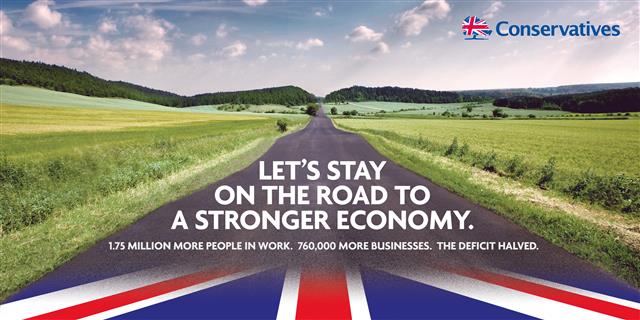
This Conservative campaign poster for the upcoming General Election is already under fire.  Why?  Because, as correctly predicted by my brother, the road in the picture is, in fact, not in Britain at all – but is in Germany, outside Weimar.

Who cares?!  I can't, for the life of me, think why this matters.  Of all the things to get worked up about, is this really the one you would pick?  It's a stock photo of a road, and it could be anywhere in the world – adverts use stock photos.  There isn't really a 'road to recovery' which you can actually drive down at all; it's a metaphor.  The manufactured outrage surrounding this is ludicrous.

What we should be looking at is the claims which the Conservative Party makes on its campaign poster.  One of the boasts they make on 'the road to recovery' is that 'the deficit is halved'.  Is it?  Fraser Nelson described in the Spectator last month why this may not be strictly accurate – and yet people are more interested in foaming at the mouth about the location of the photograph being used in the campaign!  Isn't this akin to seeing a company's advert on television and being more angry about the fact they used actors in the advert than about the possibility they may be making false claims about their product?

In politics, facts matter.  Stock images don't.  The next few months are going to get pretty ridiculous if the criticisms levelled at this Conservative 'road to recovery' poster are indicative of the level of discourse we can expect from the General Election campaign.  Let's stop worrying about these trivialities and instead subject all parties' claims and policies to the kind of proper scrutiny required to make an informed choice about who to vote for in May.

Sunday, 29 June 2014

Don't be a Glastonbully

It always makes me slightly uncomfortable to see people writing, Tweeting and whinging about the Glastonbury Festival.  The current trend, as with everything, is to disparage and mock - and I guess that's fair enough, if that's your thing.  But the sneering and snobbery can be pretty unedifying.

Brendan O'Neill makes an interesting point in The Spectator about Glastonbury's move towards regulation, green policing and health-and-safety countermanding the festival's original principals of freedom and sticking two fingers up to 'the man' - but the issue I have is with those who eschew Glastonbury because it has become 'too middle-class', or 'too corporate'.

Ignoring, for a minute, the obvious quandary of defining such 'problems' in the first place (how 'middle-class' is 'too middle-class'? And in today's complex society, what is or isn't 'middle-class' anyway?), it baffles me how people can utter such things and not consider themselves snobbish and élitist.  What people are really saying with statements like these is: "Gastonbury is not for you. We don't want these sorts of people coming 'round here!"

What would be the reaction if, for example, affluent golf club members were seen to be complaining that their club had started letting in 'the wrong class of people', and that this was ruining the atmosphere of the place?  Not good; but how is that any different, in principle, from some festival-goers' attitudes towards Glastonbury?

Surely the founding ethos of a music festival like Glastonbury is that it is an inclusive and welcoming community, and that the usual conventions of an often divisive and cut-throat society do not apply?  By denouncing Glastonbury as 'full of the wrong types of people', those expounding these views have become everything which they would normally profess to hate - élitist, classist, prejudicial snobs, looking down their noses at people for being different from them.

Saturday, 7 June 2014

Going Allsoppy

Television presenter Kirstie Allsopp has caused controversy this week by claiming that girls and young women should turn their backs on going to university and building careers in favour of finding a boyfriend and having children “by the age of twenty-seven”, in an interview with The Telegraph.

Naturally, the internet, and the world as a whole, are up-in-arms about these comments.  The idea that “a woman’s place is in the home” is outmoded - and disgracefully patronisingly.  But it is not a crime not to go to university - and it is not a crime to want to have children, even at a relatively young age; there is no ‘blueprint’ for life, and no path down which everyone must go - higher education may be the right choice for many people, but surely can never suit everyone.

Whenever someone in the public eye dares to utter anything which is not absolute orthodoxy, they are denounced as a heretic - as such, Ms. Allsopp is being held up as a symbol of misogynistic oppression.  However, she is entitled to her views - and the choices she is encouraging girls to make about their lives, whilst certainly not for everyone, are as much a valid lifestyle choice as any other.  What is wrong with a woman making a life as a stay-at-home mother - not because it is ‘her place’, but because it is her choice?

It is one of the greatest things about a free society that we are each able to choose - and to promote - the lifestyle choices which we feel best suit us.  We are not shoehorned into living a certain way, because that is ‘the way it is done’; this applies as much to pushing people towards university and high-powered careers as it does to encouraging them to stay at home and raise a family.  Surely the central message to girls of the gender equality movement is that they can be whoever they want to be - that they can make these choices for themselves, and that they don’t have to follow anyone’s dictate as to what sort of life they should lead?

Ms. Allsopp's advice certainly won't suit everyone - and, of course, people are free to heed or ignore advice from anyone, as they see fit - but to castigate her for daring to express this opinion seems (as Lara Prendergast writes in The Spectator) actually to countermand the gender equality movement.

Sunday, 11 May 2014

#Eurovision aftermath

OK, no one expects the songs in the Eurovision Song Contest to be heavyweight musical masterpieces oozing with integrity and artistic merit.  The contest has long been a showcase for Europe's lowest-common-denominator bubblegum pop music and questionable fashion choices.

That being said, even in the world of expendable cheesy pop, there are still good and bad examples of songwriting.  Unfortunately, Eurovision more often seems to give an unreasonably large platform to the latter.

My impression during the live television show last night was of an endless parade of unremarkable, instantly forgettable tunes - but it is only the day after that one realises how disposable so many of these Eurovision entries actually are.

If nothing else, pop music of this sort can at least boast irritatingly catchy chorus hooks with simple lyrics and melodies which get stuck going 'round and 'round your head, whether you want them to or not - well, usually, anyway!  However, looking back over the events of the previous night, or twenty-six songs which were performed, I can remember only a handful of them.

Interestingly, I remember the chorus to the Greek song 'Rise Up' (which also featured performers on trampolines), which came nowhere in the voting process.  I remember some parts of the Dutch song - which came second, but which I actually thought should've won.  (Even more remarkably, I actually have one mutual friend with the Netherlands' singer on Facebook.)  And I was pleased to discover that I remembered the chorus of the British entry too - despite its being rather short on words!

As for the winner - Austria's bearded lady, Conchita Wurst - only one line from the song (the crabwise sequential run into the chorus) has stuck in my mind, despite having heard it twice.  As Rod Liddle notes in The Spectator, while Conchita Wurst can certainly sing, and the Austrian song was by no means bad, it was not the best song of the evening - its extraordinarily high tally of points can be ascribed in no small part to its novelty factor.

However, rack my brains as I might, that is all of last night's musical content which I can recall.  Sure, I remember plenty of the acts' gimmicks - the Romanians' circular piano; the erotic Polish milk-churning; the Swiss whistling (Swisstling?); the Spanish singer looking like she'd just got out of the shower - but none of their actual songs.

While this slapdash approach to songwriting can work in the surreal crucible of the Eurovision Song Contest, in the real world such tracks would, in all likelihood, sink without trace.  Could it be that it's not actually as easy to write a catchy pop hit as so many people seem to think it is?

Wednesday, 30 April 2014

#Newark - what a Farage-o!

I am left somewhat bemused by the media reaction to the news that UK Independence Party leader Nigel Farage will not stand in the forthcoming parliamentary by-election in the Nottinghamshire constituency of Newark.

Always keen to jump on a Farage story, the country's political press went into a frenzy several days back over  whether the UKIP leader (currently a Member of the European Parliament) would stand in the by-election.  Having decided not to stand (rather sensibly, I think - as does Isabel Hardman in The Spectator), Farage now finds himself the subject of media taunts and jibes from politicians of other parties that he has 'bottled it'.

Well, how terribly 'playschool' that all is.  Encapsulating everything that's wrong about Britain's culture of "yah, boo!" politics, this is the equivalent of the rest of the school egging on one kid in the playground to eat worms and dirt.  That kid knows its a bad idea to eat the worms - and so do the kids gleefully trying to push him into it - but in the playground, the threat of being called 'chicken', and jeered at for being afraid, is a powerful thing indeed.

I certainly wouldn't frame myself as a UKIP supporter - but I don't think I am being unreasonable to expect our politicians and journalists to be a little more grown-up than this.