As a bit of a politics nerd (yes, I admit it), I have been looking forward to the pageantry around this referendum on Britain’s membership of the European Union. There’s something about these political events – whatever they are ultimately about – which thrills and fascinates.
The debates! The interviews! The triumphs! The cock-ups! Staying up all night eating curry and watching David Dimbleby filling time as the results slowly filter in! I love it.
But this excitement has been spoilt somewhat by those killjoys in the SNP. Ever since the Scottish people’s own referendum on their national future in September 2014, those who campaigned for Scotland to leave the UK have made it their business to ruin not just this referendum, but all referenda. Never again can we sip from the cup of a national plebiscite, without tasting the taint of Scottish nationalism.
The simple fact is that the tactics of the SNP and their supporters have changed the way that referenda in this country are fought – and, in my view, not for the better.
But in order to understand how this affects the upcoming referendum on the EU, let us first briefly examine the two key faults at the core of the way the SNP operates.
The first is that the SNP and its party machinery are seemingly unable to view politicians and activists (of any party) as individuals. This is a topic I have touched on before. The SNP is the only party in the UK whose rules actively prohibit its MPs from speaking out against party policy. There can be no ‘rebels’; no dissenters; no brave individuals who put principles before career prospects to defy the party whip. Not in the SNP.
No, the gradually dwindling numbers of SNP MPs in the House Of Commons (we all know it started out as fifty-six, but two have already been suspended by the party…) speak with one voice on every issue. All of the (almost) one-and-a-half million Scottish voters who chose the SNP at the 2015 General Election might just as well be represented in Westminster by one single person, voting on all issues according to Nicola Sturgeon’s orders. (Maybe that’s something they should look into? It might at least save a bit on Parliamentary travel expenses.)
The second is the SNP’s unshakeable belief that the only thing which really matters is Scotland’s independence. Any other political problems are subsumed by this one great issue. Tax? Health? Education? Infrastructure? It doesn’t matter what the challenges facing these policy areas – all will be solved in the blink of an eye, come Independence Day. And, until independence, there is nothing that can be done about any of them, so they may as well go hang.
These two central conceits were underlined for me recently by a conversation I had with an SNP activist while a protest march against the Trident nuclear weapons system was occurring in London. I challenged something that he wrote on Twitter about the future of Trident; his response was, weirdly, about Scotland. Apparently, I was wrong about Trident because “I didn’t understand the Scottish people”; I tried to say that I wasn’t talking about Scotland as a nation, or as a people, but that I was responding to what he had posted on the topic of nuclear missiles – but he was unable to make the distinction.
Within a few Tweets, our Nationalist friend had successfully twisted my disagreeing with one specific thing he had said about Trident into me being somehow anti- the entire country of Scotland and its population. Because no issue, and no policy, can be discussed without it inexorably transforming into The Scottish Matter. And because ‘The Scottish People’ (whose ‘mindset’ I was assured I ‘didn’t understand’) are one homogeneous groupthinking bloc, rather than over five million individuals representing a plurality of opinion across all areas of policy. Such is the SNP mentality: everything is about Scotland, always – and all Scots think alike, on every issue.
So where does this leave our European plebiscite? A referendum in this country has traditionally transcended ordinary party politics. Faced with an issue deemed to be of such burning national importance that it is not enough for our elected representatives simply to vote on our behalves in Parliament, as is normal for most day-to-day political decisions, the usual rules and ways of operating are thrown out of the window. The party whips are suspended, and the campaign is not split along party lines like at a general election. Strange alliances are forged – fractious, often, but motivated. This is not ‘politics as usual’.
The SNP, it appears, cannot understand this. The fact that the ‘Better Together’ campaign – which pushed for, and eventually won, a majority ‘No’ vote in Scotland’s independence referendum in 2014 – was supported by all three of the major UK political parties has become a standard campaigning tool for the Nationalists. That Labour (traditionally the SNP’s main opposition in Scotland) had campaigned on this issue alongside the Conservatives makes them – apparently – ‘no better than the Tories’. (And what worse insult could there possibly be, for anyone whose understanding of politics reaches no further than the end of his own nose?!)
Once again, we see how the importance of the independence debate sweeps aside all other concerns, in the eyes of the SNP faithful – that Labour and the Tories agree on Scotland’s constitutional future makes them politically identical, no matter how many other major policy areas they vehemently disagree on. “Who cares if Labour and the Conservatives disagree on far more policies than they agree on?!”, say the SNP supporters; they agree on the only one which actually matters, so they can be lumped in together for all time.
(Of course this ignores even the basic maths of a referendum. With only two possible outcomes to choose from – ‘Yes’ or ‘No’ – there is bound to be some overlap in campaigning. There are simply not enough answers on the ballot paper for all the political parties involved to have one each, so you will, at some point, inevitably find yourself on the same side as politicians who are normally your opponents. But then, figures aren’t exactly the SNP’s strong point, are they…?)
“Well, what a short-sighted, obstinate, overly simplistic view of party politics!” you might very well be thinking now. Well, yes. Exactly. And yet this pervasive, barely-literate nonsense is now shaping the way our politicians are gearing up for the referendum on the European Union.
Keen not to be tarred with the same brush as their sworn political enemies, simply because they happen to feel the same about one point of policy, MPs now seem reticent to engage in the very cross-party campaigning which makes a referendum campaign different, and worth having at all. The fear of ‘sharing a platform’ with one’s usual political enemies – and the damage this could do to one’s own political image and career in the future – is distracting from the more pressing matter of actually campaigning for the result one believes is best for the country.
If this – or any – matter is of enough significance to be put to the population as a whole to vote on, rather than being left to representatives in the Commons and the Lords, is it not also important enough to put aside party political bickering and campaign alongside whoever happens to want the same outcome as you?
In a referendum such as this, you don’t get to choose your allies – you work with whoever happens to agree with you as to the best path for the country to take. And you should reasonably expect to do so without the threat of this being held up as a stain on your character in years to come, once the referendum is over and political life has gone back to normal.
If some cabinet ministers believe Britain should remain in the EU, while other ministers feel strongly we should leave, they should be free to campaign on whichever side of the argument they wish. It is not ‘weak’ of the Prime Minister to allow his ministers this freedom – and it is not very edifying to see politicians from other parties attempting to portray him as such, choosing petty political points-scoring over the matter at hand.
And if a politician from any party finds himself by some happenstance on the same side of this debate as a politician from another party (which – as I have said – is mathematically certain to happen, given the limited number of options for campaigning), this does not suddenly make the two politicians, or their two parties, indistinguishable from each other on all matters. It would be sheer folly to suppose it did. And yet, that has been the SNP’s take on things for over two years, now – and it is a view starting to permeate the mainstream national consciousness.
I can’t help but feel sad that the SNP’s small-minded, parochial mentality is being allowed to set the agenda for a national question about which many people feel very strongly – and as a result, we are all being denied a proper referendum campaign which truly cuts across, rather than entrenches, party lines.
Showing posts with label elections. Show all posts
Showing posts with label elections. Show all posts
Sunday, 6 March 2016

Monday, 11 May 2015
Election reactions
So, it turns out that my election predictions were way off-base. But hey, whose weren't?! The exit poll, which everybody thought was so whacky and out-there it couldn't possibly be true, actually turned out instead to be rather too conservative (by which I mean not Conservative enough – note the capital 'C'), and the hung parliament which was 'a given' never materialised. Instead, the Conservatives achieved the impossible overall majority which everybody said would never happen.
It was a fascinating result – and rather a strange one. This posts details a few of my thoughts on the result, and the immediate aftermath.
It is a particularly odd phenomenon, when you consider that at the last general election the Liberal Democrats had a 23% share of the popular vote – the party's highest ever percentage, in its current guise. We voted for the Lib Dems, and the policies they espoused, in record numbers in 2010 – and then acted shocked and hurt when we actually got Lib Dems in government, enacting their policies into law.
I found it especially strange that so many of the Liberal Democrat losses were gained by the Conservative party. This suggests that the Lib Dem losses don't represent a dissatisfaction with the record of the coalition government of the last five years overall – otherwise, the Tories would have lost seats too – but a peculiar desire to 'punish' the Lib Dems for some perceived personal slight.
The Tories, on the other hand, ended up gaining seats on their 2010 total. An endorsement of their record in government, it would seem – but not one extended to their hapless coalition partners. Is this, as some pundits suggested, a result of the Lib Dems' attempts often to distance themselves from the achievements of the coalition government, and to appear as if they are 'holding their noses' to work with the Conservatives? No, I don't think so. It is much more likely to be the result of an electorate casting about for the most convenient scapegoat to turn into this election's unfortunate whipping boys.
The future of the Lib Dems remains uncertain. It is true that, since the election, several thousand people have joined the party – but I think this means much less to most people than those in 'the political bubble' think it means. I think the party will survive, though. It may take time to rebuild, but democracy this country has always had a 'liberal party' of some sort, and the Lib Dems will pick back up again, in time.
During the wrangling of the campaign, Tory scaremongering tactics involved 'warning' voters of the 'danger' of Labour forming a government propped up by the SNP – even if the Conservatives were the largest single party in the Commons. It was claimed that this government would have no mandate, and would 'lack legitimacy', but this was, of course, nonsense. The general election is a UK-wide affair, and any government which can command a Commons majority is 'legitimate' – as the Nationalists were quick to point out!
The reverse is also true, though – claims that any government not including SNP ministers would 'lack legitimacy' in Scotland are similarly ludicrous. The makeup of the House of Commons reflects the will of the entire UK electorate (to an extent!), the government formed from which then has a mandate to govern the whole of the UK. If an English constituency returns a Labour MP, and it is then the Conservatives who form a government, the voters in that Labour constituency may be a bit miffed, but they don't have the right to turn around and refuse to recognise the 'legitimacy' of the national government, based on the overall national vote. The same is true of SNP voters in Scotland.
The SNP, however, have a rather dangerous habit of conflating their party with their country. In many Nationalists' minds, the SNP is Scotland, and Scotland is the SNP. Not only does this lead to a rather nasty characterisation of Scots who vote for other parties as 'quislings' or 'traitors' (although a full 50% of Scots didn't vote SNP), but it allows Nationalists to paint criticism of the party as criticism of Scotland itself – of an entire population. This is sure to be a factor in the way the party positions itself in Westminster; any refusal to acquiesce to SNP demands will be seen as an insult to the people of Scotland.
Any attempts by the SNP to fan the flames of nationalism by claiming that not giving policy concessions to the SNP is tantamount to discrimination against, or disdain for, Scottish people in general on the part of David Cameron and his government will be as dishonourable as Cameron was being during his election campaign by stoking English nationalism in the hope that fear of the SNP setting the agenda would win him a majority in England.
I understand the temptation of this way of thinking. But, despite the scale of their victory, the SNP contingent at Westminster do not speak 'for Scotland' – they speak for the SNP, and for its (admittedly many) supporters. Rejection of SNP policy is not 'anti-Scots'; it is simply a disagreement on a point of policy.
This is especially true when you remember that SNP MPs are not allowed to deviate from the party line. The Nationalist MPs represent a particular, narrow political viewpoint, not the totality of Scottish opinion.
The response to this from the UKIP movement has been anything but gracious, however! Party activists have gone into overdrive to try and prove that the Thanet South election was 'rigged' to prevent Farage getting into parliament. Just look at the hashtag #thanetrigged on Twitter. To me, this shows a distinct lack of maturity from the party; for all that OfCom might have granted UKIP 'major party' status, they can't seem to shake off their mentality of always seeing themselves as 'victims' of 'the establishment'. For a party with only one MP, this stunningly naval-gazing attitude is simply not sustainable. After last year's European Election victory, Farage claimed that we 'hadn't heard the last of' UKIP; however, after this disappointing showing, I rather think that we have.
Not that I think we have 'heard the last' of Farage himself! He may have stood down as UKIP leader, and failed to win his seat, but I feel he will have an important rôle to play yet in the next parliament. The Conservatives' promised referendum on Britain's membership of the European Union is yet to come, and I have a feeling that those pushing for an 'out' vote will want Mr Farage to play a prominent part in their campaign. Don't be surprised to see him back in the spotlight in a year or two, debating against David Cameron (who will, of course, campaign for 'in') on television in the run-up to the referendum.
It was not a good night overall for the ungracious, self-absorbed demagogues of British politics. Nigel Farage's seat was not the only one which was supposedly 'a fix'; the British electorate, it seems, does not take too kindly to bullying – and the Respect party lost its only MP, the divisive firebrand George Galloway. After fighting a dirty, underhand campaign in Bradford West, Galloway lost his seat to Labour's Naz Shah; he may be miles from UKIP on the spectrum of political views, but the two have much in common when it comes to axe-grinding grievance-mongering.
Having first demanded a recount on the night (despite the result not being even remotely close – the Labour majority was over 11,000 votes), Galloway now says he will sue following his electoral defeat. For someone who positions himself as a champion of those oppressed by unbending, despotic régimes, Galloway is sure behaving himself like one of those despots. Unable to accept that he simply no longer has the support of the majority of people in Bradford West, there must be some shady underhand conspiracy to unseat him, and he remains determined to cling to power by any means he can find.
According to many, what democracy in the UK does need is proportional representation. The 'Fair Votes Now' campaign is gaining traction on Twitter, and with the sort of angry Facebook 'activist' who spends all day posting 'memes' of David Cameron's face captioned with "I'm going to have my woodburner modified so it will burn the limbs of poor people instead of firewood!"
I think there is a good case for reexamining the arguments for and against proportional representation. This election has thrown up some of the biggest discrepancies between voteshare and seatshare in a long, long time. It bears discussion. But unfortunately, even after this result, I simply don't think there is an appetite for electoral reform.
We had a referendum on moving to a more proportional voting system in 2011; a move that was comprehensively rejected by the electorate. I doubt it will happen (there's already one referendum scheduled for this parliament, remember!) but I think it would be interesting to see a re-run of an electoral reform referendum within the next few years.
Unfortunately for the erstwhile electoral reform campaigners, however, I think the result would be very similar to the result of the 2011 plebiscite. The ordinary British voter has very different priorities from, and nowhere near the same zeal as, the sort of person whose life's work seems to be sharing shouty, aggressive posts from 'Another Angry Voice' on Facebook.
These generalisations, however, can be (deservedly) ignored. Far worse is the much more specific nonsense about public services. "Go and make an appointment to see your doctor while you can – in five years you won't be able to!" Right. So, in five years, doctors will simply cease to exist? I doubt it. There will always be hospitals, and there will always be schools. The way they operate and the ways in which they are funded may change with time – and those changes may or not be a good thing, that is a separate debate – but they're not just going to disappear. This ridiculous hyperbole does nobody any credit.
For many who oppose the Tories, the NHS is sacred. Privatisation (of anything!) is a bogeyman which should be avoided at any cost, and fought at every opportunity. This dogmatism – this simplification into black-and-white, 'us' against 'them' – is not how politics should be. Rational arguments should win the day, and so far I have seen very few of those.
The trouble with rational arguments, though, is that they need to be substantiated. Unquantifiable platitudes – heavy on emotive rhetoric, light on any actual evidence to support their claims – are far easier. In 2020, when we have our next election, the NHS will still exist – it may be very different from how it is now, but it will still be there. And yet it will be almost impossible to hold to account all those who said it was sure to disappear entirely, because of the inherent vagaries of their amorphous, scare-mongering approach.
The arguments of the protesters (insofar as they are putting forward any coherent arguments at all) are as follows: 1) the Conservative government has no legitimacy, and does not reflect the sovereign will of the British people, because they were elected on only 37% of the total national vote share, and the makeup of the House of Commons is therefore unrepresentative of the views of the public; 2) the Conservative government will pursue policies which will be unfair, and may even be harmful to many people.
Unfortunately, these arguments don't stack up, for several reasons. The Conservative government may only have got 37% of the vote – but that is still more than any other party got. You might not like it, but that is actually how our system works; if you don't like that, that's not the fault of the party who won this election, or the party who won any other election in the era of universal suffrage. As much as you might try to dress it up as being 'angry with the system', there weren't any riots after Labour won the 2005 election with only 35% of the vote share.
Claiming (as I have seen several people on Twitter do) that David Cameron 'lost' the vote by 37% in favour to 63% against is wilful idiocy – it assumes that the only choice was 'David Cameron' or 'not David Cameron', and that everyone who didn't vote Tory can be treated as one homogeneous bloc. I have already explained why this is a very wrongheaded way to view an election, but to summarise that argument again it implies that all parties who aren't the Conservatives are the same, simply by dint of not being the Conservatives, and that the only options open to the British electorate were 'Tories' or 'not Tories'. This was not the case, and the argument falls down.
Not only that, but the argument about representation is also something of a smokescreen. Protesters claim they are angry that the makeup of parliament does not accurately reflect the electorate – however, the numbers strongly suggest that a truly representative parliament would actually be even more right-wing, based on the numbers from the vote. I doubt most of the protesters shouting 'Tory scum!' in front of Downing Street would be terribly happy about that.
(It is also interesting to note that there have been no such protests about the SNP, even though they have gained unfairly from the First Past The Post system to an even greater extent than the Tories have. The Nationalists won 50% of the vote in Scotland, but 95% of Scottish MPs are from the SNP; and yet nobody is calling this 'illegitimate' – or questioning Nicola Sturgeon's claims that Scotland voted 'overwhelmingly' for the SNP, pointing out that a 50/50 split is not 'overwhelming'. Similarly, few protesters are demanding more UKIP MPs in the House of Commons – even though, proportionally, they ought to have many more. No, this ire is reserved for the Conservatives alone; these protests are not about representation!)
What really puzzles me about the protests, though, is how thoroughly unproductive they are. It is all noise and vitriol – there are no alternatives being offered. One of the slogans of the protest has been 'Tories Out Now' – which is rather short-termist. No one has been able to tell me what happens next (and I have asked).
What if the protesters got exactly what they wanted? The Tories out. Right now. David Cameron holds a press conference this week saying he has listened to the anger of the protesters, and the arguments they've made, and he is resigning. What happens then? There are two options: a) another Prime Minister and another government are summarily imposed; or b) a second election is held.
Option a) is fundamentally undemocratic. Who would the replacement government be? The Labour party? For all that you can (disingenuously) claim that the Conservatives 'lost' the election with only 37% of the votes, the Labour party 'lost' even more badly with just 30%. But who else is there? However slim the Tory government's mandate is, it is still larger than any other party's. Furthermore, who gets to decide? If another election is not to be held, who is it who gets to decide who replaces David Cameron and the Conservatives? Why does that person, or group of people, get so much power to make such an important call? As I say, it is undemocratic – and completely unworkable.
Which leaves us with option b), the second election. That would certainly be democratic – but whether held using First Past The Post as a direct re-run of the 7th May vote, or using a more proportional system, it would quite likely turn up exactly the same result (Conservatives as the largest party). What would the protesters do then? Would they finally accept that this is the sovereign will of the people? Or would they continue protesting? Would they demand a third election? Once again, this doesn't seem workable.
The point about policies brings me back to what I was saying earlier. If you believe that Tory policies are bad, and will make Britain a worse country to live in, you need to explain why. Win people over. A lot of people – eleven million of them, in fact – said on 7th May that they liked what the Conservatives were offering. Convince them they were wrong. Calling Conservatives voters 'scum', 'murderers', and other meaninglessly hyperbolic invective only serves to alienate them more from your cause, and further entrench their Toryism (not to mention blunting the true meaning of those words, watering-down their meaning for when they truly are appropriate). How is that going to help your cause?
It was a fascinating result – and rather a strange one. This posts details a few of my thoughts on the result, and the immediate aftermath.
One of the big stories of the night was the total collapse of the Liberal Democrat vote; although leader, and former Deputy Prime Minister, Nick Clegg hung onto his seat in Sheffield Hallam, many high-profile Lib Dems defending large majorities were swept aside by a tide of truculent, ill-informed popular opinion. In all, the party lost 49 of its 57 seats in the House of Commons, leaving a total of just eight Lib Dem MPs.
It is a particularly odd phenomenon, when you consider that at the last general election the Liberal Democrats had a 23% share of the popular vote – the party's highest ever percentage, in its current guise. We voted for the Lib Dems, and the policies they espoused, in record numbers in 2010 – and then acted shocked and hurt when we actually got Lib Dems in government, enacting their policies into law.
I found it especially strange that so many of the Liberal Democrat losses were gained by the Conservative party. This suggests that the Lib Dem losses don't represent a dissatisfaction with the record of the coalition government of the last five years overall – otherwise, the Tories would have lost seats too – but a peculiar desire to 'punish' the Lib Dems for some perceived personal slight.
The Tories, on the other hand, ended up gaining seats on their 2010 total. An endorsement of their record in government, it would seem – but not one extended to their hapless coalition partners. Is this, as some pundits suggested, a result of the Lib Dems' attempts often to distance themselves from the achievements of the coalition government, and to appear as if they are 'holding their noses' to work with the Conservatives? No, I don't think so. It is much more likely to be the result of an electorate casting about for the most convenient scapegoat to turn into this election's unfortunate whipping boys.
The future of the Lib Dems remains uncertain. It is true that, since the election, several thousand people have joined the party – but I think this means much less to most people than those in 'the political bubble' think it means. I think the party will survive, though. It may take time to rebuild, but democracy this country has always had a 'liberal party' of some sort, and the Lib Dems will pick back up again, in time.
The other big shift of the night was from Labour to SNP in Scotland. The Scottish Nationalists took almost all of Scotland's Westminster seats, toppling some of the Labour campaign's biggest names in the process. I'm no fan of the SNP's policies, but I do not object to their presence in the House of Commons, when that is so clearly the will of the Scottish electorate; however, I think it's important to remember that the 'legitimacy' argument works both ways…
During the wrangling of the campaign, Tory scaremongering tactics involved 'warning' voters of the 'danger' of Labour forming a government propped up by the SNP – even if the Conservatives were the largest single party in the Commons. It was claimed that this government would have no mandate, and would 'lack legitimacy', but this was, of course, nonsense. The general election is a UK-wide affair, and any government which can command a Commons majority is 'legitimate' – as the Nationalists were quick to point out!
The reverse is also true, though – claims that any government not including SNP ministers would 'lack legitimacy' in Scotland are similarly ludicrous. The makeup of the House of Commons reflects the will of the entire UK electorate (to an extent!), the government formed from which then has a mandate to govern the whole of the UK. If an English constituency returns a Labour MP, and it is then the Conservatives who form a government, the voters in that Labour constituency may be a bit miffed, but they don't have the right to turn around and refuse to recognise the 'legitimacy' of the national government, based on the overall national vote. The same is true of SNP voters in Scotland.
The SNP, however, have a rather dangerous habit of conflating their party with their country. In many Nationalists' minds, the SNP is Scotland, and Scotland is the SNP. Not only does this lead to a rather nasty characterisation of Scots who vote for other parties as 'quislings' or 'traitors' (although a full 50% of Scots didn't vote SNP), but it allows Nationalists to paint criticism of the party as criticism of Scotland itself – of an entire population. This is sure to be a factor in the way the party positions itself in Westminster; any refusal to acquiesce to SNP demands will be seen as an insult to the people of Scotland.
Any attempts by the SNP to fan the flames of nationalism by claiming that not giving policy concessions to the SNP is tantamount to discrimination against, or disdain for, Scottish people in general on the part of David Cameron and his government will be as dishonourable as Cameron was being during his election campaign by stoking English nationalism in the hope that fear of the SNP setting the agenda would win him a majority in England.
I understand the temptation of this way of thinking. But, despite the scale of their victory, the SNP contingent at Westminster do not speak 'for Scotland' – they speak for the SNP, and for its (admittedly many) supporters. Rejection of SNP policy is not 'anti-Scots'; it is simply a disagreement on a point of policy.
This is especially true when you remember that SNP MPs are not allowed to deviate from the party line. The Nationalist MPs represent a particular, narrow political viewpoint, not the totality of Scottish opinion.
As for the SNP's supporters… Well, there may be many of them – but there aren't quite as many of them as you might think. Certainly not as many as there were UKIP supporters, and yet UKIP only returned one MP (the hugely impressive Douglas Carswell in Clacton). As a result, the 'political earthquake' promised by so many UKIP activists failed to materialise, with even leader Nigel Farage missing out on his specially chosen seat in Thanet South, sitting MP Mark Reckless losing in Rochester and Strood, and other key UKIP targets also falling to the Tories.
The response to this from the UKIP movement has been anything but gracious, however! Party activists have gone into overdrive to try and prove that the Thanet South election was 'rigged' to prevent Farage getting into parliament. Just look at the hashtag #thanetrigged on Twitter. To me, this shows a distinct lack of maturity from the party; for all that OfCom might have granted UKIP 'major party' status, they can't seem to shake off their mentality of always seeing themselves as 'victims' of 'the establishment'. For a party with only one MP, this stunningly naval-gazing attitude is simply not sustainable. After last year's European Election victory, Farage claimed that we 'hadn't heard the last of' UKIP; however, after this disappointing showing, I rather think that we have.
Not that I think we have 'heard the last' of Farage himself! He may have stood down as UKIP leader, and failed to win his seat, but I feel he will have an important rôle to play yet in the next parliament. The Conservatives' promised referendum on Britain's membership of the European Union is yet to come, and I have a feeling that those pushing for an 'out' vote will want Mr Farage to play a prominent part in their campaign. Don't be surprised to see him back in the spotlight in a year or two, debating against David Cameron (who will, of course, campaign for 'in') on television in the run-up to the referendum.
It was not a good night overall for the ungracious, self-absorbed demagogues of British politics. Nigel Farage's seat was not the only one which was supposedly 'a fix'; the British electorate, it seems, does not take too kindly to bullying – and the Respect party lost its only MP, the divisive firebrand George Galloway. After fighting a dirty, underhand campaign in Bradford West, Galloway lost his seat to Labour's Naz Shah; he may be miles from UKIP on the spectrum of political views, but the two have much in common when it comes to axe-grinding grievance-mongering.
Having first demanded a recount on the night (despite the result not being even remotely close – the Labour majority was over 11,000 votes), Galloway now says he will sue following his electoral defeat. For someone who positions himself as a champion of those oppressed by unbending, despotic régimes, Galloway is sure behaving himself like one of those despots. Unable to accept that he simply no longer has the support of the majority of people in Bradford West, there must be some shady underhand conspiracy to unseat him, and he remains determined to cling to power by any means he can find.
Galloway apparently calling for a recount. Hmmm I wonder if he campaigned for recounts in Venezuela and Gaza and Crimea...
— Tom Owolade (@owolade14) May 8, 2015
The worry now is not that Galloway's legal challenge to his election defeat will gain any traction – I doubt there are many people who won't see through this desperate attempt to sidle back into Westminster through the back door – but that he will now pop up somewhere else (rumours suggest this could be at next year's Mayoral elections in London) completely undeterred, ready to try the same poisonous, scare-mongering smear tactics. That is not what democracy in the UK needs.According to many, what democracy in the UK does need is proportional representation. The 'Fair Votes Now' campaign is gaining traction on Twitter, and with the sort of angry Facebook 'activist' who spends all day posting 'memes' of David Cameron's face captioned with "I'm going to have my woodburner modified so it will burn the limbs of poor people instead of firewood!"
I think there is a good case for reexamining the arguments for and against proportional representation. This election has thrown up some of the biggest discrepancies between voteshare and seatshare in a long, long time. It bears discussion. But unfortunately, even after this result, I simply don't think there is an appetite for electoral reform.
We had a referendum on moving to a more proportional voting system in 2011; a move that was comprehensively rejected by the electorate. I doubt it will happen (there's already one referendum scheduled for this parliament, remember!) but I think it would be interesting to see a re-run of an electoral reform referendum within the next few years.
Unfortunately for the erstwhile electoral reform campaigners, however, I think the result would be very similar to the result of the 2011 plebiscite. The ordinary British voter has very different priorities from, and nowhere near the same zeal as, the sort of person whose life's work seems to be sharing shouty, aggressive posts from 'Another Angry Voice' on Facebook.
The reaction to the result on social media has been quite startling. Those disappointed with the results have gone way beyond just being disappointed with the result. Comments such as "we have woken up in Dickensian Britain" (which I saw on Facebook) are patently rubbish – even if you do believe that the Conservatives are intent on remaking the sort of country depicted in Oliver Twist (which they're quite clearly not), that sort of change would take years to manifest itself. It wouldn't happen overnight. To suggest that you looked out of your window on the morning after the election to see soot-blackened factory chimneys belching out smoke, and barefoot street urchins clad only in scruffy rags wandering the streets is nothing short of hysterical.
These generalisations, however, can be (deservedly) ignored. Far worse is the much more specific nonsense about public services. "Go and make an appointment to see your doctor while you can – in five years you won't be able to!" Right. So, in five years, doctors will simply cease to exist? I doubt it. There will always be hospitals, and there will always be schools. The way they operate and the ways in which they are funded may change with time – and those changes may or not be a good thing, that is a separate debate – but they're not just going to disappear. This ridiculous hyperbole does nobody any credit.
Obvious hyperbole of claims Tories "dismantling welfare state" or "selling off NHS" has cry wolf effect. Means real issues don't get heard.
— Victoria Freeman (@make_trouble) May 9, 2015
For many who oppose the Tories, the NHS is sacred. Privatisation (of anything!) is a bogeyman which should be avoided at any cost, and fought at every opportunity. This dogmatism – this simplification into black-and-white, 'us' against 'them' – is not how politics should be. Rational arguments should win the day, and so far I have seen very few of those.
The trouble with rational arguments, though, is that they need to be substantiated. Unquantifiable platitudes – heavy on emotive rhetoric, light on any actual evidence to support their claims – are far easier. In 2020, when we have our next election, the NHS will still exist – it may be very different from how it is now, but it will still be there. And yet it will be almost impossible to hold to account all those who said it was sure to disappear entirely, because of the inherent vagaries of their amorphous, scare-mongering approach.
Now would be a good time for people who warned of NHS privatisation to set out some measurable predictions for us to judge them on in 2020.
— Sam Bowman (@s8mb) May 9, 2015
No, instead of rational rebuttal of Conservative policy, there have been protests and riots. There has been bitterness and shouting. There has been the desecration of memorials to women who fought for freedom in World War II. None of this achieves anything.
The arguments of the protesters (insofar as they are putting forward any coherent arguments at all) are as follows: 1) the Conservative government has no legitimacy, and does not reflect the sovereign will of the British people, because they were elected on only 37% of the total national vote share, and the makeup of the House of Commons is therefore unrepresentative of the views of the public; 2) the Conservative government will pursue policies which will be unfair, and may even be harmful to many people.
Unfortunately, these arguments don't stack up, for several reasons. The Conservative government may only have got 37% of the vote – but that is still more than any other party got. You might not like it, but that is actually how our system works; if you don't like that, that's not the fault of the party who won this election, or the party who won any other election in the era of universal suffrage. As much as you might try to dress it up as being 'angry with the system', there weren't any riots after Labour won the 2005 election with only 35% of the vote share.
Claiming (as I have seen several people on Twitter do) that David Cameron 'lost' the vote by 37% in favour to 63% against is wilful idiocy – it assumes that the only choice was 'David Cameron' or 'not David Cameron', and that everyone who didn't vote Tory can be treated as one homogeneous bloc. I have already explained why this is a very wrongheaded way to view an election, but to summarise that argument again it implies that all parties who aren't the Conservatives are the same, simply by dint of not being the Conservatives, and that the only options open to the British electorate were 'Tories' or 'not Tories'. This was not the case, and the argument falls down.
Not only that, but the argument about representation is also something of a smokescreen. Protesters claim they are angry that the makeup of parliament does not accurately reflect the electorate – however, the numbers strongly suggest that a truly representative parliament would actually be even more right-wing, based on the numbers from the vote. I doubt most of the protesters shouting 'Tory scum!' in front of Downing Street would be terribly happy about that.
(It is also interesting to note that there have been no such protests about the SNP, even though they have gained unfairly from the First Past The Post system to an even greater extent than the Tories have. The Nationalists won 50% of the vote in Scotland, but 95% of Scottish MPs are from the SNP; and yet nobody is calling this 'illegitimate' – or questioning Nicola Sturgeon's claims that Scotland voted 'overwhelmingly' for the SNP, pointing out that a 50/50 split is not 'overwhelming'. Similarly, few protesters are demanding more UKIP MPs in the House of Commons – even though, proportionally, they ought to have many more. No, this ire is reserved for the Conservatives alone; these protests are not about representation!)
What really puzzles me about the protests, though, is how thoroughly unproductive they are. It is all noise and vitriol – there are no alternatives being offered. One of the slogans of the protest has been 'Tories Out Now' – which is rather short-termist. No one has been able to tell me what happens next (and I have asked).
What if the protesters got exactly what they wanted? The Tories out. Right now. David Cameron holds a press conference this week saying he has listened to the anger of the protesters, and the arguments they've made, and he is resigning. What happens then? There are two options: a) another Prime Minister and another government are summarily imposed; or b) a second election is held.
Option a) is fundamentally undemocratic. Who would the replacement government be? The Labour party? For all that you can (disingenuously) claim that the Conservatives 'lost' the election with only 37% of the votes, the Labour party 'lost' even more badly with just 30%. But who else is there? However slim the Tory government's mandate is, it is still larger than any other party's. Furthermore, who gets to decide? If another election is not to be held, who is it who gets to decide who replaces David Cameron and the Conservatives? Why does that person, or group of people, get so much power to make such an important call? As I say, it is undemocratic – and completely unworkable.
Which leaves us with option b), the second election. That would certainly be democratic – but whether held using First Past The Post as a direct re-run of the 7th May vote, or using a more proportional system, it would quite likely turn up exactly the same result (Conservatives as the largest party). What would the protesters do then? Would they finally accept that this is the sovereign will of the people? Or would they continue protesting? Would they demand a third election? Once again, this doesn't seem workable.
The point about policies brings me back to what I was saying earlier. If you believe that Tory policies are bad, and will make Britain a worse country to live in, you need to explain why. Win people over. A lot of people – eleven million of them, in fact – said on 7th May that they liked what the Conservatives were offering. Convince them they were wrong. Calling Conservatives voters 'scum', 'murderers', and other meaninglessly hyperbolic invective only serves to alienate them more from your cause, and further entrench their Toryism (not to mention blunting the true meaning of those words, watering-down their meaning for when they truly are appropriate). How is that going to help your cause?
Thursday, 7 May 2015
A pointless prediction, and a non-endorsement
It's today. The General Election. It has come, and we still have no clue about what will actually happen. Tomorrow, I can go back to writing about Formula 1 and sandwiches. But for now, having done absolutely no polling and no research into it, here is what I think – based purely on hunches and guesswork – will happen.
There will be a hung parliament. That much is pretty obvious.
The Conservatives will be the largest party, but have no overall majority. As the incumbent Prime Minister, David Cameron will attempt to form a second coalition government with the Liberal Democrats, who will spurn him. (Obviously, that will be a very stupid move – what is the point of being in politics at all, and standing for election, if you turn down the chance to govern when it's offered you? – but that is what I think will happen; the Lib Dem membership will feel that their support suffered too much from the first coalition to risk it a second time.)
Cameron will then try to 'go it alone' heading a minority administration, surviving each Commons vote as it comes, shored up by MPs from minority parties who will go along with certain issues in return for concessions in other areas – but this will soon crumble, and Cameron won't be able to survive a vote of no confidence. Within two months, there will be a second election called – and we will get to do this all over again!
I'm probably way off the mark here. But what can you do, eh?! Whatever happens, I just hope that we have a government by Saturday morning; I want all this out of the way by Saturday so that I am free to focus on the really serious stuff – Norwich City's Play-Off Semi-Final first leg against Ipswich.
On another note, I am not going to do an endorsement of any party on this Blog. That's partly because I only get about six readers anyway, so it wouldn't make any difference, and partly because I don't feel I am in any position to tell anybody else how to vote. However, I will say that however you vote, I implore you to do so for the 'right' reasons.
If you want to vote Labour because you like their policies, or you like their local candidate, that's fine; voting Labour to 'send a message' to Rupert Murdoch, or because Katie Hopkins quipped she would 'leave the country', is stupid. Similarly, if you prefer another party over the Lib Dems, that's your call; if you would've voted Lib Dem but feel 'betrayed' by Nick Clegg, I have already explained how wrong-headed that is.
Please don't choose who to vote for out of spite. Please don't vote for a party or candidate because Russell Brand told you to. You don't have to listen to anybody else; you don't have to be ashamed of how you vote; you don't have to do what your friends, or family, or shouty Facebook acquaintances who share endless pictures of politicians' faces with made-up quotes from/about them superimposed onto the image in bold text, do. You don't have to take any notice of what the press say. You don't even have to take any notice of Bloggers like me (although I strongly suggest that you do).
Vote for whoever you honestly believe to be the best candidate in your area, or the best party nationally. But vote with your head, and in good faith. Good luck.
There will be a hung parliament. That much is pretty obvious.
The Conservatives will be the largest party, but have no overall majority. As the incumbent Prime Minister, David Cameron will attempt to form a second coalition government with the Liberal Democrats, who will spurn him. (Obviously, that will be a very stupid move – what is the point of being in politics at all, and standing for election, if you turn down the chance to govern when it's offered you? – but that is what I think will happen; the Lib Dem membership will feel that their support suffered too much from the first coalition to risk it a second time.)
Cameron will then try to 'go it alone' heading a minority administration, surviving each Commons vote as it comes, shored up by MPs from minority parties who will go along with certain issues in return for concessions in other areas – but this will soon crumble, and Cameron won't be able to survive a vote of no confidence. Within two months, there will be a second election called – and we will get to do this all over again!
I'm probably way off the mark here. But what can you do, eh?! Whatever happens, I just hope that we have a government by Saturday morning; I want all this out of the way by Saturday so that I am free to focus on the really serious stuff – Norwich City's Play-Off Semi-Final first leg against Ipswich.
On another note, I am not going to do an endorsement of any party on this Blog. That's partly because I only get about six readers anyway, so it wouldn't make any difference, and partly because I don't feel I am in any position to tell anybody else how to vote. However, I will say that however you vote, I implore you to do so for the 'right' reasons.
If you want to vote Labour because you like their policies, or you like their local candidate, that's fine; voting Labour to 'send a message' to Rupert Murdoch, or because Katie Hopkins quipped she would 'leave the country', is stupid. Similarly, if you prefer another party over the Lib Dems, that's your call; if you would've voted Lib Dem but feel 'betrayed' by Nick Clegg, I have already explained how wrong-headed that is.
Please don't choose who to vote for out of spite. Please don't vote for a party or candidate because Russell Brand told you to. You don't have to listen to anybody else; you don't have to be ashamed of how you vote; you don't have to do what your friends, or family, or shouty Facebook acquaintances who share endless pictures of politicians' faces with made-up quotes from/about them superimposed onto the image in bold text, do. You don't have to take any notice of what the press say. You don't even have to take any notice of Bloggers like me (although I strongly suggest that you do).
Vote for whoever you honestly believe to be the best candidate in your area, or the best party nationally. But vote with your head, and in good faith. Good luck.
Tuesday, 5 May 2015
This time, it's personal
But it shouldn't be.
The following image was spotted on my Facebook feed last night (I have blurred out the phone number myself, as I didn't want to be in any way a part of helping spread it):
It is unclear whether this is officially anything to do with the Green Party, or whether its appearing next to a "Vote Green" flyer is just a coincidence; I have contacted the Green Party, their leader Natalie Bennett, and their candidate in Brighton (their former leader, and only MP from the 2010 Election) Caroline Lucas for a comment on this via Twitter, but have so far had no response.
What is clear, however, is that somebody is spreading the personal phone number of the UKIP candidate in Brighton, and inciting people to use it to threaten or intimidate him (what other meaning – before anybody argues that point – of "Want to tell UKIP exactly what you think of them?" could there reasonably be?).
That's not on. That is not how democracy should work. I don't like UKIP at all, and I have found several of their activists aggressive, abusive and rude when engaging them in debate on Twitter. (In the interests of balance, I have also spoken on Twitter with a couple of UKIP activists – one of them a councillor – who were actually perfectly reasonable, decent people, who just happened to have views which differ from mine.)
But no matter how much you disagree with somebody's ideology, this kind of personal intimidation is simply beyond the pale. Spreading somebody else's personal contact details without their consent is harassment and abuse, and disliking someone's political views does not make that OK.
Whether this is the work of the Green Party, or their supporters, or just somebody working alone, if they can't separate the personal from the political then maybe they should stay out of politics entirely.
The following image was spotted on my Facebook feed last night (I have blurred out the phone number myself, as I didn't want to be in any way a part of helping spread it):
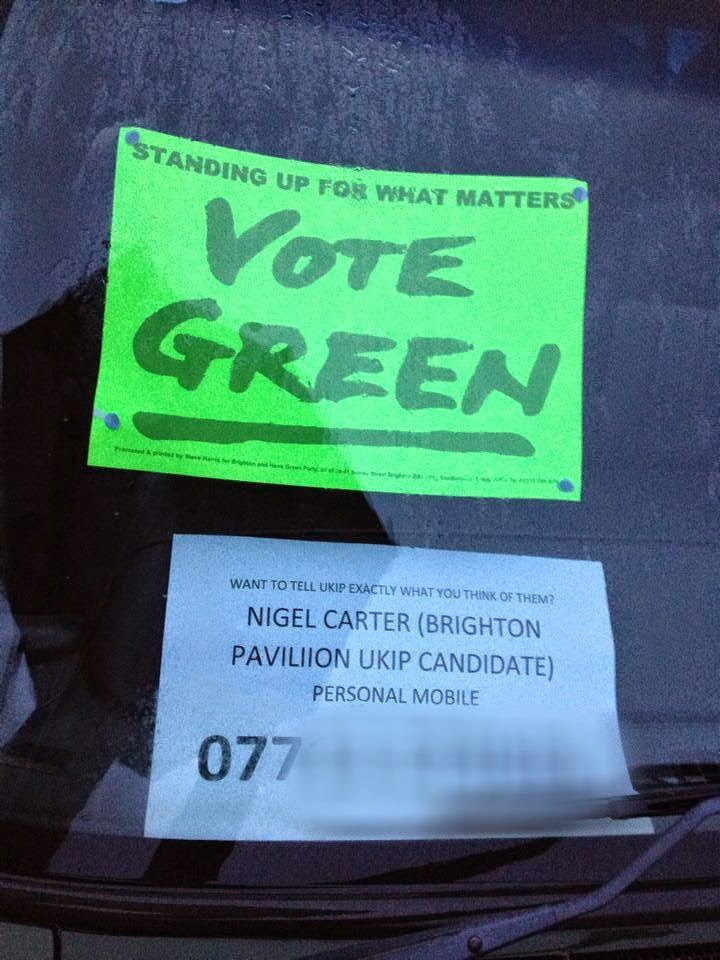 |
| Also, you misspelt 'Pavilion'. |
It is unclear whether this is officially anything to do with the Green Party, or whether its appearing next to a "Vote Green" flyer is just a coincidence; I have contacted the Green Party, their leader Natalie Bennett, and their candidate in Brighton (their former leader, and only MP from the 2010 Election) Caroline Lucas for a comment on this via Twitter, but have so far had no response.
What is clear, however, is that somebody is spreading the personal phone number of the UKIP candidate in Brighton, and inciting people to use it to threaten or intimidate him (what other meaning – before anybody argues that point – of "Want to tell UKIP exactly what you think of them?" could there reasonably be?).
That's not on. That is not how democracy should work. I don't like UKIP at all, and I have found several of their activists aggressive, abusive and rude when engaging them in debate on Twitter. (In the interests of balance, I have also spoken on Twitter with a couple of UKIP activists – one of them a councillor – who were actually perfectly reasonable, decent people, who just happened to have views which differ from mine.)
But no matter how much you disagree with somebody's ideology, this kind of personal intimidation is simply beyond the pale. Spreading somebody else's personal contact details without their consent is harassment and abuse, and disliking someone's political views does not make that OK.
Whether this is the work of the Green Party, or their supporters, or just somebody working alone, if they can't separate the personal from the political then maybe they should stay out of politics entirely.
Saturday, 2 May 2015
What's in a name?
One thing which really annoyed me when I was watching the BBC Question Time special on Thursday evening, with all three main party leaders answering questions from an audience, was the over-use of people's names.
All three party leaders did it. A question would come from an audience member called, say, Joseph. "Well, Joseph, I think that's a really good question…" David Cameron, Ed Miliband or Nick Clegg (whoever's turn it was to face the audience) would begin in response. (It always is 'a really good question', isn' it? These politicians never tell an audience member that what they've just said is an absolute load of nonsense, do they? Even when it is…)
It's a device politicians use to seem personable, reasonable, down-to-earth people who genuinely care about the people they're talking to. But it doesn't wash, because it sounds rehearsed and stilted, and is obviously something their exorbitantly expensive voice coaches have trained them to do. It is a perfect example of the polished faux-sincerity which, rather than making politicians look like 'real people', just makes them seem slimy and willing to do anything to ingratiate themselves with voters. (It is probably worth pointing out that politicians, like as not, don't actually want to do this – but they feel they have to, because there is a perception that we, the voters, want to see politicians who behave like 'ordinary people'. Even though we then crucify them for giving us what we so often seem to be telling them we want from them.)
Ed Miliband, however, took this device a step further on Thursday, though. As well as using the names of audience members whose names had already been given (either by them, or by David Dimbleby), the Labour Party leader went out of his way to find out the name of anyone else who asked him anything as well. It was obvious that the only reason he was asking for people's names before going on to answer (or, in some cases, before going on to avoid answering) their questions was so that he could shoehorn his little "I'm a nice, genuine guy, honest!" gambit in before going on to say anything of any worth.
Unfortunately, the fact that he did this – and did it so obviously, too – made him appear the opposite of genuine, decent and reasonable. He came over as someone who can't answer a straight question without relying on the 'crutch' of little pre-prepared phrases and tricks designed to make him look good. It also made him seem profoundly creepy, asking people for their names, taking an unnatural interest in them as people and constantly returning to them, repeating their full name in little idioms which had obviously been carefully worked out in advance.
I would implore all politicians to drop this faux-sincerity that makes them look like such creepy trie-hards, and instead just be genuine; actually genuine – not forced 'genuine' which has clearly been carefully rehearsed to fit certain criteria. As with any performance, you come over best when you relax, and don't try so hard to look like you really, really want to be there.
All three party leaders did it. A question would come from an audience member called, say, Joseph. "Well, Joseph, I think that's a really good question…" David Cameron, Ed Miliband or Nick Clegg (whoever's turn it was to face the audience) would begin in response. (It always is 'a really good question', isn' it? These politicians never tell an audience member that what they've just said is an absolute load of nonsense, do they? Even when it is…)
It's a device politicians use to seem personable, reasonable, down-to-earth people who genuinely care about the people they're talking to. But it doesn't wash, because it sounds rehearsed and stilted, and is obviously something their exorbitantly expensive voice coaches have trained them to do. It is a perfect example of the polished faux-sincerity which, rather than making politicians look like 'real people', just makes them seem slimy and willing to do anything to ingratiate themselves with voters. (It is probably worth pointing out that politicians, like as not, don't actually want to do this – but they feel they have to, because there is a perception that we, the voters, want to see politicians who behave like 'ordinary people'. Even though we then crucify them for giving us what we so often seem to be telling them we want from them.)
Ed Miliband, however, took this device a step further on Thursday, though. As well as using the names of audience members whose names had already been given (either by them, or by David Dimbleby), the Labour Party leader went out of his way to find out the name of anyone else who asked him anything as well. It was obvious that the only reason he was asking for people's names before going on to answer (or, in some cases, before going on to avoid answering) their questions was so that he could shoehorn his little "I'm a nice, genuine guy, honest!" gambit in before going on to say anything of any worth.
Unfortunately, the fact that he did this – and did it so obviously, too – made him appear the opposite of genuine, decent and reasonable. He came over as someone who can't answer a straight question without relying on the 'crutch' of little pre-prepared phrases and tricks designed to make him look good. It also made him seem profoundly creepy, asking people for their names, taking an unnatural interest in them as people and constantly returning to them, repeating their full name in little idioms which had obviously been carefully worked out in advance.
I would implore all politicians to drop this faux-sincerity that makes them look like such creepy trie-hards, and instead just be genuine; actually genuine – not forced 'genuine' which has clearly been carefully rehearsed to fit certain criteria. As with any performance, you come over best when you relax, and don't try so hard to look like you really, really want to be there.
Jog on, Jolyon
This is principally a post about how thunderously unimpressed I was by Jolyon Rubinstein's appearance on BBC's This Week (with Andrew Neil) on Thursday night. A self-appointed ambassador for 'young people' who claims to be a satirist speaking out against 'the establishment', Rubinstein is part of the general 'anti-politics' movement. You know the sort… Nobody speaks for me, nothing makes any difference, all politicians are bastards, there aren't any more blackcurrant ones left in my packet of Wine Gums, etc., etc., whinge, whinge.
Rubinstein's VT for This Week began with "so why did we deliver a truck full of bullshit to the Houses Of Parliament? Because Parliament's the naturally-occurring habitat of bullshit!" Yes, very droll. What an astute observation. Such biting satire.
Back on the This Week sofa, his 'go-to' trope was the invasion of Iraq in 2003. This, apparently, is why young people are so disengaged from politics. A cock-up it may have been, but I get the feeling people of my generation will still be spluttering "…but, Iraq!" as a rebuttal to any political point in another forty years. But Rubinstein and his ilk will always prefer a lazy soundbite to any informed political analysis – the latter, after all, might not fit his neat, pre-determined world view.
This was made abundantly clear when – still riffing on Iraq – Rubinstein claimed that young people today were more 'turned off' politics than ever before, and that this was the fault of politicians (who else?!) for being more sleazy, more corrupt, more dishonest and more greedy than ever before. Alan Johnson made a comparison with the Suez Crisis; Rubinstein tried to claim that this wasn't the same, because there were not "allegations that the invasion was based on a falsehood" – and in doing so, showed up his total ignorance of the subject.
This is the fundamental flaw with attempts to engage 'young people' with politics. Jolyon Rubinstein embodies the very worst of 'young people' – insular, self-absorbed and inward-looking, and utterly dismissive of anything not within his direct frame of reference. To Rubinstein, the Suez Crisis didn't count because it didn't happen to him; the Iraq invasion must have been a much worse scandal, with far more wide-reaching ramifications, because he (and other 'young people') can relate to it.
The whole time that Johnson and Michael Portillo were speaking to him (both of them making excellent, well-supported, rational points – or so I thought, anyway), Rubsinstein sat opposite rolling his eyes, looking surly and disinterested.
Rubinstein's insistence that our generation is different, is special, and has things so much harder than the generations who came before (even though, actually, the opposite is almost certainly true), and that anyone belonging to an older generation couldn't possibly know what life is like for us was just embarrassing – these are the sentiments you express when, brimming over with adolescent angst, you join your first band at the age of fifteen, wear your hair almost entirely covering your face, and write terrible, angry songs about how nobody understands you.
This arrogantly maudlin, self-indulgent wallowing might be acceptable in teenagers who know no better, but who will inevitably mature, grow out of it, and go on to write heart-rending break-up albums instead; it's pretty cringeworthy to see this proffered up on national television, masquerading as serious political commentary.
Rubinstein's VT for This Week began with "so why did we deliver a truck full of bullshit to the Houses Of Parliament? Because Parliament's the naturally-occurring habitat of bullshit!" Yes, very droll. What an astute observation. Such biting satire.
Back on the This Week sofa, his 'go-to' trope was the invasion of Iraq in 2003. This, apparently, is why young people are so disengaged from politics. A cock-up it may have been, but I get the feeling people of my generation will still be spluttering "…but, Iraq!" as a rebuttal to any political point in another forty years. But Rubinstein and his ilk will always prefer a lazy soundbite to any informed political analysis – the latter, after all, might not fit his neat, pre-determined world view.
This was made abundantly clear when – still riffing on Iraq – Rubinstein claimed that young people today were more 'turned off' politics than ever before, and that this was the fault of politicians (who else?!) for being more sleazy, more corrupt, more dishonest and more greedy than ever before. Alan Johnson made a comparison with the Suez Crisis; Rubinstein tried to claim that this wasn't the same, because there were not "allegations that the invasion was based on a falsehood" – and in doing so, showed up his total ignorance of the subject.
This is the fundamental flaw with attempts to engage 'young people' with politics. Jolyon Rubinstein embodies the very worst of 'young people' – insular, self-absorbed and inward-looking, and utterly dismissive of anything not within his direct frame of reference. To Rubinstein, the Suez Crisis didn't count because it didn't happen to him; the Iraq invasion must have been a much worse scandal, with far more wide-reaching ramifications, because he (and other 'young people') can relate to it.
The whole time that Johnson and Michael Portillo were speaking to him (both of them making excellent, well-supported, rational points – or so I thought, anyway), Rubsinstein sat opposite rolling his eyes, looking surly and disinterested.
Rubinstein's insistence that our generation is different, is special, and has things so much harder than the generations who came before (even though, actually, the opposite is almost certainly true), and that anyone belonging to an older generation couldn't possibly know what life is like for us was just embarrassing – these are the sentiments you express when, brimming over with adolescent angst, you join your first band at the age of fifteen, wear your hair almost entirely covering your face, and write terrible, angry songs about how nobody understands you.
This arrogantly maudlin, self-indulgent wallowing might be acceptable in teenagers who know no better, but who will inevitably mature, grow out of it, and go on to write heart-rending break-up albums instead; it's pretty cringeworthy to see this proffered up on national television, masquerading as serious political commentary.
Thursday, 30 April 2015
If I were Prime Minister…
In the run-up to the 2015 General Election, the Independent have been asking 100 people what they would do if they were Prime Minister. These people include journalists, authors, sportsmen, musicians, political campaigners, and the like. Obviously, I'm slightly surprised – and more than a little hurt – not to have been asked to contribute to this… So, with exactly one week to go until Polling Day, I'm going to write my piece about it anyway, and publish it here.
If I were Prime Minister, I would introduce on-the-spot fines for anybody who lets a set of double doors close in the wrong order. Y'know how lots of double doors have one door with an outer 'lip', and one with an inner 'lip', and they fit nicely together if closed correctly? I can't understand how anyone can let double doors close behind them in the wrong order and walk nonchalantly away with nary a backward glance, so I propose stamping out this cavalier behaviour with fines of up to £150.
On issues of public health, I would make it a criminal offence not to use the tongs provided at a buffet. I would also make it a criminal offence to serve buffet food without providing tongs. Either of these could elicit a jail sentence of up to six months. Further to this, it would be mandatory for all public buildings to include at least one basin with a foot-operated tap.
On education, I would ensure that university students pay twice as much for their drinks in bars and pubs as anybody else. University is a place for learning, not just a three-year-long excuse to get drunk, and students get plenty of concessions in other areas – such as clothes retailers offering student discounts, no council tax payments, and free cheeseburgers at McDonald's. I'm sure the rest of us would relish the opportunity to have a drink in a pub without a bunch of rowdy students shouting, doing 'shots' and having 'fun'.
Expanding on an idea I first proposed on this Blog several months ago, any business putting out their special Christmas-themed TV adverts or billboard advertising before the last week in November would see their corporation tax payments double as a result. There is simply no need for companies to start ramming Christmas down our throats in mid-October! While on the topic of advertising, I would ban all television adverts which anthropomorphise food.
No one would be allowed to turn right on the Ring Road; it causes far too many delays. If you want to go right, you'll have to go left, left, and left again.
I would introduce standardised flavour colours for crisp packets. It is far too confusing for some companies to make Salt'n'Vinegar packets green and Cheese'n'Onion packets blue, while other companies have Cheese'n'Onion crisps in green packets and Salt'n'Vinegar in blue ones. These guidelines will be set down by a new Minister For Crisps And Snacks, who will also be in charge of ensuring even distribution of flavours in 'Multipack' crisps (except Prawn Cocktail, because nobody likes it).
Finally, I would hold a referendum on holding a referendum on Europe. Opinion is divided on whether we should have a referendum on Britain's membership of the European Union or not, and so I believe the best and most democratic way to gauge the public mood on this matter is have a referendum on whether or not we should have the referendum – however, this would not be in any way binding upon my government.
Obviously, these proposals are just a taste of the decent, common sense policies for hardworking men and women which my government would introduce. A full copy of the UKIT Manifesto (no, that doesn't stand for anything – it's just a bit like UKIP but with my name in it instead, and much better policies) is available on request.
If I were Prime Minister, I would introduce on-the-spot fines for anybody who lets a set of double doors close in the wrong order. Y'know how lots of double doors have one door with an outer 'lip', and one with an inner 'lip', and they fit nicely together if closed correctly? I can't understand how anyone can let double doors close behind them in the wrong order and walk nonchalantly away with nary a backward glance, so I propose stamping out this cavalier behaviour with fines of up to £150.
 |
| That'll be 150 quid, mate. |
On issues of public health, I would make it a criminal offence not to use the tongs provided at a buffet. I would also make it a criminal offence to serve buffet food without providing tongs. Either of these could elicit a jail sentence of up to six months. Further to this, it would be mandatory for all public buildings to include at least one basin with a foot-operated tap.
On education, I would ensure that university students pay twice as much for their drinks in bars and pubs as anybody else. University is a place for learning, not just a three-year-long excuse to get drunk, and students get plenty of concessions in other areas – such as clothes retailers offering student discounts, no council tax payments, and free cheeseburgers at McDonald's. I'm sure the rest of us would relish the opportunity to have a drink in a pub without a bunch of rowdy students shouting, doing 'shots' and having 'fun'.
Expanding on an idea I first proposed on this Blog several months ago, any business putting out their special Christmas-themed TV adverts or billboard advertising before the last week in November would see their corporation tax payments double as a result. There is simply no need for companies to start ramming Christmas down our throats in mid-October! While on the topic of advertising, I would ban all television adverts which anthropomorphise food.
No one would be allowed to turn right on the Ring Road; it causes far too many delays. If you want to go right, you'll have to go left, left, and left again.
I would introduce standardised flavour colours for crisp packets. It is far too confusing for some companies to make Salt'n'Vinegar packets green and Cheese'n'Onion packets blue, while other companies have Cheese'n'Onion crisps in green packets and Salt'n'Vinegar in blue ones. These guidelines will be set down by a new Minister For Crisps And Snacks, who will also be in charge of ensuring even distribution of flavours in 'Multipack' crisps (except Prawn Cocktail, because nobody likes it).
Finally, I would hold a referendum on holding a referendum on Europe. Opinion is divided on whether we should have a referendum on Britain's membership of the European Union or not, and so I believe the best and most democratic way to gauge the public mood on this matter is have a referendum on whether or not we should have the referendum – however, this would not be in any way binding upon my government.
Obviously, these proposals are just a taste of the decent, common sense policies for hardworking men and women which my government would introduce. A full copy of the UKIT Manifesto (no, that doesn't stand for anything – it's just a bit like UKIP but with my name in it instead, and much better policies) is available on request.
Sunday, 26 April 2015
Aston Ham? West Villa?
Who cares?!
Obviously, fans of both Aston Villa and West Ham will care. But does it really matter which team David Cameron supports – if any?
No, of course it doesn't. But the news of the Prime Minister, who says he supports Aston Villa, mistakenly claiming to be a West Ham fan in a moment he describes as 'brain fade' has gripped the nation. Labour supporters have seized upon this with glee – Cameron doesn't even know which football team he supports! Apparently, this makes the Tory leader 'a fraud' or a 'con man'.
What utter rubbish!
The trouble is, when it comes to things like football, politicians in the UK are in a no-win situation. We (the electorate) supposedly insist that our politicians be 'normal' and 'everyday' enough to be football fans. Can you imagine the reaction if a Conservative party leader simply came out and said he wasn't a big football fan, and it just wasn't really his thing? Opponents would jump on this confession as evidence that he doesn't understand ordinary people; that he's out-of-touch; that he's 'posh'; that he can't be possibly be fit to be Prime Minister.
So, politicians who aren't that bothered by football have to pretend to be into it. And that is then held up as evidence that they are posh, out-of-touch, and don't understand ordinary people. And it also backfires on politicians who genuinely do like football (or Game Of Thrones, or Nandos, or any other aspect of modern popular culture) because people assume that they're being insincere charlatans who are only saying they like those things to appear 'normal' and win more votes.
Either David Cameron is not a football fan, but feels compelled to say his is because the fetishisation of 'normal' in politics won't let him be himself – or is actually is a football fan, but people still sneer at him for it because they assume he's putting it on to seem like a 'man of the people'. He can't win.
Ultimately, it doesn't really matter which football team the Prime Minister does – or does not – support. This whole episode simply serves to distract from what the real focus of an election campaign should be: policies. But it also demonstrates how our obsession with politicians being 'normal' is so much of what is wrong with politics in the UK.
Obviously, fans of both Aston Villa and West Ham will care. But does it really matter which team David Cameron supports – if any?
No, of course it doesn't. But the news of the Prime Minister, who says he supports Aston Villa, mistakenly claiming to be a West Ham fan in a moment he describes as 'brain fade' has gripped the nation. Labour supporters have seized upon this with glee – Cameron doesn't even know which football team he supports! Apparently, this makes the Tory leader 'a fraud' or a 'con man'.
What utter rubbish!
The trouble is, when it comes to things like football, politicians in the UK are in a no-win situation. We (the electorate) supposedly insist that our politicians be 'normal' and 'everyday' enough to be football fans. Can you imagine the reaction if a Conservative party leader simply came out and said he wasn't a big football fan, and it just wasn't really his thing? Opponents would jump on this confession as evidence that he doesn't understand ordinary people; that he's out-of-touch; that he's 'posh'; that he can't be possibly be fit to be Prime Minister.
So, politicians who aren't that bothered by football have to pretend to be into it. And that is then held up as evidence that they are posh, out-of-touch, and don't understand ordinary people. And it also backfires on politicians who genuinely do like football (or Game Of Thrones, or Nandos, or any other aspect of modern popular culture) because people assume that they're being insincere charlatans who are only saying they like those things to appear 'normal' and win more votes.
Either David Cameron is not a football fan, but feels compelled to say his is because the fetishisation of 'normal' in politics won't let him be himself – or is actually is a football fan, but people still sneer at him for it because they assume he's putting it on to seem like a 'man of the people'. He can't win.
Ultimately, it doesn't really matter which football team the Prime Minister does – or does not – support. This whole episode simply serves to distract from what the real focus of an election campaign should be: policies. But it also demonstrates how our obsession with politicians being 'normal' is so much of what is wrong with politics in the UK.
Wednesday, 22 April 2015
Is Ed's #Milifandom a force for good?
I think it's fair to say that the news of Ed Miliband having his own 'fandom' has come as a bit of a surprise to most of the politics world. While some people are content to praise the teenagers who have developed a strange obsession with the Labour leader for 'proving that young people do care about politics', and for 'helping other young people to engage', the whole thing seems to me to be rather sinister…
Started up by Twitter user '@twcuddleston', and gaining momentum and breakneck speed, the 'MiliFandom' is one of those strange, left-field phenomena which no one could ever have predicted would be filling news columns just a few weeks out from a general election. Ed Miliband having his own ‘fandom’ of adoring teenage girls would’ve seemed extraordinarily unlikely even just a couple of weeks ago – but a quick search on Twitter and an article on BuzzFeed confirm that this is in fact the case.
Personally, I have always found the ‘fandom’ concept a little odd – it is a strangely cultish attachment to an icon whose cultural significance is transient and often quite flimsy (most likely a pop star, or television programme). Ultimately, however – although these things do sometimes have a dark side – they tend to be relatively harmless; the kind of teenage obsessions many people have felt, fuelled by the passions and the certainty of youth, which subside as we progress into ever more bewildered adulthood.
When it comes to politicians, though, I’m not sure this is actually the case. Most ‘fandoms’ start out as a genuine liking for that particular thing – but this quickly morphs into besotted fanaticism where the object of the fandom’s adoration can do no wrong. This is why the most obsessive fans of pop singer Justin Bieber still leap to his defence even when he is caught drink-driving, or when he is seen on video spitting at his own fans.
From a rational, objective standpoint, this is disgraceful, indefensible behaviour and Bieber should be hauled over the coals for it; his ‘fandom’, however, make excuses for him and defend him, because their idol could never be to blame. And in doing so, members of the ‘fandom’ signal to each other what die-hard fans they truly are; somebody who enjoys Bieber’s music, but believes drink-driving is just not on, is not enough of a ‘true fan’ – the more obsessive you become about your hero, the more of a real fan you are, and the more you prove your unwavering faith to the rest of your peers in the ‘fandom’.
I don’t believe we should see politicians this way. We should respect them for taking on a difficult, often thankless, but incredibly important job – and we should give them credit when they do it well (something we currently do nowhere near enough) – but we should also view them with a healthy scepticism, not with wide-eyed adulation, or with the dogmatic devotion of religious zealots. In despotic dictatorships, political leaders demand to be worshipped; they demand unthinking praise, and total fealty even in the face of rational criticism. The cult of personality around 'the leader' in North Korea is particularly intense. In such climates, questioning a politician – or any authority – is unthinkable.
Ed Miliband has not demanded this deification – in fact, he seems slightly embarrassed by it – but it is disturbing all the same. The blinkered hero-worship of ‘fandoms’ is the antithesis of rational debate and the exchange of ideas; no matter how much it might help young people to 'engage' with 'issues', when politics becomes about the former, not the latter, we are all in trouble.
Started up by Twitter user '@twcuddleston', and gaining momentum and breakneck speed, the 'MiliFandom' is one of those strange, left-field phenomena which no one could ever have predicted would be filling news columns just a few weeks out from a general election. Ed Miliband having his own ‘fandom’ of adoring teenage girls would’ve seemed extraordinarily unlikely even just a couple of weeks ago – but a quick search on Twitter and an article on BuzzFeed confirm that this is in fact the case.
Personally, I have always found the ‘fandom’ concept a little odd – it is a strangely cultish attachment to an icon whose cultural significance is transient and often quite flimsy (most likely a pop star, or television programme). Ultimately, however – although these things do sometimes have a dark side – they tend to be relatively harmless; the kind of teenage obsessions many people have felt, fuelled by the passions and the certainty of youth, which subside as we progress into ever more bewildered adulthood.
When it comes to politicians, though, I’m not sure this is actually the case. Most ‘fandoms’ start out as a genuine liking for that particular thing – but this quickly morphs into besotted fanaticism where the object of the fandom’s adoration can do no wrong. This is why the most obsessive fans of pop singer Justin Bieber still leap to his defence even when he is caught drink-driving, or when he is seen on video spitting at his own fans.
From a rational, objective standpoint, this is disgraceful, indefensible behaviour and Bieber should be hauled over the coals for it; his ‘fandom’, however, make excuses for him and defend him, because their idol could never be to blame. And in doing so, members of the ‘fandom’ signal to each other what die-hard fans they truly are; somebody who enjoys Bieber’s music, but believes drink-driving is just not on, is not enough of a ‘true fan’ – the more obsessive you become about your hero, the more of a real fan you are, and the more you prove your unwavering faith to the rest of your peers in the ‘fandom’.
I don’t believe we should see politicians this way. We should respect them for taking on a difficult, often thankless, but incredibly important job – and we should give them credit when they do it well (something we currently do nowhere near enough) – but we should also view them with a healthy scepticism, not with wide-eyed adulation, or with the dogmatic devotion of religious zealots. In despotic dictatorships, political leaders demand to be worshipped; they demand unthinking praise, and total fealty even in the face of rational criticism. The cult of personality around 'the leader' in North Korea is particularly intense. In such climates, questioning a politician – or any authority – is unthinkable.
Ed Miliband has not demanded this deification – in fact, he seems slightly embarrassed by it – but it is disturbing all the same. The blinkered hero-worship of ‘fandoms’ is the antithesis of rational debate and the exchange of ideas; no matter how much it might help young people to 'engage' with 'issues', when politics becomes about the former, not the latter, we are all in trouble.
The myth of the 'Progressive Alliance'
The BBC's Challengers' Debate which aired last Thursday was interesting for several reasons. It was particularly strange to see Ed Miliband – remember him? 'Hopeless' or 'useless' Ed Miliband – come off surprisingly well, seeming the sanest, most serious option with the most credibility compared with the leaders of four minor, rather parochial parties.
One of the most frustrating things, however, was the evidence that the concept of a 'Progressive Alliance' – of all the parties who are even vaguely on 'the left' of British politics teaming up to work together 'for the common good' – still hasn't died the death it richly deserves.
In the UK, we live in a multi-party democratic system; something which most 'progressives' consider a good thing, and would want to increase. "Multi-party politics is here to stay!" claims the Electoral Reform Society, who say they campaign for 'a better democracy'. Why, then, do the leaders and representatives of self-professed 'progressive' parties forsake this view when push comes to shove, and instead attempt to reduce politics to a simple, binary choice between 'the Tories' and 'not the Tories'?
On the BBC debate last week, Scottish National Party leader Nicola Sturgeon made an offer to Ed Miliband, claiming she could help the Labour leader 'lock out the Tories' (a stance which is rather at odds with the SNP's earlier claims that Labour and the Conservatives are 'all the same' – if this were really the case, why would Sturgeon be happy to work with one but not with the other?). The implication of this exchange between Sturgeon and Miliband, however, is that it is actually Labour and the SNP (and the Green Party, Plaid Cymru, and anyone else who comes under the broad 'progressive' banner) who are 'the same' – simply by dint of not being the Tories.
There may be some common ground between these parties (both the SNP and Labour are advocating a 'Mansion Tax', for example), but there are fundamental differences, too. Even aside from the most obvious split between the parties – that the Labour Party is innately unionist, whilst the SNP have long campaigned for Scotland's independence – there are other issues on which the parties are divided (for example, on the renewal of the Trident Nuclear Deterrent, which Ed Miliband explicitly said he supported during last week's debate on the BBC). Add into this mix the Green Party – which might agree with the SNP on Trident, but has starkly different plans from Labour in areas such as immigration, education, and a referendum on Britain's membership of the European Union – and Plaid Cymru – who oppose welfare caps and are looking for billions more funding to devolved Wales – and we can see that the concept of the 'progressive alliance' airbrushes the heterogeneity of these different parties and their diverse aims and policies, instead assuming that anybody who doesn't vote for the Conservatives automatically dream the same dream and want the same thing.
This doesn't mean that these parties could not work together in a coalition government, or in a 'supply and confidence' voting arrangement – we have been governed for the last five years by a coalition of two parties who disagree in many areas, after all. But this is different from the suggestion that these parties are all the same because they all disagree with the Conservatives.
Indeed, on some issues, a 'progressive' party may agree more with a party on 'the right' than with their fellow left-wingers. For example, the Green Party propose to hold a referendum on Britain's rôle in the EU (although they would campaign for Britain to stay in); the Conservatives have also promised an EU referendum, but Labour (much more a natural ally of the Greens, you would think) have ruled it out. The Green Party also support scrapping the costly HS2 high-speed rail infrastructure project – another area where they align with UKIP policy instead of with their 'progressive' counterparts in the SNP, Plaid Cymru or Labour. To lump all these 'progressive' parties in together as being in agreement with each other, and as opposing the Tories, consistently and across the board, is simplistic and wrong.
It is worth remembering that, in the UK, you can only vote for a party or candidate – you cannot specifically vote against a party or candidate. It is fallacious to claim that a vote for any one party is automatically a vote against another party, and a de facto rejection of that party's stance on all issues. Any attempt to turn the UK's interesting and diverse plurality of left-wing political parties and movements into one homogeneous bloc with the same views and the same aims, therefore, is extremely facile. The 'progressive alliance' remains, I am afraid, a delusion which exists only in the minds of nerdy politics wonks obsessed with strategies and polls, and naïve left-wing student 'activists'.
One of the most frustrating things, however, was the evidence that the concept of a 'Progressive Alliance' – of all the parties who are even vaguely on 'the left' of British politics teaming up to work together 'for the common good' – still hasn't died the death it richly deserves.
In the UK, we live in a multi-party democratic system; something which most 'progressives' consider a good thing, and would want to increase. "Multi-party politics is here to stay!" claims the Electoral Reform Society, who say they campaign for 'a better democracy'. Why, then, do the leaders and representatives of self-professed 'progressive' parties forsake this view when push comes to shove, and instead attempt to reduce politics to a simple, binary choice between 'the Tories' and 'not the Tories'?
On the BBC debate last week, Scottish National Party leader Nicola Sturgeon made an offer to Ed Miliband, claiming she could help the Labour leader 'lock out the Tories' (a stance which is rather at odds with the SNP's earlier claims that Labour and the Conservatives are 'all the same' – if this were really the case, why would Sturgeon be happy to work with one but not with the other?). The implication of this exchange between Sturgeon and Miliband, however, is that it is actually Labour and the SNP (and the Green Party, Plaid Cymru, and anyone else who comes under the broad 'progressive' banner) who are 'the same' – simply by dint of not being the Tories.
There may be some common ground between these parties (both the SNP and Labour are advocating a 'Mansion Tax', for example), but there are fundamental differences, too. Even aside from the most obvious split between the parties – that the Labour Party is innately unionist, whilst the SNP have long campaigned for Scotland's independence – there are other issues on which the parties are divided (for example, on the renewal of the Trident Nuclear Deterrent, which Ed Miliband explicitly said he supported during last week's debate on the BBC). Add into this mix the Green Party – which might agree with the SNP on Trident, but has starkly different plans from Labour in areas such as immigration, education, and a referendum on Britain's membership of the European Union – and Plaid Cymru – who oppose welfare caps and are looking for billions more funding to devolved Wales – and we can see that the concept of the 'progressive alliance' airbrushes the heterogeneity of these different parties and their diverse aims and policies, instead assuming that anybody who doesn't vote for the Conservatives automatically dream the same dream and want the same thing.
This doesn't mean that these parties could not work together in a coalition government, or in a 'supply and confidence' voting arrangement – we have been governed for the last five years by a coalition of two parties who disagree in many areas, after all. But this is different from the suggestion that these parties are all the same because they all disagree with the Conservatives.
Indeed, on some issues, a 'progressive' party may agree more with a party on 'the right' than with their fellow left-wingers. For example, the Green Party propose to hold a referendum on Britain's rôle in the EU (although they would campaign for Britain to stay in); the Conservatives have also promised an EU referendum, but Labour (much more a natural ally of the Greens, you would think) have ruled it out. The Green Party also support scrapping the costly HS2 high-speed rail infrastructure project – another area where they align with UKIP policy instead of with their 'progressive' counterparts in the SNP, Plaid Cymru or Labour. To lump all these 'progressive' parties in together as being in agreement with each other, and as opposing the Tories, consistently and across the board, is simplistic and wrong.
It is worth remembering that, in the UK, you can only vote for a party or candidate – you cannot specifically vote against a party or candidate. It is fallacious to claim that a vote for any one party is automatically a vote against another party, and a de facto rejection of that party's stance on all issues. Any attempt to turn the UK's interesting and diverse plurality of left-wing political parties and movements into one homogeneous bloc with the same views and the same aims, therefore, is extremely facile. The 'progressive alliance' remains, I am afraid, a delusion which exists only in the minds of nerdy politics wonks obsessed with strategies and polls, and naïve left-wing student 'activists'.
Tuesday, 21 April 2015
Demo-crass-y
'Democracy', we are told, is a good thing. Unfortunately, it turns out most people no longer know what 'democracy' means.
According to Graeme Archer (writing today for the Daily Telegraph), a minority Labour government supported by the Scottish Nationalists would 'have no democratic legitimacy'. As Twitter user 'Primly Sable' points out, this must mean the last coalition government also 'lacked legitimacy'.
I do not like the SNP. Not one bit. But it is ludicrous to think that, if they win a significant number of Westminster seats on 7th May (as well they might!), any influence they end up having in a UK government is somehow 'illegitimate' – as if they took part in some sort of heist. Like MPs from any other party, SNP MPs are democratically elected to parliament, because that is who the voters in that constituency want to represent them. And although the SNP, or their supporters, have occasionally been guilty of this themselves (think 'postal votes' in the Scottish Independence Referendum last September!), being an advocate of democracy also means not crying 'foul!' and branding the whole system bankrupt just because you end up with a result you don't like.
It's fine not to like the government – in fact, it should be encouraged! But if that's the case, just say so, instead of hiding behind high-minded obfuscation about 'democratic legitimacy'.
According to Graeme Archer (writing today for the Daily Telegraph), a minority Labour government supported by the Scottish Nationalists would 'have no democratic legitimacy'. As Twitter user 'Primly Sable' points out, this must mean the last coalition government also 'lacked legitimacy'.
@TeleComment @graemearcher So the current government also lacks legitimacy?
— Primly Stable (@PrimlyStable) April 21, 2015
And it's true that I did see plenty of people complaining about the coalition in 2010, claiming that the government had no mandate. Phrases like "nobody voted for this government!" were very much in evidence (despite being demonstrably false). The truth is, however, not that those people genuinely believed the coalition government 'lacked legitimacy', but more that they simply didn't like the coalition government. All too often, questioning a government's mandate is simply a tactic to damage the credibility of a government you don't support.I do not like the SNP. Not one bit. But it is ludicrous to think that, if they win a significant number of Westminster seats on 7th May (as well they might!), any influence they end up having in a UK government is somehow 'illegitimate' – as if they took part in some sort of heist. Like MPs from any other party, SNP MPs are democratically elected to parliament, because that is who the voters in that constituency want to represent them. And although the SNP, or their supporters, have occasionally been guilty of this themselves (think 'postal votes' in the Scottish Independence Referendum last September!), being an advocate of democracy also means not crying 'foul!' and branding the whole system bankrupt just because you end up with a result you don't like.
It's fine not to like the government – in fact, it should be encouraged! But if that's the case, just say so, instead of hiding behind high-minded obfuscation about 'democratic legitimacy'.
Friday, 17 April 2015
Premature wrangling
If I were the leader of a political party ("ohh, if only!" I hear you say), the only thing I would 'rule out' at this stage of my campaign is ruling anything out.
I can't, for the life of me, understand our premature obsession with 'deals' and 'red lines' in the run-up to this year's General Election. It's like we all got bitten by the coalition government bug five years ago, and now we want to skip the actual business of campaigning and voting altogether so we can get straight down to the good stuff – the coalition negotiations.
The trouble is, it's very difficult to negotiate 'blind' like this. Which is why I think it so incredibly foolish for party leaders to be ruling out dealing with certain other parties already – and so irresponsible of journalists and others to try and hustle them into doing so.
You (as the leader of a political party) might well say you would never deal with party x in the event of a hung parliament – and you might very well mean it, too – but it's all a little meaningless when you don't know how many seats they're going to have after the vote, or even how many seats you're going to have! If a deal with party x then becomes your best (or only!) option, you're going to regret that you backed yourself into a corner during the campaign in order to win a cheap round of applause during a television appearance.
In 'A Scandal in Bohemia', the inimitable Sherlock Holmes famously says:
I can't, for the life of me, understand our premature obsession with 'deals' and 'red lines' in the run-up to this year's General Election. It's like we all got bitten by the coalition government bug five years ago, and now we want to skip the actual business of campaigning and voting altogether so we can get straight down to the good stuff – the coalition negotiations.
The trouble is, it's very difficult to negotiate 'blind' like this. Which is why I think it so incredibly foolish for party leaders to be ruling out dealing with certain other parties already – and so irresponsible of journalists and others to try and hustle them into doing so.
You (as the leader of a political party) might well say you would never deal with party x in the event of a hung parliament – and you might very well mean it, too – but it's all a little meaningless when you don't know how many seats they're going to have after the vote, or even how many seats you're going to have! If a deal with party x then becomes your best (or only!) option, you're going to regret that you backed yourself into a corner during the campaign in order to win a cheap round of applause during a television appearance.
In 'A Scandal in Bohemia', the inimitable Sherlock Holmes famously says:
It is a capital mistake to theorise before one has data. Insensibly one begins to twist facts to suit theories, instead of theories to suit facts.Increasingly, it seems that this is exactly what our political leaders are doing – laying the groundwork for coalition talks before they have any facts to deal with. And that, to me, seems rather daft.
Sunday, 5 April 2015
Campaign getting shirty
It shouldn't matter what politicians wear, should it? Sadly, in the modern age, such image-related issues have become the main focus of election coverage; the politics of personality – of identity – has superseded the politics of ideas in a quite alarming fashion. Which is why the BBC News website today is running a story about what shirts David Cameron, Ed Miliband and Nick Clegg have been wearing on the campaign trail.
It shouldn't matter. And yet, for some reason, it does. It matters because the strangely homogenous garb of political leaders (all three leaders have favoured a dark blue V-neck jumper over a light blue shirt, with dark jeans or trousers) is indicative of the 'no-win' situation many politicians find themselves in. What I mean by that is that politicians are always being told that we (the electorate) want to see politicians who are 'normal', and who act just like 'ordinary people' (whatever that means); they can't go out and about campaigning in a suit and tie, because 'normal people' don't go out in a suit and tie, and they need to look like they're 'one of us'. And yet when they try to look like 'one of us', we lambast them for trying to look 'normal'. Which is pretty mean of us, really.
It's also pretty stupid. This shallow vapidity distracts from the serious side of politics, and while everyone's busy laughing at the Prime Minister trying to be one of 'the kids', or the leader of the Opposition looking silly while eating a bacon sandwich, their policies – which may well be pretty ghastly – go unnoticed.
The fetishisation of 'normal' is not good for British politics. The more we force politicians to behave in the way they think we want them to, ever fearful of putting a toe wrong lest they be laughed out of office by the court of public opinion, the more homogenous and consensual politics becomes, and the less choice there is (or, at least, appears to be) between the different parties and their different leaders. And then we have the temerity to complain that all politicians are 'the same'! Maybe you think politicians are all the same – but as I have remarked before, the incessant whining of the electorate has made politics that way.
It shouldn't matter. And yet, for some reason, it does. It matters because the strangely homogenous garb of political leaders (all three leaders have favoured a dark blue V-neck jumper over a light blue shirt, with dark jeans or trousers) is indicative of the 'no-win' situation many politicians find themselves in. What I mean by that is that politicians are always being told that we (the electorate) want to see politicians who are 'normal', and who act just like 'ordinary people' (whatever that means); they can't go out and about campaigning in a suit and tie, because 'normal people' don't go out in a suit and tie, and they need to look like they're 'one of us'. And yet when they try to look like 'one of us', we lambast them for trying to look 'normal'. Which is pretty mean of us, really.
It's also pretty stupid. This shallow vapidity distracts from the serious side of politics, and while everyone's busy laughing at the Prime Minister trying to be one of 'the kids', or the leader of the Opposition looking silly while eating a bacon sandwich, their policies – which may well be pretty ghastly – go unnoticed.
'How the leaders would dress if they weren't tied to focus groups' would be an interesting feature. I reckon Ed would untuck his shirt.
— Jeremy Duns (@jeremyduns) April 5, 2015
Saturday, 4 April 2015
Reasons you shouldn't not vote Liberal Democrat
Obviously, there are plenty of valid reasons not to vote Liberal Democrat – for example, if you don't agree with any of their policies, or you prefer another party and think they'd do a better job in government – but there are also a good many people around in the run-up to the 2015 General Election claiming they won't vote Lib Dem for reasons which are, to put it politely, utterly daft. Of course, people are free to vote for whoever they want, and for whatever reasons they want – but I think it's probably worth explaining why a couple of the reasons people have for not voting Lib Dem are daft.
Nick Clegg and the Liberal Democrats betrayed their voters by going into coalition.
Let's ask a very simple question first: why do people vote for a particular political party? There can be plenty of reasons, but I would imagine that one of the main reasons for voting for a party is that you like their policies. People who voted Lib Dem in 2010, therefore, presumably wanted Nick Clegg and his party to be in government. And that is what they got.
By going into coalition, the party were not able to enact all of their manifesto pledges (more on that later), but at least some distinctive Liberal Democrat policies (a referendum on a more proportional voting system, raising the personal tax allowance threshold, equality of marriage, etc.) have become law during this parliament. If you are a supporter of the party, and believe their policies to be good for the country, even just one of their policies coming to fruition is better than none; the real 'betrayal' would've been if Clegg had had an opportunity to give his party's voters what they said (via the ballot box) they wanted, and had turned his back on it.
There is an argument that saddling Liberal Democrat voters with Tory policies which they didn't want was not worth the opportunity to deliver a few of the Liberal Democrat policies they did want, but this is based on a spurious assumption – ie. that a vote for the Lib Dems automatically counts as a vote against the Conservatives. In a two-party system, this is a more-or-less true; in the American Presidential elections, for example, where there is a straight choice between Candidate A and Candidate B it could be said that a vote for A is a vote which says 'no, I don't want B'. In the UK, where multi-party politics is on the up, this is not the case.
Our voting system only allows you to cast a vote for a candidate or party – not against a candidate or party. It is therefore disingenuous to say voting Liberal Democrat is an empirical rejection of Conservative policy. The hung parliament which was the result of the 2010 general election was a democratic result – no major party managed to convince enough of the electorate that their ideas were best for the country. The coalition government which followed was, necessarily, a compromise – but one which ensured that 59% of the electorate (36% Conservative, 23% Lib Dem) got at least some of what they had voted for.
Nick Clegg and the Liberal Democrats broke their promise(s).
Tuition fees. The thorn in the side of the Lib Dems for the past five years. During the 2010 election campaign, Nick Clegg promised that he would not raise tuition fees for university students (which at that time were capped at £3,000 per year). In government, the Tory-Lib Dem coalition raised the maximum figure to £9,000 per year. As a result, the Liberal Democrats have suffered hugely, having been seen to break their promises on the subject. However, this is false logic.
The promise – the pledge – was null and void the moment the coalition agreement was signed. When a politician promises to do something in the run-up to an election, that promise comes with a caveat – ie. that that politician is actually elected. The small print of every manifesto pledge is '…if we win a majority'. Nick Clegg didn't promise not to raise tuition fees; he promised not to raise tuition fees if the Liberal Democrats won a majority. And they didn't win a majority.
You may as well get all stroppy with the Labour party for not introducing 'legally binding guarantees for patients including the right to cancer test results within one week of referral, and a maximum eighteen weeks' wait for treatment or the offer of going private', as promised in their 2010 manifesto, as well. But Labour didn't win the 2010 election, so how could we expect them to uphold all the promises they made before it?
So even if the tuition fees increase were a bad thing (and there is plenty of evidence to show it may not be, considering that it also entailed a significant change in the way repayments are worked out after students graduate), it simply does not follow that the Lib Dems broke their promise here. A coalition government requires compromise – that much should be fairly obvious. Raising the tuition fee limit was not Liberal Democrat policy before the 2010 election, but it was Conservative party policy; in order to enact Liberal Democrat policy in other areas, Clegg must've ceded ground to the Tories on the issue of tuition fees (possibly after being shown the arithmetic in the Blog posts I have linked to above, and realising that the rise in fees would not be so bad after all). You can't expect a junior coalition partner to have things all their own way – there were always going to be areas in which Lib Dem policy would lose out to the Conservatives.
As I've said, there are perfectly valid reasons to vote for a party other than the Liberal Democrats. And that's fine. But personally, I think a General Election is too big and too important to vote for a party – or not to vote for a party – based on spite or grudges.
Nick Clegg and the Liberal Democrats betrayed their voters by going into coalition.
Let's ask a very simple question first: why do people vote for a particular political party? There can be plenty of reasons, but I would imagine that one of the main reasons for voting for a party is that you like their policies. People who voted Lib Dem in 2010, therefore, presumably wanted Nick Clegg and his party to be in government. And that is what they got.
By going into coalition, the party were not able to enact all of their manifesto pledges (more on that later), but at least some distinctive Liberal Democrat policies (a referendum on a more proportional voting system, raising the personal tax allowance threshold, equality of marriage, etc.) have become law during this parliament. If you are a supporter of the party, and believe their policies to be good for the country, even just one of their policies coming to fruition is better than none; the real 'betrayal' would've been if Clegg had had an opportunity to give his party's voters what they said (via the ballot box) they wanted, and had turned his back on it.
 |
| Image by Mark Pack (www.markpack.org.uk). |
There is an argument that saddling Liberal Democrat voters with Tory policies which they didn't want was not worth the opportunity to deliver a few of the Liberal Democrat policies they did want, but this is based on a spurious assumption – ie. that a vote for the Lib Dems automatically counts as a vote against the Conservatives. In a two-party system, this is a more-or-less true; in the American Presidential elections, for example, where there is a straight choice between Candidate A and Candidate B it could be said that a vote for A is a vote which says 'no, I don't want B'. In the UK, where multi-party politics is on the up, this is not the case.
Our voting system only allows you to cast a vote for a candidate or party – not against a candidate or party. It is therefore disingenuous to say voting Liberal Democrat is an empirical rejection of Conservative policy. The hung parliament which was the result of the 2010 general election was a democratic result – no major party managed to convince enough of the electorate that their ideas were best for the country. The coalition government which followed was, necessarily, a compromise – but one which ensured that 59% of the electorate (36% Conservative, 23% Lib Dem) got at least some of what they had voted for.
Nick Clegg and the Liberal Democrats broke their promise(s).
Tuition fees. The thorn in the side of the Lib Dems for the past five years. During the 2010 election campaign, Nick Clegg promised that he would not raise tuition fees for university students (which at that time were capped at £3,000 per year). In government, the Tory-Lib Dem coalition raised the maximum figure to £9,000 per year. As a result, the Liberal Democrats have suffered hugely, having been seen to break their promises on the subject. However, this is false logic.
The promise – the pledge – was null and void the moment the coalition agreement was signed. When a politician promises to do something in the run-up to an election, that promise comes with a caveat – ie. that that politician is actually elected. The small print of every manifesto pledge is '…if we win a majority'. Nick Clegg didn't promise not to raise tuition fees; he promised not to raise tuition fees if the Liberal Democrats won a majority. And they didn't win a majority.
You may as well get all stroppy with the Labour party for not introducing 'legally binding guarantees for patients including the right to cancer test results within one week of referral, and a maximum eighteen weeks' wait for treatment or the offer of going private', as promised in their 2010 manifesto, as well. But Labour didn't win the 2010 election, so how could we expect them to uphold all the promises they made before it?
So even if the tuition fees increase were a bad thing (and there is plenty of evidence to show it may not be, considering that it also entailed a significant change in the way repayments are worked out after students graduate), it simply does not follow that the Lib Dems broke their promise here. A coalition government requires compromise – that much should be fairly obvious. Raising the tuition fee limit was not Liberal Democrat policy before the 2010 election, but it was Conservative party policy; in order to enact Liberal Democrat policy in other areas, Clegg must've ceded ground to the Tories on the issue of tuition fees (possibly after being shown the arithmetic in the Blog posts I have linked to above, and realising that the rise in fees would not be so bad after all). You can't expect a junior coalition partner to have things all their own way – there were always going to be areas in which Lib Dem policy would lose out to the Conservatives.
As I've said, there are perfectly valid reasons to vote for a party other than the Liberal Democrats. And that's fine. But personally, I think a General Election is too big and too important to vote for a party – or not to vote for a party – based on spite or grudges.
Tuesday, 27 January 2015
Debatable, at best
I think there are now one hundred days until the General Election (I haven't bothered to count, but that's what people on Twitter are saying – and they're never wrong!), but most of the talk so far has been about the damned televised leaders' debates. The leaders' debates were a new innovation for the 2010 General Election – I have already explained why they were a bad idea then, and are still a bad idea now. But the more I hear of the debates, the more convinced I become that they not only add nothing to the election campaign, but are detrimental to democracy in general.
As I described in my post from October last year:
A seven-way debate, of course, is not impossible. But whether it's possible should not be the question we are asking here – rather, we should ask 'is it desirable?' There are several reasons why I believe it is not.
Firstly, the simple fact of the inclusion of parties who don't put up candidates across the whole of the UK – and who, therefore, necessarily only speak to a portion of the electorate – is problematic. As the broadcasters reach out to the SNP and Plaid Cymru, Northern Irish parties such as the DUP are now wondering aloud why they are not also being invited to join the debates; if the DUP (who, let's not forget, currently have more seats in the House Of Commons than either Plaid Cymru or the SNP) were invited, we would end up with a debate between eight party leaders. These debates are supposed to help voters decide how to cast their votes – how does presenting them with options at least 25% of which they couldn't possibly vote for even if they wanted to do that?
Secondly, even leaving that issue aside, I don't see how the televised debates are meant to help an undecided voter make up his or her mind. In 2010, the analysis of each leader's performance in the debates seemed to focus much more on 'body language', what colour tie each leader was wearing – and, afterwards, who had 'won' – than on the actual content of each argument. The whole process struck me as horribly superficial. With seven, or even eight, people involved instead of three, that rigmarole will be intensified further, with pundits and public discussing who stood where, who wore what, and who 'won' instead of – y'know – actual politics. That's not the way to build a thriving democratic process.
My final objection is closely related to the last one, because even before the debates have begun people are not talking about politics and policies – they are talking about the debates. They are talking about who should, or should not, be invited to the debates; what the format of the debates should be; when they should take place; whether broadcasters should 'empty chair' any leader who declines to take part… Are these the issues on which we should be focussing, with only a hundred days left before we have to decide who will be running our country for the next five years?
The more we allow the ins-and-outs of the debates to dominate the discourse leading up the election, the more we allow the superficiality of politics to take over, and the less we as voters can connect with the issues which really matter. That is not democracy, and that is why we need to consign the televised leaders' debates to the history books.
As I described in my post from October last year:
[…] this clunky, unnecessary, counter-productive political device […] has been imported from America and shoehorned into our vastly different political system with practically no alterations.
The televised leaders' debates serve to make our electoral system seem more presidential, and in doing so, diminish the link between local MPs and their constituents. They oversimplify politics in a way which doesn't serve the country at all. It's time to admit that they were a mistake in 2010, and we'll be better off without them in 2015.However, when I wrote in October, the debates were in the spotlight over the issue of whether UKIP should be included. By now, however, we have moved way past that – with UKIP's participation in the debates now seemingly a given, the latest wrangling is about whether the Green Party should also be involved, along with the nationalist parties of Plaid Cymru and the SNP.
A seven-way debate, of course, is not impossible. But whether it's possible should not be the question we are asking here – rather, we should ask 'is it desirable?' There are several reasons why I believe it is not.
Firstly, the simple fact of the inclusion of parties who don't put up candidates across the whole of the UK – and who, therefore, necessarily only speak to a portion of the electorate – is problematic. As the broadcasters reach out to the SNP and Plaid Cymru, Northern Irish parties such as the DUP are now wondering aloud why they are not also being invited to join the debates; if the DUP (who, let's not forget, currently have more seats in the House Of Commons than either Plaid Cymru or the SNP) were invited, we would end up with a debate between eight party leaders. These debates are supposed to help voters decide how to cast their votes – how does presenting them with options at least 25% of which they couldn't possibly vote for even if they wanted to do that?
Secondly, even leaving that issue aside, I don't see how the televised debates are meant to help an undecided voter make up his or her mind. In 2010, the analysis of each leader's performance in the debates seemed to focus much more on 'body language', what colour tie each leader was wearing – and, afterwards, who had 'won' – than on the actual content of each argument. The whole process struck me as horribly superficial. With seven, or even eight, people involved instead of three, that rigmarole will be intensified further, with pundits and public discussing who stood where, who wore what, and who 'won' instead of – y'know – actual politics. That's not the way to build a thriving democratic process.
My final objection is closely related to the last one, because even before the debates have begun people are not talking about politics and policies – they are talking about the debates. They are talking about who should, or should not, be invited to the debates; what the format of the debates should be; when they should take place; whether broadcasters should 'empty chair' any leader who declines to take part… Are these the issues on which we should be focussing, with only a hundred days left before we have to decide who will be running our country for the next five years?
The more we allow the ins-and-outs of the debates to dominate the discourse leading up the election, the more we allow the superficiality of politics to take over, and the less we as voters can connect with the issues which really matter. That is not democracy, and that is why we need to consign the televised leaders' debates to the history books.
Sunday, 4 January 2015
The road to hell is paved with good intentions
This Conservative campaign poster for the upcoming General Election is already under fire. Why? Because, as correctly predicted by my brother, the road in the picture is, in fact, not in Britain at all – but is in Germany, outside Weimar.
Who cares?! I can't, for the life of me, think why this matters. Of all the things to get worked up about, is this really the one you would pick? It's a stock photo of a road, and it could be anywhere in the world – adverts use stock photos. There isn't really a 'road to recovery' which you can actually drive down at all; it's a metaphor. The manufactured outrage surrounding this is ludicrous.
What we should be looking at is the claims which the Conservative Party makes on its campaign poster. One of the boasts they make on 'the road to recovery' is that 'the deficit is halved'. Is it? Fraser Nelson described in the Spectator last month why this may not be strictly accurate – and yet people are more interested in foaming at the mouth about the location of the photograph being used in the campaign! Isn't this akin to seeing a company's advert on television and being more angry about the fact they used actors in the advert than about the possibility they may be making false claims about their product?
In politics, facts matter. Stock images don't. The next few months are going to get pretty ridiculous if the criticisms levelled at this Conservative 'road to recovery' poster are indicative of the level of discourse we can expect from the General Election campaign. Let's stop worrying about these trivialities and instead subject all parties' claims and policies to the kind of proper scrutiny required to make an informed choice about who to vote for in May.
Friday, 21 November 2014
The political Richter Scale
UKIP are keen to tell us that there is a 'political earthquake' underway. That the party is gathering momentum is not in doubt – but is it really an 'earthquake'? No.
Last night saw Mark Reckless (re)elected as the MP for Rochester Strood, to become the second MP to be elected under the UKIP name. His majority of close to three thousand over the Conservatives was comfortable, but not insurmountable for the Tories at a General Election, where polls show voters do tend to approach things slightly differently. Nevertheless, it was a good victory for UKIP and they are quite understandably celebrating the result.
However, I don't believe this result is quite as momentous as the UKIP types on the news and on social media would have us believe. Sure, it's a good result for them – but how earth-shattering really is it?
As in last month's by-election in Clacton, UKIP's candidate was a defector to the party from the Conservatives, and the incumbent MP in that seat. Incumbency brings with it certain benefits, and when we look at other recent by-elections in Heywood & Middleton and in Newark – where UKIP have not been 'helped along' by the defection of a local MP already known to the people in the constituency – UKIP have polled fairly well, but not won the seat. Really winning a seat is a different proposition from holding a seat (even under different party colours), and that is something UKIP are still yet to do.
Personally, I think it's quite unlikely that we'll see any further defections to UKIP before the General Election. So, when we come to May next year, UKIP candidates will stand or fall on their own merits – and although the party is on the rise, I don't think we will see the huge numbers of UKIP MPs some of their activists are hoping for.
My personal feeling is that they'll be extremely lucky to get into double figures with the number of seats they win. That's a tremor, but is it truly an earthquake? Not really.
Last night saw Mark Reckless (re)elected as the MP for Rochester Strood, to become the second MP to be elected under the UKIP name. His majority of close to three thousand over the Conservatives was comfortable, but not insurmountable for the Tories at a General Election, where polls show voters do tend to approach things slightly differently. Nevertheless, it was a good victory for UKIP and they are quite understandably celebrating the result.
However, I don't believe this result is quite as momentous as the UKIP types on the news and on social media would have us believe. Sure, it's a good result for them – but how earth-shattering really is it?
As in last month's by-election in Clacton, UKIP's candidate was a defector to the party from the Conservatives, and the incumbent MP in that seat. Incumbency brings with it certain benefits, and when we look at other recent by-elections in Heywood & Middleton and in Newark – where UKIP have not been 'helped along' by the defection of a local MP already known to the people in the constituency – UKIP have polled fairly well, but not won the seat. Really winning a seat is a different proposition from holding a seat (even under different party colours), and that is something UKIP are still yet to do.
the people of #RochesterAndStrood have spoken. They have said: “we told you before that we wanted this guy, why are you asking us again?!”
— Kit Marsden (@manek43509) November 21, 2014
What is certain, though, is that the General Election next year is looking set to be very interesting indeed! It will be fascinating to see how UKIP fare with their 'homegrown' (for want of a better word) candidates – those dyed-in-the-wool 'Kippers who haven't crossed over from another party, taking with them a certain level of local support and a preexisting record of achievement in parliament which they can use on the campaign trail.Personally, I think it's quite unlikely that we'll see any further defections to UKIP before the General Election. So, when we come to May next year, UKIP candidates will stand or fall on their own merits – and although the party is on the rise, I don't think we will see the huge numbers of UKIP MPs some of their activists are hoping for.
My personal feeling is that they'll be extremely lucky to get into double figures with the number of seats they win. That's a tremor, but is it truly an earthquake? Not really.
Thursday, 6 November 2014
#MontyThePenguin
I've just watched the new John Lewis Christmas advert. If you haven't seen it yet, here it is:
According to the response on my Facebook and Twitter feeds, people have actually been crying at this. Genuinely shedding real life tears. Can you believe that? It's a television advert. And you're crying at it?! Pull yourselves together! You'll find you get a lot less emotional watching it if you bear in mind that it's been cynically calculated to make you spend as much money as possible.
Even worse, however, is John Lewis' appropriation of Christmas. This article in The Telegraph declares that "today sees the start of the countdown to Christmas: the launch of the John Lewis Christmas advert". No, it doesn't. We already have a 'countdown to Christmas' – it's called Advent, and it begins four Sundays before Christmas Day (this year, that's 30th November). And with its traditions of lighting candles, singing songs and baking cakes, Advent is considerably more festive and more community-spirited than an unashamed attempt to squeeze more money out of consumers by tugging on their heartstrings.
I shall be expanding on this at a later time, but when my political party sweeps to power next May in a landslide election victory, our flagship policy will be to double corporation tax on any company who puts out a Christmas advert before the last week of November. If John Lewis decide to pass that increase on to their customers, they may find their Christmas marketing campaign doesn't bring it quite so much profit any more.
According to the response on my Facebook and Twitter feeds, people have actually been crying at this. Genuinely shedding real life tears. Can you believe that? It's a television advert. And you're crying at it?! Pull yourselves together! You'll find you get a lot less emotional watching it if you bear in mind that it's been cynically calculated to make you spend as much money as possible.
Even worse, however, is John Lewis' appropriation of Christmas. This article in The Telegraph declares that "today sees the start of the countdown to Christmas: the launch of the John Lewis Christmas advert". No, it doesn't. We already have a 'countdown to Christmas' – it's called Advent, and it begins four Sundays before Christmas Day (this year, that's 30th November). And with its traditions of lighting candles, singing songs and baking cakes, Advent is considerably more festive and more community-spirited than an unashamed attempt to squeeze more money out of consumers by tugging on their heartstrings.
I shall be expanding on this at a later time, but when my political party sweeps to power next May in a landslide election victory, our flagship policy will be to double corporation tax on any company who puts out a Christmas advert before the last week of November. If John Lewis decide to pass that increase on to their customers, they may find their Christmas marketing campaign doesn't bring it quite so much profit any more.
Monday, 13 October 2014
Throw away your television
As Douglas Carswell returns to parliament today as the first ever UKIP MP to be elected to the House Of Commons, the issue of whether UKIP leader Nigel Farage should appear in the party leaders' television debates in the run up to next year's general election is once again in the spotlight.
It's easy to think there's no simple answer to this conundrum. Some people say the debates should be restricted to those party leaders who have a realistic chance of becoming the next Prime Minister - in which case, should Liberal Democrat leader Nick Clegg even be included, since the next Prime Minister is likely to be either David Cameron or Ed Miliband? Other people, however, say that UKIP have a right to be included, now that they have parliamentary representation, and can therefore claim to be a serious political movement - but in that case, shouldn't the Green Party, who've been represented in the Commons by Caroline Lucas since 2010, also be involved? And how about parties like Plaid Cymru, the SNP, the DUP, etc. - all of whom have more MPs sitting in Westminster than either UKIP or the Greens?
However, there is a simple answer, and it is this: scrap the television debates.
That's right. Let's get rid of this clunky, unnecessary, counter-productive political device which has been imported from America and shoehorned into our vastly different political system with practically no alterations.
In America, voters have a straight choice between candidate this guy and candidate that guy - the television debates can help to set out the difference between each candidate's vision, and allow people to make a more informed choice when they go to vote. Here in the UK, we have a multi-party parliamentary system; very few of the people watching the debates will actually be voting for David Cameron, Ed Miliband, Nick Clegg or Nigel Farage - and with many parties competing for representation in the House Of Commons, looking to influence policy, the choice facing British voters is not a simple 'this or that' decision.
The televised leaders' debates serve to make our electoral system seem more presidential, and in doing so, diminish the link between local MPs and their constituents. They oversimplify politics in a way which doesn't serve the country at all. It's time to admit that they were a mistake in 2010, and we'll be better off without them in 2015.
As for UKIP…? They have one narrative - an attempt to frame political discourse as a simple case of UKIP and their supporters against the world (because all the other political parties are the same), and whether they are involved in the television debates or not, this too will be twisted to fit this narrative.
Exclusion from the debates will prove that UKIP are victims of an 'establishment' conspiracy to keep them down - whilst inclusion will give Mr Farage the chance to show how the other party leaders are all 'ganging up' on him, proving that there's no difference between the main parties, and that UKIP is the only credible alternative to a Westminster consensus which is only looking out for itself and not the interests of the country at large. Once again, we're better off without the debates altogether.
It's easy to think there's no simple answer to this conundrum. Some people say the debates should be restricted to those party leaders who have a realistic chance of becoming the next Prime Minister - in which case, should Liberal Democrat leader Nick Clegg even be included, since the next Prime Minister is likely to be either David Cameron or Ed Miliband? Other people, however, say that UKIP have a right to be included, now that they have parliamentary representation, and can therefore claim to be a serious political movement - but in that case, shouldn't the Green Party, who've been represented in the Commons by Caroline Lucas since 2010, also be involved? And how about parties like Plaid Cymru, the SNP, the DUP, etc. - all of whom have more MPs sitting in Westminster than either UKIP or the Greens?
However, there is a simple answer, and it is this: scrap the television debates.
That's right. Let's get rid of this clunky, unnecessary, counter-productive political device which has been imported from America and shoehorned into our vastly different political system with practically no alterations.
In America, voters have a straight choice between candidate this guy and candidate that guy - the television debates can help to set out the difference between each candidate's vision, and allow people to make a more informed choice when they go to vote. Here in the UK, we have a multi-party parliamentary system; very few of the people watching the debates will actually be voting for David Cameron, Ed Miliband, Nick Clegg or Nigel Farage - and with many parties competing for representation in the House Of Commons, looking to influence policy, the choice facing British voters is not a simple 'this or that' decision.
The televised leaders' debates serve to make our electoral system seem more presidential, and in doing so, diminish the link between local MPs and their constituents. They oversimplify politics in a way which doesn't serve the country at all. It's time to admit that they were a mistake in 2010, and we'll be better off without them in 2015.
As for UKIP…? They have one narrative - an attempt to frame political discourse as a simple case of UKIP and their supporters against the world (because all the other political parties are the same), and whether they are involved in the television debates or not, this too will be twisted to fit this narrative.
Exclusion from the debates will prove that UKIP are victims of an 'establishment' conspiracy to keep them down - whilst inclusion will give Mr Farage the chance to show how the other party leaders are all 'ganging up' on him, proving that there's no difference between the main parties, and that UKIP is the only credible alternative to a Westminster consensus which is only looking out for itself and not the interests of the country at large. Once again, we're better off without the debates altogether.
Thursday, 9 October 2014
Good by-election
Douglas Carswell - former Conservative MP for Clacton, and now UKIP candidate in today's Clacton by-election - is almost certainly going to retain his seat in Parliament, and become UKIP's first MP. Which I find a little odd.
The thing is, voting UKIP is a protest - a kick in the teeth to the corpulent, self-serving, disinterested complacency of the political establishment. It is a vote for change. A vote for a different kind of politics - not for 'more of the same'. Which is why it is a little strange, then, to cast this anti-establishment vote for somebody who, until only a few weeks ago, was as much a part of the ruling elite as any other politician in the mainstream parties.
Mr Carswell is clearly popular with the people of Clacton; at the last general election, he achieved a majority of over 12,000 votes. But to be so disaffected with 'business as usual' in politics that you vote to maintain the status quo is a bit unusual, isn't it?
Mr Carswell's highly probable re-election in Clacton is likely to owe as much to the benefits of incumbency and local voters' familiarity with him as a candidate as it is to UKIP's rising popularity as a party.
Much more interesting, as a barometer of the political mood, will be the concurrent by-election in Heywood & Middleton. Following the death of Labour MP Jim Dobbin in September, this is a by-election campaign with no incumbent fighting to retain the seat - it is expected that Labour will hold this constituency, but UKIP's progress here will tell us a lot more about their fortunes ahead of next year's general election than the 'coronation' of an already popular defector could ever hope to.
the curious thing about voting for a #UKIP defector is that you are supporting continuation because you are fed up of the status quo.
— Kit Marsden (@manek43509) October 9, 2014
The thing is, voting UKIP is a protest - a kick in the teeth to the corpulent, self-serving, disinterested complacency of the political establishment. It is a vote for change. A vote for a different kind of politics - not for 'more of the same'. Which is why it is a little strange, then, to cast this anti-establishment vote for somebody who, until only a few weeks ago, was as much a part of the ruling elite as any other politician in the mainstream parties.
Mr Carswell is clearly popular with the people of Clacton; at the last general election, he achieved a majority of over 12,000 votes. But to be so disaffected with 'business as usual' in politics that you vote to maintain the status quo is a bit unusual, isn't it?
Mr Carswell's highly probable re-election in Clacton is likely to owe as much to the benefits of incumbency and local voters' familiarity with him as a candidate as it is to UKIP's rising popularity as a party.
Much more interesting, as a barometer of the political mood, will be the concurrent by-election in Heywood & Middleton. Following the death of Labour MP Jim Dobbin in September, this is a by-election campaign with no incumbent fighting to retain the seat - it is expected that Labour will hold this constituency, but UKIP's progress here will tell us a lot more about their fortunes ahead of next year's general election than the 'coronation' of an already popular defector could ever hope to.
Subscribe to:
Posts (Atom)