Earlier this week, I read a remark on Twitter about how long it seems to be taking for the post-election Tory-DUP voting arrangement to be agreed. The poster mused that if we were in the same situation with a proposed deal between Labour and the SNP dragging on and on – leaving the country effectively without a stable government in the meantime – the press would be all over it! I think he's right, and I think the Tories are being given far more leeway on this matter than Labour would be afforded in similar circumstances.
But the implied conclusion – that our media (and our society) harbours an inherent bias towards the Conservatives – doesn't really hold water, for me. What we are seeing here is not an intentional skewing of the playing field, or weighting of the dice, but simply the potency of our own preconceptions.
Reputations are powerful things. The general perception of the Tories is that they are competent and efficient governors, and utterly heartless bastards. You have only to look at the reactions to the Conservative Party manifesto last month to see how this impacts on reporting; by and large, they get away with including no costing details for their policies at all, because it is assumed that they're Tories so they know what they're doing with money – whilst they get hammered in the press for even the slightest hint of heartlessness and bastardness, like the so-called 'dementia tax' (the intentions of which were actually rather more noble than you think – to reduce intergenerational inequality).
On the other side of the coin, Labour have so much farther to go to prove themselves fiscally responsible, thanks to an ingrained reputation for profligacy (which, it can be argued, has not always been entirely deserved). And yet, Labour politicians can get away with some things their Conservative counterparts could never hope to…
I am constantly baffled, for example, how the odious Labour MP John McDonnell has managed to remain in the senior job of Shadow Chancellor for as long as he has. McDonnell is a thug and a bully who not only makes excuses for violence and rioting, but actively praises and encourages it. He is to the left what Tommy Robinson is to the right – and I know beyond doubt that he would not be able to stay in such a high-ranking position within the party if he were Conservative, rather than a Labour MP.
But McDonnell is Labour. They're the nice ones, right? Not great with money, maybe – but they mean well, and at least they care about people… So his inflammatory rhetoric and his incitements to violence – his descriptions of recent riots in London as 'the best of our movement' – are given a pass, when they surely would not be if they came from a right-winger.
McDonnell's recent calls for a 'Day Of Rage' and for 'a million people on the streets' to force out the government are dog whistles to violence and insurrection; the term 'Day Of Rage' is even borrowed from his boss Jeremy Corbyn's 'friends' in Hamas.
Controversial right-wing broadcaster Katie Hopkins (deservedly) lost her job at LBC radio after tweeting about jihadist terrorism using the phrase 'final solution' – an expression synonymous with the atrocities of Nazi Germany and the Holocaust. But Labour's Shadow Chancellor can employ the vernacular of an organisation designated on the EU's terrorism blacklist – whose constitution, until earlier this year, explicitly called for jihad and the killing of jews – and not even be asked to apologise.
McDonnell's 'joke' about Esther McVey – 'Why aren't we lynching the bitch?' – during a former election campaign, for which he refused to apologise, was condemned by prominent members of his own party as 'atrocious' 'misogynistic' 'vitriol'. This alone would've been enough to see a Tory MP forced to resign his position; the Shadow Chancellor escapes with barely a scratch, yet again.
By any reasonable assessment, John McDonnell is a truly nasty piece of work. The fact that he is still allowed to retain a high-profile shadow cabinet job – even after all his incitements to rioting and 'lynching', and using the language of terrorists – is testament to the strength of people's perceptions of Labour politicians – even when they get things wrong – as fundamentally good, well-intentioned, kind-hearted people. And that's how he gets away with it.
Showing posts with label conservatives. Show all posts
Showing posts with label conservatives. Show all posts
Friday, 23 June 2017

Sunday, 6 March 2016
How the SNP ruined referenda for all of us
As a bit of a politics nerd (yes, I admit it), I have been looking forward to the pageantry around this referendum on Britain’s membership of the European Union. There’s something about these political events – whatever they are ultimately about – which thrills and fascinates.
The debates! The interviews! The triumphs! The cock-ups! Staying up all night eating curry and watching David Dimbleby filling time as the results slowly filter in! I love it.
But this excitement has been spoilt somewhat by those killjoys in the SNP. Ever since the Scottish people’s own referendum on their national future in September 2014, those who campaigned for Scotland to leave the UK have made it their business to ruin not just this referendum, but all referenda. Never again can we sip from the cup of a national plebiscite, without tasting the taint of Scottish nationalism.
The simple fact is that the tactics of the SNP and their supporters have changed the way that referenda in this country are fought – and, in my view, not for the better.
But in order to understand how this affects the upcoming referendum on the EU, let us first briefly examine the two key faults at the core of the way the SNP operates.
The first is that the SNP and its party machinery are seemingly unable to view politicians and activists (of any party) as individuals. This is a topic I have touched on before. The SNP is the only party in the UK whose rules actively prohibit its MPs from speaking out against party policy. There can be no ‘rebels’; no dissenters; no brave individuals who put principles before career prospects to defy the party whip. Not in the SNP.
No, the gradually dwindling numbers of SNP MPs in the House Of Commons (we all know it started out as fifty-six, but two have already been suspended by the party…) speak with one voice on every issue. All of the (almost) one-and-a-half million Scottish voters who chose the SNP at the 2015 General Election might just as well be represented in Westminster by one single person, voting on all issues according to Nicola Sturgeon’s orders. (Maybe that’s something they should look into? It might at least save a bit on Parliamentary travel expenses.)
The second is the SNP’s unshakeable belief that the only thing which really matters is Scotland’s independence. Any other political problems are subsumed by this one great issue. Tax? Health? Education? Infrastructure? It doesn’t matter what the challenges facing these policy areas – all will be solved in the blink of an eye, come Independence Day. And, until independence, there is nothing that can be done about any of them, so they may as well go hang.
These two central conceits were underlined for me recently by a conversation I had with an SNP activist while a protest march against the Trident nuclear weapons system was occurring in London. I challenged something that he wrote on Twitter about the future of Trident; his response was, weirdly, about Scotland. Apparently, I was wrong about Trident because “I didn’t understand the Scottish people”; I tried to say that I wasn’t talking about Scotland as a nation, or as a people, but that I was responding to what he had posted on the topic of nuclear missiles – but he was unable to make the distinction.
Within a few Tweets, our Nationalist friend had successfully twisted my disagreeing with one specific thing he had said about Trident into me being somehow anti- the entire country of Scotland and its population. Because no issue, and no policy, can be discussed without it inexorably transforming into The Scottish Matter. And because ‘The Scottish People’ (whose ‘mindset’ I was assured I ‘didn’t understand’) are one homogeneous groupthinking bloc, rather than over five million individuals representing a plurality of opinion across all areas of policy. Such is the SNP mentality: everything is about Scotland, always – and all Scots think alike, on every issue.
So where does this leave our European plebiscite? A referendum in this country has traditionally transcended ordinary party politics. Faced with an issue deemed to be of such burning national importance that it is not enough for our elected representatives simply to vote on our behalves in Parliament, as is normal for most day-to-day political decisions, the usual rules and ways of operating are thrown out of the window. The party whips are suspended, and the campaign is not split along party lines like at a general election. Strange alliances are forged – fractious, often, but motivated. This is not ‘politics as usual’.
The SNP, it appears, cannot understand this. The fact that the ‘Better Together’ campaign – which pushed for, and eventually won, a majority ‘No’ vote in Scotland’s independence referendum in 2014 – was supported by all three of the major UK political parties has become a standard campaigning tool for the Nationalists. That Labour (traditionally the SNP’s main opposition in Scotland) had campaigned on this issue alongside the Conservatives makes them – apparently – ‘no better than the Tories’. (And what worse insult could there possibly be, for anyone whose understanding of politics reaches no further than the end of his own nose?!)
Once again, we see how the importance of the independence debate sweeps aside all other concerns, in the eyes of the SNP faithful – that Labour and the Tories agree on Scotland’s constitutional future makes them politically identical, no matter how many other major policy areas they vehemently disagree on. “Who cares if Labour and the Conservatives disagree on far more policies than they agree on?!”, say the SNP supporters; they agree on the only one which actually matters, so they can be lumped in together for all time.
(Of course this ignores even the basic maths of a referendum. With only two possible outcomes to choose from – ‘Yes’ or ‘No’ – there is bound to be some overlap in campaigning. There are simply not enough answers on the ballot paper for all the political parties involved to have one each, so you will, at some point, inevitably find yourself on the same side as politicians who are normally your opponents. But then, figures aren’t exactly the SNP’s strong point, are they…?)
“Well, what a short-sighted, obstinate, overly simplistic view of party politics!” you might very well be thinking now. Well, yes. Exactly. And yet this pervasive, barely-literate nonsense is now shaping the way our politicians are gearing up for the referendum on the European Union.
Keen not to be tarred with the same brush as their sworn political enemies, simply because they happen to feel the same about one point of policy, MPs now seem reticent to engage in the very cross-party campaigning which makes a referendum campaign different, and worth having at all. The fear of ‘sharing a platform’ with one’s usual political enemies – and the damage this could do to one’s own political image and career in the future – is distracting from the more pressing matter of actually campaigning for the result one believes is best for the country.
If this – or any – matter is of enough significance to be put to the population as a whole to vote on, rather than being left to representatives in the Commons and the Lords, is it not also important enough to put aside party political bickering and campaign alongside whoever happens to want the same outcome as you?
In a referendum such as this, you don’t get to choose your allies – you work with whoever happens to agree with you as to the best path for the country to take. And you should reasonably expect to do so without the threat of this being held up as a stain on your character in years to come, once the referendum is over and political life has gone back to normal.
If some cabinet ministers believe Britain should remain in the EU, while other ministers feel strongly we should leave, they should be free to campaign on whichever side of the argument they wish. It is not ‘weak’ of the Prime Minister to allow his ministers this freedom – and it is not very edifying to see politicians from other parties attempting to portray him as such, choosing petty political points-scoring over the matter at hand.
And if a politician from any party finds himself by some happenstance on the same side of this debate as a politician from another party (which – as I have said – is mathematically certain to happen, given the limited number of options for campaigning), this does not suddenly make the two politicians, or their two parties, indistinguishable from each other on all matters. It would be sheer folly to suppose it did. And yet, that has been the SNP’s take on things for over two years, now – and it is a view starting to permeate the mainstream national consciousness.
I can’t help but feel sad that the SNP’s small-minded, parochial mentality is being allowed to set the agenda for a national question about which many people feel very strongly – and as a result, we are all being denied a proper referendum campaign which truly cuts across, rather than entrenches, party lines.
Thursday, 3 September 2015
The Syrian refugee crisis is not about you
Isn't it remarkable how practically every large-scale global event always proves just how right you were all along?
People on the internet seem determined to use the Syrian refugee crisis as a means to shore up their own prejudices – whatever they may be.
Conservative supporters on Twitter were busily Tweeting last night that the crisis is all Ed Miliband's fault, for blocking military action against the Assad regime in Syria during 2013 (because bombing a country is a surefire way to ensure nobody wants to leave it and seek asylum elsewhere).
Labour and the Green Party are keen to lay the blame at the door of David Cameron and the 'heartless' Tories (although when Conservatives have shown compassion on this issue, they've just got abuse from the left all the same).
And of course the Scottish Nationalists are quick to point out that if 'Yes' had won the referendum, and Scotland were an independent country, this problem would simply evaporate (just as all other problems would evaporate if Scotland were an independent land of milk and honey).
Is there nothing we won't politicise? Is there nothing we won't use to bash our ideological nemeses over the head? People are dying, and they need our help.
Perhaps if we stopped sniping at each other with vituperations of moralising piety, using strangers' tragic deaths to score cheap points off our political opponents, falling back on the same tired, predictable 'bogey-men' we blame for everything, we might be able to do something to ease the suffering.
Or do we, as a nation, honestly care more about assigning blame than saving those in need?
Tuesday, 14 July 2015
Why can't I go shopping when I want to, Giles Fraser?
With the Sunday trading laws in the government's crosshairs following last week's budget, pious moralising chumps like the Guardian's Giles Fraser are falling over themselves to tell us how this move is all part of the Tories' grand plan to turn us all into consumerist drones who worship at the feet of big corporations and simply live from one opportunity to spend money to the next.
Fraser says 'Money is the only god the Tories want you to worship on Sunday' – but this demonstrates a fundamental misunderstanding of what deregulation is (or, at least, should be!) about. This move is not about pushing people in one direction or another; unlike those who want to keep the strict regulations on Sunday trading, the government is not using this to try and encourage people to make certain lifestyle choices over others. Instead, it is about government stepping back, and letting people make those choices for themselves.
The Tories don't want you to 'worship' money on a Sunday. They don't much care what you do, I expect. What they want is for you to be free to do whatever you please – on a Sunday, or on any other day – rather than having those choices made for you by the government.
Fraser says that Sunday is 'special' to him 'because it is a day when we are not forced to worship the market'. He misses the point that nobody is 'forced' to 'worship' anything, on any day – but that intelligent adults should be allowed to make their own choices about how, and when, to spend their money, rather than being nannied by a government which thinks it knows best.
Perhaps Fraser thinks people are too stupid, or too immoral, to make those choices for themselves? Perhaps he doesn't care that other people might not want their Sundays to be 'special', or that for some people with certain lifestyles or certain jobs, Sunday might be the only time they have available to go shopping? That is a short-sighted, egotistical approach.
Giles Fraser might not want to go shopping on a Sunday – but even with the trading laws relaxed, he still won't have to. Nobody will force him to go shopping on a Sunday, if he doesn't want to; he can still keep Sundays 'special', distinct from the shallow consumerism of the rest of the week, if that is his choice. So why is he so keen to force people who would want to go shopping on a Sunday not to? Fraser and his ilk should stop trying to impose his own morals and views on the rest of us, who may have different priorities, and different lives to lead.
Sunday, 17 May 2015
Human Rights Sacked
Michael Gove is an intelligent man. He's opinionated, bullish and stubborn – qualities which made him a lot of enemies during his tenure as Education Secretary in the last Parliament – and he has an unshakable faith in his own infallibility which can be quite off-putting. But he is clever, perceptive, and a formidable opponent.
It is baffling, therefore, that he is even considering touching the Conservatives' proposed repeal of the Human Rights Act (1998) with a bargepole. The problems surrounding such a repeal are many – and not easily overcome. The ramifications could be huge. Lawyer and legal writer David Allen Green (@JackOfKent on Twitter – well worth following, if you're interested in this area of policy) details the issues with his customary clarity on his Blog.
Interestingly, though, Green also touches on the common misconceptions surrounding the Tory party and human rights issues in his column in the Financial Times – pointing out that despite their reputation, the Conservatives historically have delivered constitutional reform and civil liberties legislation of a significant and lasting kind. It appears to be the Human Rights Act – not the concept of human rights itself – to which the Conservatives seem to object.
That is, in itself, not unreasonable. Personally, I don't have any great attachment to a particular piece of legislation; I think human rights, and enshrining those rights in law, are hugely important – but the Human Rights Act itself is just a vehicle for delivering that. Any other similar vehicle would be as good. The Conservatives' plans include replacing the Human Rights Act with something they are calling The British Bill Of Rights. Fine. If the British Bill Of Rights functions in the same way as the Human Rights Act, I've no objections to that – at least not in principle…
What I do object to is the needless constitutional turmoil which could end up endangering the United Kingdom. Replacing the Human Rights Act with a British Bill Of Rights is a task fraught with difficulty. As we've already seen, the consequences of meddling with the Human Rights Act could be huge; there would be a knock-on effect for devolution settlements in Scotland, and on the Good Friday Agreement (not just an Act of Parliament, but an international treaty) in Northern Ireland, and this controversial move would further strain the already fractious relationship between the national government in Westminster and the devolved legislatures affected.
All of which leads me to wonder: is it worth it?
The Tories' proposal is to remove the Human Rights Act and replace it with something which performs pretty much the same job, but under a different name. As I have said, I don't object to that in principle – what's good about the Human Rights Act is not its name, but the fundamental rights of citizens which it exists to uphold, and as long as something is fulfilling that duty I don't much mind what it is, or what it's called.
However, the corollary is that if the proposed British Bill Of Rights would do the same thing as the Human Rights Act, why not just leave the Human Rights Act in place? Risking a constitutional crisis for the sake of removing one piece of legislation and replacing it with another which does pretty much the same job seems, to me, to be utterly ludicrous.
Until we see a draft of it, we don't know what the British Bill Of Rights will hold. It may well be that the British Bill would enshrine our civil liberties in law just as well as the current Human Rights Act does. And that would, therefore, be fine. But even if the outcome would be fine, the process to get there seems incredibly perilous. Any negatives of the Human Rights Act can surely be addressed without a wholesale repeal, and all the brouhaha that will inevitably cause; that is the much safer, more sensible option for critics of the Act.
It is wrong, I believe, to say that the Conservatives are trying to "take away our human rights", or any such hyperbole as that. Conservative MPs such as Dominic Raab (a newly appointed junior minister at the Ministry Of Justice) have a keen interest in civil liberties, and genuinely believe that their approach to defending human rights is the best way. But I think it is correct to say that they are being needlessly, recklessly dogmatic, and putting the future of our country at risk for the sake of what is, essentially, an ideological vanity project designed to appeal to those hysterically populist tabloid newspapers who would otherwise be screaming about the indignities of Brussels-mandated banana curvature.
Replacing the Human Rights Act with a British Bill Of Rights might not be the worst thing in the world – but getting there is so risky and so labyrinthine that it simply isn't worth it. I seriously hope this government drops the stunt, stops pandering to whoever in the tabloid press can shout the loudest, and gets on with something meaningful and worthwhile before too much damage is done.
Monday, 11 May 2015
Election reactions
So, it turns out that my election predictions were way off-base. But hey, whose weren't?! The exit poll, which everybody thought was so whacky and out-there it couldn't possibly be true, actually turned out instead to be rather too conservative (by which I mean not Conservative enough – note the capital 'C'), and the hung parliament which was 'a given' never materialised. Instead, the Conservatives achieved the impossible overall majority which everybody said would never happen.
It was a fascinating result – and rather a strange one. This posts details a few of my thoughts on the result, and the immediate aftermath.
It is a particularly odd phenomenon, when you consider that at the last general election the Liberal Democrats had a 23% share of the popular vote – the party's highest ever percentage, in its current guise. We voted for the Lib Dems, and the policies they espoused, in record numbers in 2010 – and then acted shocked and hurt when we actually got Lib Dems in government, enacting their policies into law.
I found it especially strange that so many of the Liberal Democrat losses were gained by the Conservative party. This suggests that the Lib Dem losses don't represent a dissatisfaction with the record of the coalition government of the last five years overall – otherwise, the Tories would have lost seats too – but a peculiar desire to 'punish' the Lib Dems for some perceived personal slight.
The Tories, on the other hand, ended up gaining seats on their 2010 total. An endorsement of their record in government, it would seem – but not one extended to their hapless coalition partners. Is this, as some pundits suggested, a result of the Lib Dems' attempts often to distance themselves from the achievements of the coalition government, and to appear as if they are 'holding their noses' to work with the Conservatives? No, I don't think so. It is much more likely to be the result of an electorate casting about for the most convenient scapegoat to turn into this election's unfortunate whipping boys.
The future of the Lib Dems remains uncertain. It is true that, since the election, several thousand people have joined the party – but I think this means much less to most people than those in 'the political bubble' think it means. I think the party will survive, though. It may take time to rebuild, but democracy this country has always had a 'liberal party' of some sort, and the Lib Dems will pick back up again, in time.
During the wrangling of the campaign, Tory scaremongering tactics involved 'warning' voters of the 'danger' of Labour forming a government propped up by the SNP – even if the Conservatives were the largest single party in the Commons. It was claimed that this government would have no mandate, and would 'lack legitimacy', but this was, of course, nonsense. The general election is a UK-wide affair, and any government which can command a Commons majority is 'legitimate' – as the Nationalists were quick to point out!
The reverse is also true, though – claims that any government not including SNP ministers would 'lack legitimacy' in Scotland are similarly ludicrous. The makeup of the House of Commons reflects the will of the entire UK electorate (to an extent!), the government formed from which then has a mandate to govern the whole of the UK. If an English constituency returns a Labour MP, and it is then the Conservatives who form a government, the voters in that Labour constituency may be a bit miffed, but they don't have the right to turn around and refuse to recognise the 'legitimacy' of the national government, based on the overall national vote. The same is true of SNP voters in Scotland.
The SNP, however, have a rather dangerous habit of conflating their party with their country. In many Nationalists' minds, the SNP is Scotland, and Scotland is the SNP. Not only does this lead to a rather nasty characterisation of Scots who vote for other parties as 'quislings' or 'traitors' (although a full 50% of Scots didn't vote SNP), but it allows Nationalists to paint criticism of the party as criticism of Scotland itself – of an entire population. This is sure to be a factor in the way the party positions itself in Westminster; any refusal to acquiesce to SNP demands will be seen as an insult to the people of Scotland.
Any attempts by the SNP to fan the flames of nationalism by claiming that not giving policy concessions to the SNP is tantamount to discrimination against, or disdain for, Scottish people in general on the part of David Cameron and his government will be as dishonourable as Cameron was being during his election campaign by stoking English nationalism in the hope that fear of the SNP setting the agenda would win him a majority in England.
I understand the temptation of this way of thinking. But, despite the scale of their victory, the SNP contingent at Westminster do not speak 'for Scotland' – they speak for the SNP, and for its (admittedly many) supporters. Rejection of SNP policy is not 'anti-Scots'; it is simply a disagreement on a point of policy.
This is especially true when you remember that SNP MPs are not allowed to deviate from the party line. The Nationalist MPs represent a particular, narrow political viewpoint, not the totality of Scottish opinion.
The response to this from the UKIP movement has been anything but gracious, however! Party activists have gone into overdrive to try and prove that the Thanet South election was 'rigged' to prevent Farage getting into parliament. Just look at the hashtag #thanetrigged on Twitter. To me, this shows a distinct lack of maturity from the party; for all that OfCom might have granted UKIP 'major party' status, they can't seem to shake off their mentality of always seeing themselves as 'victims' of 'the establishment'. For a party with only one MP, this stunningly naval-gazing attitude is simply not sustainable. After last year's European Election victory, Farage claimed that we 'hadn't heard the last of' UKIP; however, after this disappointing showing, I rather think that we have.
Not that I think we have 'heard the last' of Farage himself! He may have stood down as UKIP leader, and failed to win his seat, but I feel he will have an important rôle to play yet in the next parliament. The Conservatives' promised referendum on Britain's membership of the European Union is yet to come, and I have a feeling that those pushing for an 'out' vote will want Mr Farage to play a prominent part in their campaign. Don't be surprised to see him back in the spotlight in a year or two, debating against David Cameron (who will, of course, campaign for 'in') on television in the run-up to the referendum.
It was not a good night overall for the ungracious, self-absorbed demagogues of British politics. Nigel Farage's seat was not the only one which was supposedly 'a fix'; the British electorate, it seems, does not take too kindly to bullying – and the Respect party lost its only MP, the divisive firebrand George Galloway. After fighting a dirty, underhand campaign in Bradford West, Galloway lost his seat to Labour's Naz Shah; he may be miles from UKIP on the spectrum of political views, but the two have much in common when it comes to axe-grinding grievance-mongering.
Having first demanded a recount on the night (despite the result not being even remotely close – the Labour majority was over 11,000 votes), Galloway now says he will sue following his electoral defeat. For someone who positions himself as a champion of those oppressed by unbending, despotic régimes, Galloway is sure behaving himself like one of those despots. Unable to accept that he simply no longer has the support of the majority of people in Bradford West, there must be some shady underhand conspiracy to unseat him, and he remains determined to cling to power by any means he can find.
According to many, what democracy in the UK does need is proportional representation. The 'Fair Votes Now' campaign is gaining traction on Twitter, and with the sort of angry Facebook 'activist' who spends all day posting 'memes' of David Cameron's face captioned with "I'm going to have my woodburner modified so it will burn the limbs of poor people instead of firewood!"
I think there is a good case for reexamining the arguments for and against proportional representation. This election has thrown up some of the biggest discrepancies between voteshare and seatshare in a long, long time. It bears discussion. But unfortunately, even after this result, I simply don't think there is an appetite for electoral reform.
We had a referendum on moving to a more proportional voting system in 2011; a move that was comprehensively rejected by the electorate. I doubt it will happen (there's already one referendum scheduled for this parliament, remember!) but I think it would be interesting to see a re-run of an electoral reform referendum within the next few years.
Unfortunately for the erstwhile electoral reform campaigners, however, I think the result would be very similar to the result of the 2011 plebiscite. The ordinary British voter has very different priorities from, and nowhere near the same zeal as, the sort of person whose life's work seems to be sharing shouty, aggressive posts from 'Another Angry Voice' on Facebook.
These generalisations, however, can be (deservedly) ignored. Far worse is the much more specific nonsense about public services. "Go and make an appointment to see your doctor while you can – in five years you won't be able to!" Right. So, in five years, doctors will simply cease to exist? I doubt it. There will always be hospitals, and there will always be schools. The way they operate and the ways in which they are funded may change with time – and those changes may or not be a good thing, that is a separate debate – but they're not just going to disappear. This ridiculous hyperbole does nobody any credit.
For many who oppose the Tories, the NHS is sacred. Privatisation (of anything!) is a bogeyman which should be avoided at any cost, and fought at every opportunity. This dogmatism – this simplification into black-and-white, 'us' against 'them' – is not how politics should be. Rational arguments should win the day, and so far I have seen very few of those.
The trouble with rational arguments, though, is that they need to be substantiated. Unquantifiable platitudes – heavy on emotive rhetoric, light on any actual evidence to support their claims – are far easier. In 2020, when we have our next election, the NHS will still exist – it may be very different from how it is now, but it will still be there. And yet it will be almost impossible to hold to account all those who said it was sure to disappear entirely, because of the inherent vagaries of their amorphous, scare-mongering approach.
The arguments of the protesters (insofar as they are putting forward any coherent arguments at all) are as follows: 1) the Conservative government has no legitimacy, and does not reflect the sovereign will of the British people, because they were elected on only 37% of the total national vote share, and the makeup of the House of Commons is therefore unrepresentative of the views of the public; 2) the Conservative government will pursue policies which will be unfair, and may even be harmful to many people.
Unfortunately, these arguments don't stack up, for several reasons. The Conservative government may only have got 37% of the vote – but that is still more than any other party got. You might not like it, but that is actually how our system works; if you don't like that, that's not the fault of the party who won this election, or the party who won any other election in the era of universal suffrage. As much as you might try to dress it up as being 'angry with the system', there weren't any riots after Labour won the 2005 election with only 35% of the vote share.
Claiming (as I have seen several people on Twitter do) that David Cameron 'lost' the vote by 37% in favour to 63% against is wilful idiocy – it assumes that the only choice was 'David Cameron' or 'not David Cameron', and that everyone who didn't vote Tory can be treated as one homogeneous bloc. I have already explained why this is a very wrongheaded way to view an election, but to summarise that argument again it implies that all parties who aren't the Conservatives are the same, simply by dint of not being the Conservatives, and that the only options open to the British electorate were 'Tories' or 'not Tories'. This was not the case, and the argument falls down.
Not only that, but the argument about representation is also something of a smokescreen. Protesters claim they are angry that the makeup of parliament does not accurately reflect the electorate – however, the numbers strongly suggest that a truly representative parliament would actually be even more right-wing, based on the numbers from the vote. I doubt most of the protesters shouting 'Tory scum!' in front of Downing Street would be terribly happy about that.
(It is also interesting to note that there have been no such protests about the SNP, even though they have gained unfairly from the First Past The Post system to an even greater extent than the Tories have. The Nationalists won 50% of the vote in Scotland, but 95% of Scottish MPs are from the SNP; and yet nobody is calling this 'illegitimate' – or questioning Nicola Sturgeon's claims that Scotland voted 'overwhelmingly' for the SNP, pointing out that a 50/50 split is not 'overwhelming'. Similarly, few protesters are demanding more UKIP MPs in the House of Commons – even though, proportionally, they ought to have many more. No, this ire is reserved for the Conservatives alone; these protests are not about representation!)
What really puzzles me about the protests, though, is how thoroughly unproductive they are. It is all noise and vitriol – there are no alternatives being offered. One of the slogans of the protest has been 'Tories Out Now' – which is rather short-termist. No one has been able to tell me what happens next (and I have asked).
What if the protesters got exactly what they wanted? The Tories out. Right now. David Cameron holds a press conference this week saying he has listened to the anger of the protesters, and the arguments they've made, and he is resigning. What happens then? There are two options: a) another Prime Minister and another government are summarily imposed; or b) a second election is held.
Option a) is fundamentally undemocratic. Who would the replacement government be? The Labour party? For all that you can (disingenuously) claim that the Conservatives 'lost' the election with only 37% of the votes, the Labour party 'lost' even more badly with just 30%. But who else is there? However slim the Tory government's mandate is, it is still larger than any other party's. Furthermore, who gets to decide? If another election is not to be held, who is it who gets to decide who replaces David Cameron and the Conservatives? Why does that person, or group of people, get so much power to make such an important call? As I say, it is undemocratic – and completely unworkable.
Which leaves us with option b), the second election. That would certainly be democratic – but whether held using First Past The Post as a direct re-run of the 7th May vote, or using a more proportional system, it would quite likely turn up exactly the same result (Conservatives as the largest party). What would the protesters do then? Would they finally accept that this is the sovereign will of the people? Or would they continue protesting? Would they demand a third election? Once again, this doesn't seem workable.
The point about policies brings me back to what I was saying earlier. If you believe that Tory policies are bad, and will make Britain a worse country to live in, you need to explain why. Win people over. A lot of people – eleven million of them, in fact – said on 7th May that they liked what the Conservatives were offering. Convince them they were wrong. Calling Conservatives voters 'scum', 'murderers', and other meaninglessly hyperbolic invective only serves to alienate them more from your cause, and further entrench their Toryism (not to mention blunting the true meaning of those words, watering-down their meaning for when they truly are appropriate). How is that going to help your cause?
It was a fascinating result – and rather a strange one. This posts details a few of my thoughts on the result, and the immediate aftermath.
One of the big stories of the night was the total collapse of the Liberal Democrat vote; although leader, and former Deputy Prime Minister, Nick Clegg hung onto his seat in Sheffield Hallam, many high-profile Lib Dems defending large majorities were swept aside by a tide of truculent, ill-informed popular opinion. In all, the party lost 49 of its 57 seats in the House of Commons, leaving a total of just eight Lib Dem MPs.
It is a particularly odd phenomenon, when you consider that at the last general election the Liberal Democrats had a 23% share of the popular vote – the party's highest ever percentage, in its current guise. We voted for the Lib Dems, and the policies they espoused, in record numbers in 2010 – and then acted shocked and hurt when we actually got Lib Dems in government, enacting their policies into law.
I found it especially strange that so many of the Liberal Democrat losses were gained by the Conservative party. This suggests that the Lib Dem losses don't represent a dissatisfaction with the record of the coalition government of the last five years overall – otherwise, the Tories would have lost seats too – but a peculiar desire to 'punish' the Lib Dems for some perceived personal slight.
The Tories, on the other hand, ended up gaining seats on their 2010 total. An endorsement of their record in government, it would seem – but not one extended to their hapless coalition partners. Is this, as some pundits suggested, a result of the Lib Dems' attempts often to distance themselves from the achievements of the coalition government, and to appear as if they are 'holding their noses' to work with the Conservatives? No, I don't think so. It is much more likely to be the result of an electorate casting about for the most convenient scapegoat to turn into this election's unfortunate whipping boys.
The future of the Lib Dems remains uncertain. It is true that, since the election, several thousand people have joined the party – but I think this means much less to most people than those in 'the political bubble' think it means. I think the party will survive, though. It may take time to rebuild, but democracy this country has always had a 'liberal party' of some sort, and the Lib Dems will pick back up again, in time.
The other big shift of the night was from Labour to SNP in Scotland. The Scottish Nationalists took almost all of Scotland's Westminster seats, toppling some of the Labour campaign's biggest names in the process. I'm no fan of the SNP's policies, but I do not object to their presence in the House of Commons, when that is so clearly the will of the Scottish electorate; however, I think it's important to remember that the 'legitimacy' argument works both ways…
During the wrangling of the campaign, Tory scaremongering tactics involved 'warning' voters of the 'danger' of Labour forming a government propped up by the SNP – even if the Conservatives were the largest single party in the Commons. It was claimed that this government would have no mandate, and would 'lack legitimacy', but this was, of course, nonsense. The general election is a UK-wide affair, and any government which can command a Commons majority is 'legitimate' – as the Nationalists were quick to point out!
The reverse is also true, though – claims that any government not including SNP ministers would 'lack legitimacy' in Scotland are similarly ludicrous. The makeup of the House of Commons reflects the will of the entire UK electorate (to an extent!), the government formed from which then has a mandate to govern the whole of the UK. If an English constituency returns a Labour MP, and it is then the Conservatives who form a government, the voters in that Labour constituency may be a bit miffed, but they don't have the right to turn around and refuse to recognise the 'legitimacy' of the national government, based on the overall national vote. The same is true of SNP voters in Scotland.
The SNP, however, have a rather dangerous habit of conflating their party with their country. In many Nationalists' minds, the SNP is Scotland, and Scotland is the SNP. Not only does this lead to a rather nasty characterisation of Scots who vote for other parties as 'quislings' or 'traitors' (although a full 50% of Scots didn't vote SNP), but it allows Nationalists to paint criticism of the party as criticism of Scotland itself – of an entire population. This is sure to be a factor in the way the party positions itself in Westminster; any refusal to acquiesce to SNP demands will be seen as an insult to the people of Scotland.
Any attempts by the SNP to fan the flames of nationalism by claiming that not giving policy concessions to the SNP is tantamount to discrimination against, or disdain for, Scottish people in general on the part of David Cameron and his government will be as dishonourable as Cameron was being during his election campaign by stoking English nationalism in the hope that fear of the SNP setting the agenda would win him a majority in England.
I understand the temptation of this way of thinking. But, despite the scale of their victory, the SNP contingent at Westminster do not speak 'for Scotland' – they speak for the SNP, and for its (admittedly many) supporters. Rejection of SNP policy is not 'anti-Scots'; it is simply a disagreement on a point of policy.
This is especially true when you remember that SNP MPs are not allowed to deviate from the party line. The Nationalist MPs represent a particular, narrow political viewpoint, not the totality of Scottish opinion.
As for the SNP's supporters… Well, there may be many of them – but there aren't quite as many of them as you might think. Certainly not as many as there were UKIP supporters, and yet UKIP only returned one MP (the hugely impressive Douglas Carswell in Clacton). As a result, the 'political earthquake' promised by so many UKIP activists failed to materialise, with even leader Nigel Farage missing out on his specially chosen seat in Thanet South, sitting MP Mark Reckless losing in Rochester and Strood, and other key UKIP targets also falling to the Tories.
The response to this from the UKIP movement has been anything but gracious, however! Party activists have gone into overdrive to try and prove that the Thanet South election was 'rigged' to prevent Farage getting into parliament. Just look at the hashtag #thanetrigged on Twitter. To me, this shows a distinct lack of maturity from the party; for all that OfCom might have granted UKIP 'major party' status, they can't seem to shake off their mentality of always seeing themselves as 'victims' of 'the establishment'. For a party with only one MP, this stunningly naval-gazing attitude is simply not sustainable. After last year's European Election victory, Farage claimed that we 'hadn't heard the last of' UKIP; however, after this disappointing showing, I rather think that we have.
Not that I think we have 'heard the last' of Farage himself! He may have stood down as UKIP leader, and failed to win his seat, but I feel he will have an important rôle to play yet in the next parliament. The Conservatives' promised referendum on Britain's membership of the European Union is yet to come, and I have a feeling that those pushing for an 'out' vote will want Mr Farage to play a prominent part in their campaign. Don't be surprised to see him back in the spotlight in a year or two, debating against David Cameron (who will, of course, campaign for 'in') on television in the run-up to the referendum.
It was not a good night overall for the ungracious, self-absorbed demagogues of British politics. Nigel Farage's seat was not the only one which was supposedly 'a fix'; the British electorate, it seems, does not take too kindly to bullying – and the Respect party lost its only MP, the divisive firebrand George Galloway. After fighting a dirty, underhand campaign in Bradford West, Galloway lost his seat to Labour's Naz Shah; he may be miles from UKIP on the spectrum of political views, but the two have much in common when it comes to axe-grinding grievance-mongering.
Having first demanded a recount on the night (despite the result not being even remotely close – the Labour majority was over 11,000 votes), Galloway now says he will sue following his electoral defeat. For someone who positions himself as a champion of those oppressed by unbending, despotic régimes, Galloway is sure behaving himself like one of those despots. Unable to accept that he simply no longer has the support of the majority of people in Bradford West, there must be some shady underhand conspiracy to unseat him, and he remains determined to cling to power by any means he can find.
Galloway apparently calling for a recount. Hmmm I wonder if he campaigned for recounts in Venezuela and Gaza and Crimea...
— Tom Owolade (@owolade14) May 8, 2015
The worry now is not that Galloway's legal challenge to his election defeat will gain any traction – I doubt there are many people who won't see through this desperate attempt to sidle back into Westminster through the back door – but that he will now pop up somewhere else (rumours suggest this could be at next year's Mayoral elections in London) completely undeterred, ready to try the same poisonous, scare-mongering smear tactics. That is not what democracy in the UK needs.According to many, what democracy in the UK does need is proportional representation. The 'Fair Votes Now' campaign is gaining traction on Twitter, and with the sort of angry Facebook 'activist' who spends all day posting 'memes' of David Cameron's face captioned with "I'm going to have my woodburner modified so it will burn the limbs of poor people instead of firewood!"
I think there is a good case for reexamining the arguments for and against proportional representation. This election has thrown up some of the biggest discrepancies between voteshare and seatshare in a long, long time. It bears discussion. But unfortunately, even after this result, I simply don't think there is an appetite for electoral reform.
We had a referendum on moving to a more proportional voting system in 2011; a move that was comprehensively rejected by the electorate. I doubt it will happen (there's already one referendum scheduled for this parliament, remember!) but I think it would be interesting to see a re-run of an electoral reform referendum within the next few years.
Unfortunately for the erstwhile electoral reform campaigners, however, I think the result would be very similar to the result of the 2011 plebiscite. The ordinary British voter has very different priorities from, and nowhere near the same zeal as, the sort of person whose life's work seems to be sharing shouty, aggressive posts from 'Another Angry Voice' on Facebook.
The reaction to the result on social media has been quite startling. Those disappointed with the results have gone way beyond just being disappointed with the result. Comments such as "we have woken up in Dickensian Britain" (which I saw on Facebook) are patently rubbish – even if you do believe that the Conservatives are intent on remaking the sort of country depicted in Oliver Twist (which they're quite clearly not), that sort of change would take years to manifest itself. It wouldn't happen overnight. To suggest that you looked out of your window on the morning after the election to see soot-blackened factory chimneys belching out smoke, and barefoot street urchins clad only in scruffy rags wandering the streets is nothing short of hysterical.
These generalisations, however, can be (deservedly) ignored. Far worse is the much more specific nonsense about public services. "Go and make an appointment to see your doctor while you can – in five years you won't be able to!" Right. So, in five years, doctors will simply cease to exist? I doubt it. There will always be hospitals, and there will always be schools. The way they operate and the ways in which they are funded may change with time – and those changes may or not be a good thing, that is a separate debate – but they're not just going to disappear. This ridiculous hyperbole does nobody any credit.
Obvious hyperbole of claims Tories "dismantling welfare state" or "selling off NHS" has cry wolf effect. Means real issues don't get heard.
— Victoria Freeman (@make_trouble) May 9, 2015
For many who oppose the Tories, the NHS is sacred. Privatisation (of anything!) is a bogeyman which should be avoided at any cost, and fought at every opportunity. This dogmatism – this simplification into black-and-white, 'us' against 'them' – is not how politics should be. Rational arguments should win the day, and so far I have seen very few of those.
The trouble with rational arguments, though, is that they need to be substantiated. Unquantifiable platitudes – heavy on emotive rhetoric, light on any actual evidence to support their claims – are far easier. In 2020, when we have our next election, the NHS will still exist – it may be very different from how it is now, but it will still be there. And yet it will be almost impossible to hold to account all those who said it was sure to disappear entirely, because of the inherent vagaries of their amorphous, scare-mongering approach.
Now would be a good time for people who warned of NHS privatisation to set out some measurable predictions for us to judge them on in 2020.
— Sam Bowman (@s8mb) May 9, 2015
No, instead of rational rebuttal of Conservative policy, there have been protests and riots. There has been bitterness and shouting. There has been the desecration of memorials to women who fought for freedom in World War II. None of this achieves anything.
The arguments of the protesters (insofar as they are putting forward any coherent arguments at all) are as follows: 1) the Conservative government has no legitimacy, and does not reflect the sovereign will of the British people, because they were elected on only 37% of the total national vote share, and the makeup of the House of Commons is therefore unrepresentative of the views of the public; 2) the Conservative government will pursue policies which will be unfair, and may even be harmful to many people.
Unfortunately, these arguments don't stack up, for several reasons. The Conservative government may only have got 37% of the vote – but that is still more than any other party got. You might not like it, but that is actually how our system works; if you don't like that, that's not the fault of the party who won this election, or the party who won any other election in the era of universal suffrage. As much as you might try to dress it up as being 'angry with the system', there weren't any riots after Labour won the 2005 election with only 35% of the vote share.
Claiming (as I have seen several people on Twitter do) that David Cameron 'lost' the vote by 37% in favour to 63% against is wilful idiocy – it assumes that the only choice was 'David Cameron' or 'not David Cameron', and that everyone who didn't vote Tory can be treated as one homogeneous bloc. I have already explained why this is a very wrongheaded way to view an election, but to summarise that argument again it implies that all parties who aren't the Conservatives are the same, simply by dint of not being the Conservatives, and that the only options open to the British electorate were 'Tories' or 'not Tories'. This was not the case, and the argument falls down.
Not only that, but the argument about representation is also something of a smokescreen. Protesters claim they are angry that the makeup of parliament does not accurately reflect the electorate – however, the numbers strongly suggest that a truly representative parliament would actually be even more right-wing, based on the numbers from the vote. I doubt most of the protesters shouting 'Tory scum!' in front of Downing Street would be terribly happy about that.
(It is also interesting to note that there have been no such protests about the SNP, even though they have gained unfairly from the First Past The Post system to an even greater extent than the Tories have. The Nationalists won 50% of the vote in Scotland, but 95% of Scottish MPs are from the SNP; and yet nobody is calling this 'illegitimate' – or questioning Nicola Sturgeon's claims that Scotland voted 'overwhelmingly' for the SNP, pointing out that a 50/50 split is not 'overwhelming'. Similarly, few protesters are demanding more UKIP MPs in the House of Commons – even though, proportionally, they ought to have many more. No, this ire is reserved for the Conservatives alone; these protests are not about representation!)
What really puzzles me about the protests, though, is how thoroughly unproductive they are. It is all noise and vitriol – there are no alternatives being offered. One of the slogans of the protest has been 'Tories Out Now' – which is rather short-termist. No one has been able to tell me what happens next (and I have asked).
What if the protesters got exactly what they wanted? The Tories out. Right now. David Cameron holds a press conference this week saying he has listened to the anger of the protesters, and the arguments they've made, and he is resigning. What happens then? There are two options: a) another Prime Minister and another government are summarily imposed; or b) a second election is held.
Option a) is fundamentally undemocratic. Who would the replacement government be? The Labour party? For all that you can (disingenuously) claim that the Conservatives 'lost' the election with only 37% of the votes, the Labour party 'lost' even more badly with just 30%. But who else is there? However slim the Tory government's mandate is, it is still larger than any other party's. Furthermore, who gets to decide? If another election is not to be held, who is it who gets to decide who replaces David Cameron and the Conservatives? Why does that person, or group of people, get so much power to make such an important call? As I say, it is undemocratic – and completely unworkable.
Which leaves us with option b), the second election. That would certainly be democratic – but whether held using First Past The Post as a direct re-run of the 7th May vote, or using a more proportional system, it would quite likely turn up exactly the same result (Conservatives as the largest party). What would the protesters do then? Would they finally accept that this is the sovereign will of the people? Or would they continue protesting? Would they demand a third election? Once again, this doesn't seem workable.
The point about policies brings me back to what I was saying earlier. If you believe that Tory policies are bad, and will make Britain a worse country to live in, you need to explain why. Win people over. A lot of people – eleven million of them, in fact – said on 7th May that they liked what the Conservatives were offering. Convince them they were wrong. Calling Conservatives voters 'scum', 'murderers', and other meaninglessly hyperbolic invective only serves to alienate them more from your cause, and further entrench their Toryism (not to mention blunting the true meaning of those words, watering-down their meaning for when they truly are appropriate). How is that going to help your cause?
Thursday, 7 May 2015
A pointless prediction, and a non-endorsement
It's today. The General Election. It has come, and we still have no clue about what will actually happen. Tomorrow, I can go back to writing about Formula 1 and sandwiches. But for now, having done absolutely no polling and no research into it, here is what I think – based purely on hunches and guesswork – will happen.
There will be a hung parliament. That much is pretty obvious.
The Conservatives will be the largest party, but have no overall majority. As the incumbent Prime Minister, David Cameron will attempt to form a second coalition government with the Liberal Democrats, who will spurn him. (Obviously, that will be a very stupid move – what is the point of being in politics at all, and standing for election, if you turn down the chance to govern when it's offered you? – but that is what I think will happen; the Lib Dem membership will feel that their support suffered too much from the first coalition to risk it a second time.)
Cameron will then try to 'go it alone' heading a minority administration, surviving each Commons vote as it comes, shored up by MPs from minority parties who will go along with certain issues in return for concessions in other areas – but this will soon crumble, and Cameron won't be able to survive a vote of no confidence. Within two months, there will be a second election called – and we will get to do this all over again!
I'm probably way off the mark here. But what can you do, eh?! Whatever happens, I just hope that we have a government by Saturday morning; I want all this out of the way by Saturday so that I am free to focus on the really serious stuff – Norwich City's Play-Off Semi-Final first leg against Ipswich.
On another note, I am not going to do an endorsement of any party on this Blog. That's partly because I only get about six readers anyway, so it wouldn't make any difference, and partly because I don't feel I am in any position to tell anybody else how to vote. However, I will say that however you vote, I implore you to do so for the 'right' reasons.
If you want to vote Labour because you like their policies, or you like their local candidate, that's fine; voting Labour to 'send a message' to Rupert Murdoch, or because Katie Hopkins quipped she would 'leave the country', is stupid. Similarly, if you prefer another party over the Lib Dems, that's your call; if you would've voted Lib Dem but feel 'betrayed' by Nick Clegg, I have already explained how wrong-headed that is.
Please don't choose who to vote for out of spite. Please don't vote for a party or candidate because Russell Brand told you to. You don't have to listen to anybody else; you don't have to be ashamed of how you vote; you don't have to do what your friends, or family, or shouty Facebook acquaintances who share endless pictures of politicians' faces with made-up quotes from/about them superimposed onto the image in bold text, do. You don't have to take any notice of what the press say. You don't even have to take any notice of Bloggers like me (although I strongly suggest that you do).
Vote for whoever you honestly believe to be the best candidate in your area, or the best party nationally. But vote with your head, and in good faith. Good luck.
Wednesday, 22 April 2015
The myth of the 'Progressive Alliance'
The BBC's Challengers' Debate which aired last Thursday was interesting for several reasons. It was particularly strange to see Ed Miliband – remember him? 'Hopeless' or 'useless' Ed Miliband – come off surprisingly well, seeming the sanest, most serious option with the most credibility compared with the leaders of four minor, rather parochial parties.
One of the most frustrating things, however, was the evidence that the concept of a 'Progressive Alliance' – of all the parties who are even vaguely on 'the left' of British politics teaming up to work together 'for the common good' – still hasn't died the death it richly deserves.
In the UK, we live in a multi-party democratic system; something which most 'progressives' consider a good thing, and would want to increase. "Multi-party politics is here to stay!" claims the Electoral Reform Society, who say they campaign for 'a better democracy'. Why, then, do the leaders and representatives of self-professed 'progressive' parties forsake this view when push comes to shove, and instead attempt to reduce politics to a simple, binary choice between 'the Tories' and 'not the Tories'?
On the BBC debate last week, Scottish National Party leader Nicola Sturgeon made an offer to Ed Miliband, claiming she could help the Labour leader 'lock out the Tories' (a stance which is rather at odds with the SNP's earlier claims that Labour and the Conservatives are 'all the same' – if this were really the case, why would Sturgeon be happy to work with one but not with the other?). The implication of this exchange between Sturgeon and Miliband, however, is that it is actually Labour and the SNP (and the Green Party, Plaid Cymru, and anyone else who comes under the broad 'progressive' banner) who are 'the same' – simply by dint of not being the Tories.
There may be some common ground between these parties (both the SNP and Labour are advocating a 'Mansion Tax', for example), but there are fundamental differences, too. Even aside from the most obvious split between the parties – that the Labour Party is innately unionist, whilst the SNP have long campaigned for Scotland's independence – there are other issues on which the parties are divided (for example, on the renewal of the Trident Nuclear Deterrent, which Ed Miliband explicitly said he supported during last week's debate on the BBC). Add into this mix the Green Party – which might agree with the SNP on Trident, but has starkly different plans from Labour in areas such as immigration, education, and a referendum on Britain's membership of the European Union – and Plaid Cymru – who oppose welfare caps and are looking for billions more funding to devolved Wales – and we can see that the concept of the 'progressive alliance' airbrushes the heterogeneity of these different parties and their diverse aims and policies, instead assuming that anybody who doesn't vote for the Conservatives automatically dream the same dream and want the same thing.
This doesn't mean that these parties could not work together in a coalition government, or in a 'supply and confidence' voting arrangement – we have been governed for the last five years by a coalition of two parties who disagree in many areas, after all. But this is different from the suggestion that these parties are all the same because they all disagree with the Conservatives.
Indeed, on some issues, a 'progressive' party may agree more with a party on 'the right' than with their fellow left-wingers. For example, the Green Party propose to hold a referendum on Britain's rôle in the EU (although they would campaign for Britain to stay in); the Conservatives have also promised an EU referendum, but Labour (much more a natural ally of the Greens, you would think) have ruled it out. The Green Party also support scrapping the costly HS2 high-speed rail infrastructure project – another area where they align with UKIP policy instead of with their 'progressive' counterparts in the SNP, Plaid Cymru or Labour. To lump all these 'progressive' parties in together as being in agreement with each other, and as opposing the Tories, consistently and across the board, is simplistic and wrong.
It is worth remembering that, in the UK, you can only vote for a party or candidate – you cannot specifically vote against a party or candidate. It is fallacious to claim that a vote for any one party is automatically a vote against another party, and a de facto rejection of that party's stance on all issues. Any attempt to turn the UK's interesting and diverse plurality of left-wing political parties and movements into one homogeneous bloc with the same views and the same aims, therefore, is extremely facile. The 'progressive alliance' remains, I am afraid, a delusion which exists only in the minds of nerdy politics wonks obsessed with strategies and polls, and naïve left-wing student 'activists'.
Saturday, 4 April 2015
Reasons you shouldn't not vote Liberal Democrat
Obviously, there are plenty of valid reasons not to vote Liberal Democrat – for example, if you don't agree with any of their policies, or you prefer another party and think they'd do a better job in government – but there are also a good many people around in the run-up to the 2015 General Election claiming they won't vote Lib Dem for reasons which are, to put it politely, utterly daft. Of course, people are free to vote for whoever they want, and for whatever reasons they want – but I think it's probably worth explaining why a couple of the reasons people have for not voting Lib Dem are daft.
Nick Clegg and the Liberal Democrats betrayed their voters by going into coalition.
Let's ask a very simple question first: why do people vote for a particular political party? There can be plenty of reasons, but I would imagine that one of the main reasons for voting for a party is that you like their policies. People who voted Lib Dem in 2010, therefore, presumably wanted Nick Clegg and his party to be in government. And that is what they got.
By going into coalition, the party were not able to enact all of their manifesto pledges (more on that later), but at least some distinctive Liberal Democrat policies (a referendum on a more proportional voting system, raising the personal tax allowance threshold, equality of marriage, etc.) have become law during this parliament. If you are a supporter of the party, and believe their policies to be good for the country, even just one of their policies coming to fruition is better than none; the real 'betrayal' would've been if Clegg had had an opportunity to give his party's voters what they said (via the ballot box) they wanted, and had turned his back on it.
There is an argument that saddling Liberal Democrat voters with Tory policies which they didn't want was not worth the opportunity to deliver a few of the Liberal Democrat policies they did want, but this is based on a spurious assumption – ie. that a vote for the Lib Dems automatically counts as a vote against the Conservatives. In a two-party system, this is a more-or-less true; in the American Presidential elections, for example, where there is a straight choice between Candidate A and Candidate B it could be said that a vote for A is a vote which says 'no, I don't want B'. In the UK, where multi-party politics is on the up, this is not the case.
Our voting system only allows you to cast a vote for a candidate or party – not against a candidate or party. It is therefore disingenuous to say voting Liberal Democrat is an empirical rejection of Conservative policy. The hung parliament which was the result of the 2010 general election was a democratic result – no major party managed to convince enough of the electorate that their ideas were best for the country. The coalition government which followed was, necessarily, a compromise – but one which ensured that 59% of the electorate (36% Conservative, 23% Lib Dem) got at least some of what they had voted for.
Nick Clegg and the Liberal Democrats broke their promise(s).
Tuition fees. The thorn in the side of the Lib Dems for the past five years. During the 2010 election campaign, Nick Clegg promised that he would not raise tuition fees for university students (which at that time were capped at £3,000 per year). In government, the Tory-Lib Dem coalition raised the maximum figure to £9,000 per year. As a result, the Liberal Democrats have suffered hugely, having been seen to break their promises on the subject. However, this is false logic.
The promise – the pledge – was null and void the moment the coalition agreement was signed. When a politician promises to do something in the run-up to an election, that promise comes with a caveat – ie. that that politician is actually elected. The small print of every manifesto pledge is '…if we win a majority'. Nick Clegg didn't promise not to raise tuition fees; he promised not to raise tuition fees if the Liberal Democrats won a majority. And they didn't win a majority.
You may as well get all stroppy with the Labour party for not introducing 'legally binding guarantees for patients including the right to cancer test results within one week of referral, and a maximum eighteen weeks' wait for treatment or the offer of going private', as promised in their 2010 manifesto, as well. But Labour didn't win the 2010 election, so how could we expect them to uphold all the promises they made before it?
So even if the tuition fees increase were a bad thing (and there is plenty of evidence to show it may not be, considering that it also entailed a significant change in the way repayments are worked out after students graduate), it simply does not follow that the Lib Dems broke their promise here. A coalition government requires compromise – that much should be fairly obvious. Raising the tuition fee limit was not Liberal Democrat policy before the 2010 election, but it was Conservative party policy; in order to enact Liberal Democrat policy in other areas, Clegg must've ceded ground to the Tories on the issue of tuition fees (possibly after being shown the arithmetic in the Blog posts I have linked to above, and realising that the rise in fees would not be so bad after all). You can't expect a junior coalition partner to have things all their own way – there were always going to be areas in which Lib Dem policy would lose out to the Conservatives.
As I've said, there are perfectly valid reasons to vote for a party other than the Liberal Democrats. And that's fine. But personally, I think a General Election is too big and too important to vote for a party – or not to vote for a party – based on spite or grudges.
Nick Clegg and the Liberal Democrats betrayed their voters by going into coalition.
Let's ask a very simple question first: why do people vote for a particular political party? There can be plenty of reasons, but I would imagine that one of the main reasons for voting for a party is that you like their policies. People who voted Lib Dem in 2010, therefore, presumably wanted Nick Clegg and his party to be in government. And that is what they got.
By going into coalition, the party were not able to enact all of their manifesto pledges (more on that later), but at least some distinctive Liberal Democrat policies (a referendum on a more proportional voting system, raising the personal tax allowance threshold, equality of marriage, etc.) have become law during this parliament. If you are a supporter of the party, and believe their policies to be good for the country, even just one of their policies coming to fruition is better than none; the real 'betrayal' would've been if Clegg had had an opportunity to give his party's voters what they said (via the ballot box) they wanted, and had turned his back on it.
 |
| Image by Mark Pack (www.markpack.org.uk). |
There is an argument that saddling Liberal Democrat voters with Tory policies which they didn't want was not worth the opportunity to deliver a few of the Liberal Democrat policies they did want, but this is based on a spurious assumption – ie. that a vote for the Lib Dems automatically counts as a vote against the Conservatives. In a two-party system, this is a more-or-less true; in the American Presidential elections, for example, where there is a straight choice between Candidate A and Candidate B it could be said that a vote for A is a vote which says 'no, I don't want B'. In the UK, where multi-party politics is on the up, this is not the case.
Our voting system only allows you to cast a vote for a candidate or party – not against a candidate or party. It is therefore disingenuous to say voting Liberal Democrat is an empirical rejection of Conservative policy. The hung parliament which was the result of the 2010 general election was a democratic result – no major party managed to convince enough of the electorate that their ideas were best for the country. The coalition government which followed was, necessarily, a compromise – but one which ensured that 59% of the electorate (36% Conservative, 23% Lib Dem) got at least some of what they had voted for.
Nick Clegg and the Liberal Democrats broke their promise(s).
Tuition fees. The thorn in the side of the Lib Dems for the past five years. During the 2010 election campaign, Nick Clegg promised that he would not raise tuition fees for university students (which at that time were capped at £3,000 per year). In government, the Tory-Lib Dem coalition raised the maximum figure to £9,000 per year. As a result, the Liberal Democrats have suffered hugely, having been seen to break their promises on the subject. However, this is false logic.
The promise – the pledge – was null and void the moment the coalition agreement was signed. When a politician promises to do something in the run-up to an election, that promise comes with a caveat – ie. that that politician is actually elected. The small print of every manifesto pledge is '…if we win a majority'. Nick Clegg didn't promise not to raise tuition fees; he promised not to raise tuition fees if the Liberal Democrats won a majority. And they didn't win a majority.
You may as well get all stroppy with the Labour party for not introducing 'legally binding guarantees for patients including the right to cancer test results within one week of referral, and a maximum eighteen weeks' wait for treatment or the offer of going private', as promised in their 2010 manifesto, as well. But Labour didn't win the 2010 election, so how could we expect them to uphold all the promises they made before it?
So even if the tuition fees increase were a bad thing (and there is plenty of evidence to show it may not be, considering that it also entailed a significant change in the way repayments are worked out after students graduate), it simply does not follow that the Lib Dems broke their promise here. A coalition government requires compromise – that much should be fairly obvious. Raising the tuition fee limit was not Liberal Democrat policy before the 2010 election, but it was Conservative party policy; in order to enact Liberal Democrat policy in other areas, Clegg must've ceded ground to the Tories on the issue of tuition fees (possibly after being shown the arithmetic in the Blog posts I have linked to above, and realising that the rise in fees would not be so bad after all). You can't expect a junior coalition partner to have things all their own way – there were always going to be areas in which Lib Dem policy would lose out to the Conservatives.
As I've said, there are perfectly valid reasons to vote for a party other than the Liberal Democrats. And that's fine. But personally, I think a General Election is too big and too important to vote for a party – or not to vote for a party – based on spite or grudges.
Saturday, 7 March 2015
An empty gesture
Oh, good! The discourse of the 2015 General Election continues to be dominated by Televised Debates between the main party leaders (or between the main and not-so-main party leaders, or between one party leader and a cat named Gilbert). Y'know, because it's not like there are any more important issues to talk about just a couple of months before an election – like policies, or anything…
I have written at length about why the TV Debates are a bad idea, and should be scrapped. They are a farce which threaten to turn British politics into a soap opera with relatable 'characters' at which one can cheer or boo. They pull focus away from local party candidates and onto party leaders, further diminishing the all-too-important link between constituency residents and their local parliamentary representative. And, as we are already seeing, they dominate the news agenda ahead of the things people should actually be talking about.
Despite all of this, the TV Debates look likely to go ahead anyway. But things still aren't straight forward! David Cameron – the Prime Minister, and leader of the Conservative party – is still refusing to take part in the debates. That is his prerogative.
Despite the fact that a debate between party leaders which does not include the leader of the current largest party – the party which is likely to be either the largest or second largest party in the next parliament too – would be rather odd, broadcasters are undeterred, and plan to go ahead with the debates with or without Mr Cameron. That is their prerogative.
However, the latest furore in this saga that will not die is how broadcasters should treat the Prime Minister's absence (if absent he be). Those keen to paint Mr Cameron as 'scared' of the debates (because who doesn't love political discourse which is lifted straight from the vernacular of eight-year-old playground bullies?) would like to see an 'empty chair' in his stead. In my opinion, however, this would be the very worst thing the broadcasters could do, in the event of a debate which did not include the Prime Minister.
Imagine how this kind of debate would go. Seven eerily-lit lecterns in front of a studio audience – six of them occupied by the leaders of the Labour Party, the Liberal Democrats, UKIP, the Green Party, the SNP and Plaid Cymru; one of them conspicuously empty. What are those six other party leaders going to focus on?
I know what I would do in that situation, if I were one of those party leaders.
I would be at great pains to draw attention to Mr Cameron's empty lectern, at every opportunity. I would address all my remarks to it personally. I would highlight the Tory leader's lack of participation in the debate every chance I got. In short, I would hope to 'win' the debate (or, at least, come out of it looking favourable) simply by showing up.
It's the obvious tactic, isn't it? Some of our major party leaders are prone to some incredible gaffes (as are some of our minor party leaders), but I don't think any of them are stupid enough not to spot that. By 'empty chair'-ing David Cameron, the broadcasters will let six other party leaders off the hook – allowing them to spend ninety minutes pointing and jeering at a 'pantomime villain' figure, making snide remarks about the Prime Minister to general applause, rather than putting forward their own policies and their own visions for Britain.
However much you may feel David Cameron would deserve such treatment for his obstinacy on the issue of the debates, we are often told that the advantage of having televised debates at all is to help voters make up their minds about which party to vote for come Polling Day; this farce of a debate would not do that – it would simply allow six politicians to hurl petty insults at a seventh politician who isn't there. How is that a meaningful part of the democratic process?
Sunday, 4 January 2015
The road to hell is paved with good intentions
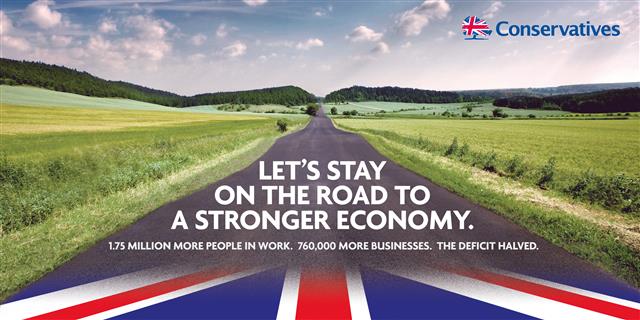
This Conservative campaign poster for the upcoming General Election is already under fire. Why? Because, as correctly predicted by my brother, the road in the picture is, in fact, not in Britain at all – but is in Germany, outside Weimar.
Who cares?! I can't, for the life of me, think why this matters. Of all the things to get worked up about, is this really the one you would pick? It's a stock photo of a road, and it could be anywhere in the world – adverts use stock photos. There isn't really a 'road to recovery' which you can actually drive down at all; it's a metaphor. The manufactured outrage surrounding this is ludicrous.
What we should be looking at is the claims which the Conservative Party makes on its campaign poster. One of the boasts they make on 'the road to recovery' is that 'the deficit is halved'. Is it? Fraser Nelson described in the Spectator last month why this may not be strictly accurate – and yet people are more interested in foaming at the mouth about the location of the photograph being used in the campaign! Isn't this akin to seeing a company's advert on television and being more angry about the fact they used actors in the advert than about the possibility they may be making false claims about their product?
In politics, facts matter. Stock images don't. The next few months are going to get pretty ridiculous if the criticisms levelled at this Conservative 'road to recovery' poster are indicative of the level of discourse we can expect from the General Election campaign. Let's stop worrying about these trivialities and instead subject all parties' claims and policies to the kind of proper scrutiny required to make an informed choice about who to vote for in May.
Thursday, 9 October 2014
Good by-election
Douglas Carswell - former Conservative MP for Clacton, and now UKIP candidate in today's Clacton by-election - is almost certainly going to retain his seat in Parliament, and become UKIP's first MP. Which I find a little odd.
The thing is, voting UKIP is a protest - a kick in the teeth to the corpulent, self-serving, disinterested complacency of the political establishment. It is a vote for change. A vote for a different kind of politics - not for 'more of the same'. Which is why it is a little strange, then, to cast this anti-establishment vote for somebody who, until only a few weeks ago, was as much a part of the ruling elite as any other politician in the mainstream parties.
Mr Carswell is clearly popular with the people of Clacton; at the last general election, he achieved a majority of over 12,000 votes. But to be so disaffected with 'business as usual' in politics that you vote to maintain the status quo is a bit unusual, isn't it?
Mr Carswell's highly probable re-election in Clacton is likely to owe as much to the benefits of incumbency and local voters' familiarity with him as a candidate as it is to UKIP's rising popularity as a party.
Much more interesting, as a barometer of the political mood, will be the concurrent by-election in Heywood & Middleton. Following the death of Labour MP Jim Dobbin in September, this is a by-election campaign with no incumbent fighting to retain the seat - it is expected that Labour will hold this constituency, but UKIP's progress here will tell us a lot more about their fortunes ahead of next year's general election than the 'coronation' of an already popular defector could ever hope to.
the curious thing about voting for a #UKIP defector is that you are supporting continuation because you are fed up of the status quo.
— Kit Marsden (@manek43509) October 9, 2014
The thing is, voting UKIP is a protest - a kick in the teeth to the corpulent, self-serving, disinterested complacency of the political establishment. It is a vote for change. A vote for a different kind of politics - not for 'more of the same'. Which is why it is a little strange, then, to cast this anti-establishment vote for somebody who, until only a few weeks ago, was as much a part of the ruling elite as any other politician in the mainstream parties.
Mr Carswell is clearly popular with the people of Clacton; at the last general election, he achieved a majority of over 12,000 votes. But to be so disaffected with 'business as usual' in politics that you vote to maintain the status quo is a bit unusual, isn't it?
Mr Carswell's highly probable re-election in Clacton is likely to owe as much to the benefits of incumbency and local voters' familiarity with him as a candidate as it is to UKIP's rising popularity as a party.
Much more interesting, as a barometer of the political mood, will be the concurrent by-election in Heywood & Middleton. Following the death of Labour MP Jim Dobbin in September, this is a by-election campaign with no incumbent fighting to retain the seat - it is expected that Labour will hold this constituency, but UKIP's progress here will tell us a lot more about their fortunes ahead of next year's general election than the 'coronation' of an already popular defector could ever hope to.
Saturday, 4 October 2014
Freedom Of Bin-formation Act
This piece originally appeared in my FLiCK Magazine column in June 2014.
I was recently informed that I would have to be more careful when throwing things out. This isn’t because I’ve been launching empty food packaging and used matchsticks across the room, and missing the bin. Nor is it because I have been piloting my wheelie bin so violently up and down the drive that I have received a ticket for dangerous driving whilst at the helm.
No, I have to be careful because I have occasionally thrown food waste into the general rubbish bin, rather than the special food waste bin - out of, I admit, laziness - and that I have now been ‘caught’ by the bin men. The bin men, it seems, have spotted food waste in the regular bin, and they are not happy about this; apparently, if you get ‘caught’ too many times, you may have to pay a fine.
Now, I would like to make it absolutely clear that I don’t have an issue with the concept of recycling, or of being careful with your rubbish for the sake of the environment. If you’re the sort of person who believes passionately in this stuff, then good for you - I really mean that. But I definitely do have an issue with the idea of being coerced into behaving in a certain way (in this case, an environmentally conscious way) either through threats or rewards.
The thought of agents of the state (the bin men are employed by the council) sifting through my rubbish to check up on whether I’m being a ‘good citizen’ is like something out of Stalinist Russia, and is frankly rather sinister.
Maybe you think I’m being melodramatic - that comparisons with totalitarian regimes are unnecessarily hyperbolic, bordering on preposterous. Perhaps you’d be right. But personally, I find the idea of anyone being legally allowed to invade my privacy, rifle through my things on my property and report to the state on how I am living (who can then levy ‘corrective’ punishments to encourage me to change my ‘behaviour’ if it is deemed not orthodoxy), like some kind of Securitate informer, deeply disturbing.
There will, I am sure, be those who argue that this self-important government interloping is ‘a price worth paying’ for a better, cleaner, more responsible society - but I’m afraid I cannot agree. The state should exist to protect individuals’ freedoms, not to ride roughshod over them in the name of one ideology or another, and this sort of invasion of privacy is something of which we should be very wary indeed, even in the name of a ‘good cause’ - in fact, especially in the name of a good cause. Once we accept one pretext for government making life choices for us, we are on very shaky ground indeed.
I don’t ever want to live in a world where the state is peering into our homes to makes sure we are living the ‘right way’. It may start with our bins - but where will it end?
We are the dead.
Addendum
In the wake of new Tory proposals to repeal the Human Rights Act, and replace it with some bungling alternative, it becomes ever more important to make people aware of the growing reach of the oppressive arm of the state. Far from repealing the Human Rights Act, we need to enshrine more individual freedoms in law - including the freedom to dispose of our own property without the state rummaging though our bins to check what we've been up to. We could call this the Freedom Of Bin-formation Act.
Subscribe to:
Posts (Atom)