Isn't it remarkable how practically every large-scale global event always proves just how right you were all along?
People on the internet seem determined to use the Syrian refugee crisis as a means to shore up their own prejudices – whatever they may be.
Conservative supporters on Twitter were busily Tweeting last night that the crisis is all Ed Miliband's fault, for blocking military action against the Assad regime in Syria during 2013 (because bombing a country is a surefire way to ensure nobody wants to leave it and seek asylum elsewhere).
Labour and the Green Party are keen to lay the blame at the door of David Cameron and the 'heartless' Tories (although when Conservatives have shown compassion on this issue, they've just got abuse from the left all the same).
And of course the Scottish Nationalists are quick to point out that if 'Yes' had won the referendum, and Scotland were an independent country, this problem would simply evaporate (just as all other problems would evaporate if Scotland were an independent land of milk and honey).
Is there nothing we won't politicise? Is there nothing we won't use to bash our ideological nemeses over the head? People are dying, and they need our help.
Perhaps if we stopped sniping at each other with vituperations of moralising piety, using strangers' tragic deaths to score cheap points off our political opponents, falling back on the same tired, predictable 'bogey-men' we blame for everything, we might be able to do something to ease the suffering.
Or do we, as a nation, honestly care more about assigning blame than saving those in need?
Showing posts with label green party. Show all posts
Showing posts with label green party. Show all posts
Thursday, 3 September 2015

Tuesday, 9 June 2015
No, you don’t have to nominate Jeremy Corbyn
Jeremy Corbyn, the hard-left Labour MP, wants to stand for the Labour Party leadership. But he’s not doing terribly well, with only eleven nominations from his fellow Labour MPs (leadership hopefuls need to be nominated by at least 35 MPs to make the cut, and be able to stand for leader). Most people, I think, would take this distinct lack of faith from their parliamentary colleagues as a sign that they shouldn’t really be in the contest at all. But in Corbyn’s case, there has been no such realisation – instead, a slightly surreal campaign has sprung up, pushed by supporters of Corbyn both inside and outside the Parliamentary Labour Party, urging Labour MPs to nominate Corbyn even if they don’t agree with him. Which, I think you’ll agree, is a little odd.
What is the point of nominating Corbyn if you don’t think he’d be a good candidate for the leadership? Well, the Corbynites argue, even if you personally don’t agree with our chap, he at least deserves a chance to state his views. His inclusion in the leadership contest will ‘widen the debate’.
Yes, that’s almost certainly true! But if the object is to ‘widen the debate’ by including a bunch of opinions very few people actually agree with – instead of, y’know, actually finding an effective leader who can make Labour electable again – then why not stick Jean-Marie Le Pen in there too?! Sure, nobody in the Labour Party will actually like anything he says – but having him there will ‘widen the debate’, so they should nominate him anyway! (Obviously this is absurd – Jean-Marie Le Pen is not even a Labour MP! – but I think you see the point I’m trying to make…)
By this logic, lots of people should vote at the next election for the nutty authoritarian idealism of the Green Party, or the closed-minded, racist nastiness of the BNP – even if they don’t like any of their policies – because including those parties will ‘widen the debate’. After all, having – say – eight or nine BNP MPs in the House Of Commons would certainly ‘widen the debate’! So we should all vote for them! Would that really be for the best, though?
The irony is that I suspect those pushing for Labour MPs to nominate Corbyn even if they don’t like him are some of the same people who were frothing at the mouth after last month’s General Election, squealing that the result of the vote didn’t accurately reflect the views of the people who had voted. If Labour MPs nominate Corbyn simply to ‘widen the debate’, the same will be true of the leaderships contest – the candidates nominated won’t actually reflect the views of the Parliamentary Labour Party. What is the point of 'widening the debate' to include views that don't actually represent the people the debate is for?
If Jeremy Corbyn wants to be the leader of the Labour Party, then he has every right to put himself forward for it. And good luck to him! But if people don’t buy what he’s selling, there’s no compulsion for his colleagues to nominate him regardless. If Labour MPs don’t want Corbyn to be the leader of their party, it would be foolish of them to nominate him. So, if Corbyn wants in, he needs to offer an agenda which will appeal to enough people to get him elected based on people actually supporting him – just like everybody else on that ballot has had to. Labour's hard left should stop trying to parachute in a candidate if that candidate has no right to be on the ballot on merit.
Tuesday, 5 May 2015
This time, it's personal
But it shouldn't be.
The following image was spotted on my Facebook feed last night (I have blurred out the phone number myself, as I didn't want to be in any way a part of helping spread it):
It is unclear whether this is officially anything to do with the Green Party, or whether its appearing next to a "Vote Green" flyer is just a coincidence; I have contacted the Green Party, their leader Natalie Bennett, and their candidate in Brighton (their former leader, and only MP from the 2010 Election) Caroline Lucas for a comment on this via Twitter, but have so far had no response.
What is clear, however, is that somebody is spreading the personal phone number of the UKIP candidate in Brighton, and inciting people to use it to threaten or intimidate him (what other meaning – before anybody argues that point – of "Want to tell UKIP exactly what you think of them?" could there reasonably be?).
That's not on. That is not how democracy should work. I don't like UKIP at all, and I have found several of their activists aggressive, abusive and rude when engaging them in debate on Twitter. (In the interests of balance, I have also spoken on Twitter with a couple of UKIP activists – one of them a councillor – who were actually perfectly reasonable, decent people, who just happened to have views which differ from mine.)
But no matter how much you disagree with somebody's ideology, this kind of personal intimidation is simply beyond the pale. Spreading somebody else's personal contact details without their consent is harassment and abuse, and disliking someone's political views does not make that OK.
Whether this is the work of the Green Party, or their supporters, or just somebody working alone, if they can't separate the personal from the political then maybe they should stay out of politics entirely.
The following image was spotted on my Facebook feed last night (I have blurred out the phone number myself, as I didn't want to be in any way a part of helping spread it):
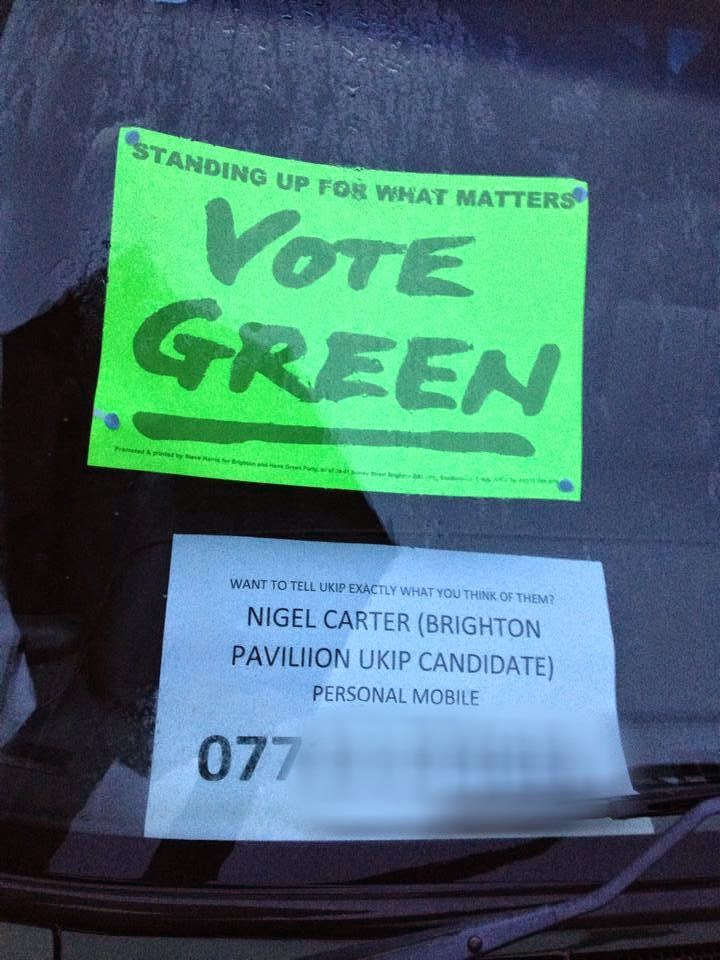 |
| Also, you misspelt 'Pavilion'. |
It is unclear whether this is officially anything to do with the Green Party, or whether its appearing next to a "Vote Green" flyer is just a coincidence; I have contacted the Green Party, their leader Natalie Bennett, and their candidate in Brighton (their former leader, and only MP from the 2010 Election) Caroline Lucas for a comment on this via Twitter, but have so far had no response.
What is clear, however, is that somebody is spreading the personal phone number of the UKIP candidate in Brighton, and inciting people to use it to threaten or intimidate him (what other meaning – before anybody argues that point – of "Want to tell UKIP exactly what you think of them?" could there reasonably be?).
That's not on. That is not how democracy should work. I don't like UKIP at all, and I have found several of their activists aggressive, abusive and rude when engaging them in debate on Twitter. (In the interests of balance, I have also spoken on Twitter with a couple of UKIP activists – one of them a councillor – who were actually perfectly reasonable, decent people, who just happened to have views which differ from mine.)
But no matter how much you disagree with somebody's ideology, this kind of personal intimidation is simply beyond the pale. Spreading somebody else's personal contact details without their consent is harassment and abuse, and disliking someone's political views does not make that OK.
Whether this is the work of the Green Party, or their supporters, or just somebody working alone, if they can't separate the personal from the political then maybe they should stay out of politics entirely.
Wednesday, 22 April 2015
The myth of the 'Progressive Alliance'
The BBC's Challengers' Debate which aired last Thursday was interesting for several reasons. It was particularly strange to see Ed Miliband – remember him? 'Hopeless' or 'useless' Ed Miliband – come off surprisingly well, seeming the sanest, most serious option with the most credibility compared with the leaders of four minor, rather parochial parties.
One of the most frustrating things, however, was the evidence that the concept of a 'Progressive Alliance' – of all the parties who are even vaguely on 'the left' of British politics teaming up to work together 'for the common good' – still hasn't died the death it richly deserves.
In the UK, we live in a multi-party democratic system; something which most 'progressives' consider a good thing, and would want to increase. "Multi-party politics is here to stay!" claims the Electoral Reform Society, who say they campaign for 'a better democracy'. Why, then, do the leaders and representatives of self-professed 'progressive' parties forsake this view when push comes to shove, and instead attempt to reduce politics to a simple, binary choice between 'the Tories' and 'not the Tories'?
On the BBC debate last week, Scottish National Party leader Nicola Sturgeon made an offer to Ed Miliband, claiming she could help the Labour leader 'lock out the Tories' (a stance which is rather at odds with the SNP's earlier claims that Labour and the Conservatives are 'all the same' – if this were really the case, why would Sturgeon be happy to work with one but not with the other?). The implication of this exchange between Sturgeon and Miliband, however, is that it is actually Labour and the SNP (and the Green Party, Plaid Cymru, and anyone else who comes under the broad 'progressive' banner) who are 'the same' – simply by dint of not being the Tories.
There may be some common ground between these parties (both the SNP and Labour are advocating a 'Mansion Tax', for example), but there are fundamental differences, too. Even aside from the most obvious split between the parties – that the Labour Party is innately unionist, whilst the SNP have long campaigned for Scotland's independence – there are other issues on which the parties are divided (for example, on the renewal of the Trident Nuclear Deterrent, which Ed Miliband explicitly said he supported during last week's debate on the BBC). Add into this mix the Green Party – which might agree with the SNP on Trident, but has starkly different plans from Labour in areas such as immigration, education, and a referendum on Britain's membership of the European Union – and Plaid Cymru – who oppose welfare caps and are looking for billions more funding to devolved Wales – and we can see that the concept of the 'progressive alliance' airbrushes the heterogeneity of these different parties and their diverse aims and policies, instead assuming that anybody who doesn't vote for the Conservatives automatically dream the same dream and want the same thing.
This doesn't mean that these parties could not work together in a coalition government, or in a 'supply and confidence' voting arrangement – we have been governed for the last five years by a coalition of two parties who disagree in many areas, after all. But this is different from the suggestion that these parties are all the same because they all disagree with the Conservatives.
Indeed, on some issues, a 'progressive' party may agree more with a party on 'the right' than with their fellow left-wingers. For example, the Green Party propose to hold a referendum on Britain's rôle in the EU (although they would campaign for Britain to stay in); the Conservatives have also promised an EU referendum, but Labour (much more a natural ally of the Greens, you would think) have ruled it out. The Green Party also support scrapping the costly HS2 high-speed rail infrastructure project – another area where they align with UKIP policy instead of with their 'progressive' counterparts in the SNP, Plaid Cymru or Labour. To lump all these 'progressive' parties in together as being in agreement with each other, and as opposing the Tories, consistently and across the board, is simplistic and wrong.
It is worth remembering that, in the UK, you can only vote for a party or candidate – you cannot specifically vote against a party or candidate. It is fallacious to claim that a vote for any one party is automatically a vote against another party, and a de facto rejection of that party's stance on all issues. Any attempt to turn the UK's interesting and diverse plurality of left-wing political parties and movements into one homogeneous bloc with the same views and the same aims, therefore, is extremely facile. The 'progressive alliance' remains, I am afraid, a delusion which exists only in the minds of nerdy politics wonks obsessed with strategies and polls, and naïve left-wing student 'activists'.
Monday, 13 October 2014
Throw away your television
As Douglas Carswell returns to parliament today as the first ever UKIP MP to be elected to the House Of Commons, the issue of whether UKIP leader Nigel Farage should appear in the party leaders' television debates in the run up to next year's general election is once again in the spotlight.
It's easy to think there's no simple answer to this conundrum. Some people say the debates should be restricted to those party leaders who have a realistic chance of becoming the next Prime Minister - in which case, should Liberal Democrat leader Nick Clegg even be included, since the next Prime Minister is likely to be either David Cameron or Ed Miliband? Other people, however, say that UKIP have a right to be included, now that they have parliamentary representation, and can therefore claim to be a serious political movement - but in that case, shouldn't the Green Party, who've been represented in the Commons by Caroline Lucas since 2010, also be involved? And how about parties like Plaid Cymru, the SNP, the DUP, etc. - all of whom have more MPs sitting in Westminster than either UKIP or the Greens?
However, there is a simple answer, and it is this: scrap the television debates.
That's right. Let's get rid of this clunky, unnecessary, counter-productive political device which has been imported from America and shoehorned into our vastly different political system with practically no alterations.
In America, voters have a straight choice between candidate this guy and candidate that guy - the television debates can help to set out the difference between each candidate's vision, and allow people to make a more informed choice when they go to vote. Here in the UK, we have a multi-party parliamentary system; very few of the people watching the debates will actually be voting for David Cameron, Ed Miliband, Nick Clegg or Nigel Farage - and with many parties competing for representation in the House Of Commons, looking to influence policy, the choice facing British voters is not a simple 'this or that' decision.
The televised leaders' debates serve to make our electoral system seem more presidential, and in doing so, diminish the link between local MPs and their constituents. They oversimplify politics in a way which doesn't serve the country at all. It's time to admit that they were a mistake in 2010, and we'll be better off without them in 2015.
As for UKIP…? They have one narrative - an attempt to frame political discourse as a simple case of UKIP and their supporters against the world (because all the other political parties are the same), and whether they are involved in the television debates or not, this too will be twisted to fit this narrative.
Exclusion from the debates will prove that UKIP are victims of an 'establishment' conspiracy to keep them down - whilst inclusion will give Mr Farage the chance to show how the other party leaders are all 'ganging up' on him, proving that there's no difference between the main parties, and that UKIP is the only credible alternative to a Westminster consensus which is only looking out for itself and not the interests of the country at large. Once again, we're better off without the debates altogether.
Subscribe to:
Posts (Atom)